. 2010 Nov;12(11):899-905.
doi: 10.1593/neo.10716.

Loss of STAT1 from mouse mammary epithelium results in an increased Neu-induced tumor burden

Affiliations

Loss of STAT1 from mouse mammary epithelium results in an increased Neu-induced tumor burden

Peter J Klover et al. Neoplasia. 2010 Nov.

Abstract

Type I and type II classes of interferons (IFNs) signal through the JAK/STAT1 pathway and are known to be important in adaptive and innate immune responses and in protection against tumors. Although STAT1 is widely considered a tumor suppressor, it remains unclear, however, if this function occurs in tumor cells (cell autonomous) or if STAT1 acts primarily through immune cells. Here, the question of whether STAT1 has a cell autonomous role in mammary tumor formation was addressed in a mouse model of ERBB2/neu-induced breast cancer in the absence and presence of STAT1. For this purpose, mice that carry floxed Stat1 alleles, which permit cell-specific removal of STAT1, were generated. To induce tumors only in mammary cells lacking STAT1, Stat1 floxed mice were crossed with transgenic mice that express cre recombinase and the neu oncogene under the mouse mammary tumor virus LTR (Stat1fl/fl NIC). Stat1 was effectively deleted in mammary epithelium of virgin Stat1fl/fl NIC females. Time-to-tumor onset was significantly shorter in Stat1fl/fl NIC females than in WT NIC (Wilcoxon rank sum test, P = .02). The median time-to-tumor onset in the Stat1fl/fl NIC mice was 49.4 weeks, whereas it was 62.4 weeks in the WT NIC mice. These results suggest that STAT1 in mammary epithelial cells may play a role in suppressing tumorigenesis. The Stat1 floxed allele described in this study is also a unique resource to determine the cellular targets of IFNs and STAT1 action, which should aid our understanding and appreciation of these pathways.


Figures

Figure 1
Figure 1
(A) Stat1 locus-targeting strategy. Targeting strategy used to introduce loxP sites into the Stat1 locus. Generation of the Stat1 floxed allele was accomplished by addition of loxp sites flanking a 4-kb region of the Stat1 gene approximately 750 bp upstream of the transcription start site and just 3′ of the first translated exon. Gray boxes and dashed lines indicate regions in the Stat1 locus that underwent homologous recombination. Bold arrows indicate loxP sites. Probe indicates position of probe used for Southern blot with SpeI digestion. Taking advantage of the property that the NIC transgene expresses in germ line cells, an allele containing a deleted neomycin cassette, but retaining two intact loxP sites, was selected (floxed allele). After cre-mediated recombination of the floxed allele, the first two untranslated exons and first translated exon (noted by ATG) are removed, forming a null allele. Figure not necessarily to scale. (B) Representative Southern blot demonstrating an untargeted (left) and targeted (right) Stat1 locus. (C) Diagram of floxneo allele (top), flox allele (middle), and null allele (lower). (D) STAT1 protein expression in liver, mammary gland, spleen, and thymus harvested from Stat1+/+, Stat1 flneo/fl, and Stat1 flneo/flneo mice. STAT1 protein is not detectable in the Stat1 flneo/flneo tissue but is observed in Stat1flneo/fl, indicating that the 1.9-kb neomycin cassette was inserted into a critical Stat1 promoter region at -750 bp.
Figure 2
Figure 2
Mouse embryo fibroblasts were isolated from Stat1 fl/+ and Stat1-/- embryos. STAT1 and pSTAT1 protein expression was confirmed to be absent in Stat1-/- MEFs using C-terminal antibodies.
Figure 3
Figure 3
Analysis of tumor formation in Stat1fl/fl NIC and WT NIC mice over time. Kaplan-Meier cumulative tumor-free proportion (labeled as “Survival Function”) versus time in weeks in WT NIC (n = 21) and Stat1fl/fl NIC (n = 27) mice. Mice without tumor development were censored and included in the analysis.
Figure 4
Figure 4
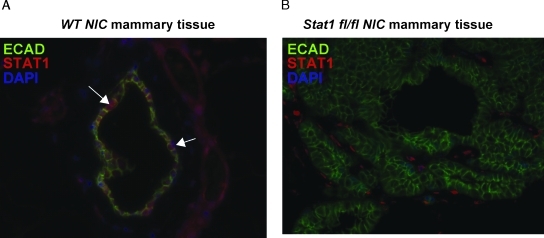
Expression of STAT1 protein in mammary epithelium from WT NIC and Stat1fl/fl NIC mice by IHC. STAT1 staining was used to test for the absence of STAT1 in tumors from Stat1fl/fl NIC mice. (A) WT NIC mammary duct showing nuclear STAT1 staining (pinkish color, indicated by white arrows). (B) A complete lack of STAT1 expression is observed in Stat1fl/fl NIC mice. Non-tumor-containing epithelium from approximately 1 year-old tumor-bearing mice is shown.
Figure 5
Figure 5
Expression of STAT1 in WT NIC and Stat1fl/fl NIC mammary tumors and cultured primary tumor cells. (A, B) STAT1 staining (red color) of WT (A) and Stat1fl/fl NIC (B) tumors. White arrow indicates STAT1 staining. (C, D) pSTAT1 staining of WT (C) and Stat1fl/fl NIC (D) tumors. Nuclear pSTAT1 staining (pinkish color) is observed in WT NIC tumors near blood vessels after IFNγ injection (indicated by white arrow). (E) Western blot analysis demonstrating the complete absence of STAT1 in Stat1fl/fl NIC tumor cells.
Figure 6
Figure 6
Whole mounts of mammary tissue from Stat1fl/fl WAP-cre and controls showing similar mammary development and no sign of hyperplasia. (A) Stat1fl/fl nonparous. (B) Stat1 fl/fl WAP-Cre nonparous. (C) Stat1fl/fl parous. (D) Stat1fl/fl WAP-Cre parous. Arrows are present to indicate ductal structures, and white arrowheads point to lymph nodes.

References

    1. Dunn GP, Bruce AT, Ikeda H, Old LJ, Schreiber RD. Cancer immunoediting: from immunosurveillance to tumor escape. Nat Immunol. 2002;3:991–998. - PubMed
    1. de Weerd NA, Samarajiwa SA, Hertzog PJ. Type I interferon receptors: biochemistry and biological functions. J Biol Chem. 2007;282:20053–20057. - PubMed
    1. Le Bon A, Tough DF. Links between innate and adaptive immunity via type I interferon. Curr Opin Immunol. 2002;14:432–436. - PubMed
    1. Durbin JE, Hackenmiller R, Simon MC, Levy DE. Targeted disruption of the mouse Stat1 gene results in compromised innate immunity to viral disease. Cell. 1996;84:443–450. - PubMed
    1. Meraz MA, White JM, Sheehan KC, Bach EA, Rodig SJ, Dighe AS, Kaplan DH, Riley JK, Greenlund AC, Campbell D, et al. Targeted disruption of the Stat1 gene in mice reveals unexpected physiologic specificity in the JAK-STAT signaling pathway. Cell. 1996;84:431–442. - PubMed

Publication types

MeSH terms

Substances

LinkOut - more resources