. 2010 Dec 9;114(48):15985-90.
doi: 10.1021/jp1071296. Epub 2010 Nov 15.

Slow conformational motions that favor sub-picosecond motions important for catalysis

Affiliations

Slow conformational motions that favor sub-picosecond motions important for catalysis

J R Exequiel T Pineda et al. J Phys Chem B. .

Abstract

It has been accepted for many years that functionally important motions are crucial to binding properties of ligands in such molecules as hemoglobin and myoglobin. In enzymatic reactions, theory and now experiment are beginning to confirm the importance of motions on a fast (ps) time scale in the chemical step of the catalytic process. What is missing is a clear physical picture of how slow conformational fluctuations are related to the fast motions that have been identified as crucial. This paper presents a theoretical analysis of this issue for human heart lactate dehydrogenase. We will examine how slow conformational motions bring the system to conformations that are distinguished as catalytically competent because they favor specific fast motions.


Figures
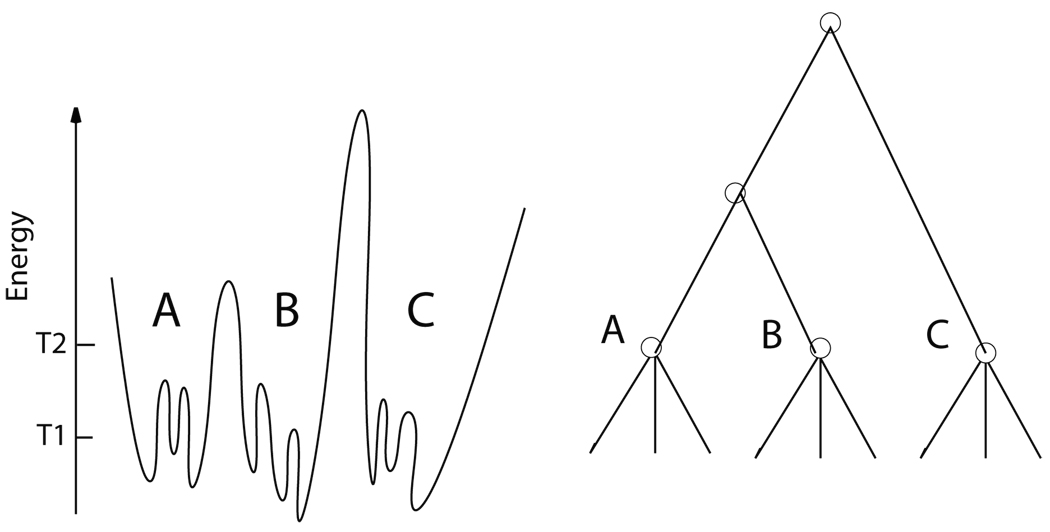
Figure 1
Figure 1
The topological connectivity view of the energy landscape of a protein: at left is the energy landscape and at the right the disconnectivity graph. The nodes of the disconnectivity graph are determined by the energies T1, T2 which define energy wells at different scales. As an example, 3 basins (A, B, C) are shown. Conformations in the same “basin” (e.g. A) are separated by barriers of only a few kBT, so intraconversions between conformations of the same basin are frequent. Also, conformations in the same basin are geometrically similar. However, to have an interconversion between conformations belonging to different basins, the system has to overcome a high barrier, therefore these transitions are rare. Conformations belonging to different basins are not geometrically similar.
Figure 2
Figure 2
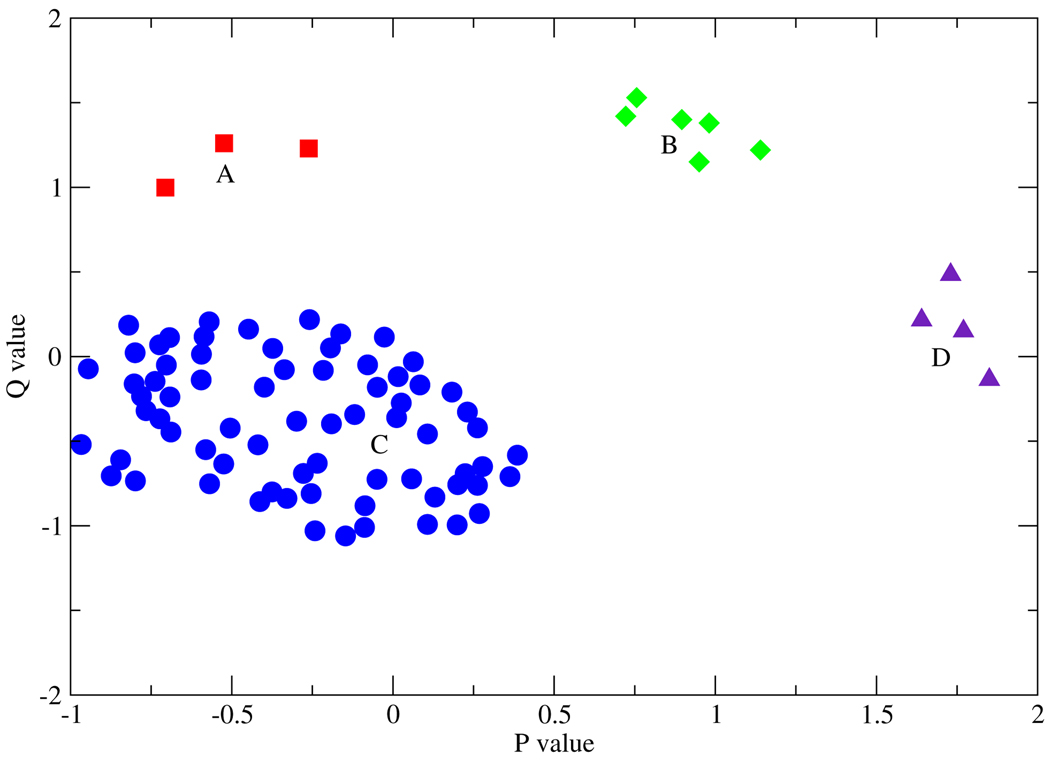
The clustered conformations found from cluster analysis after identification of stable low donor acceptor distance conformations. 94 distinct structures coalesce into the 4 clusters shown. The meaning of the p,q coordinates is explained in the text.
Figure 3
Figure 3
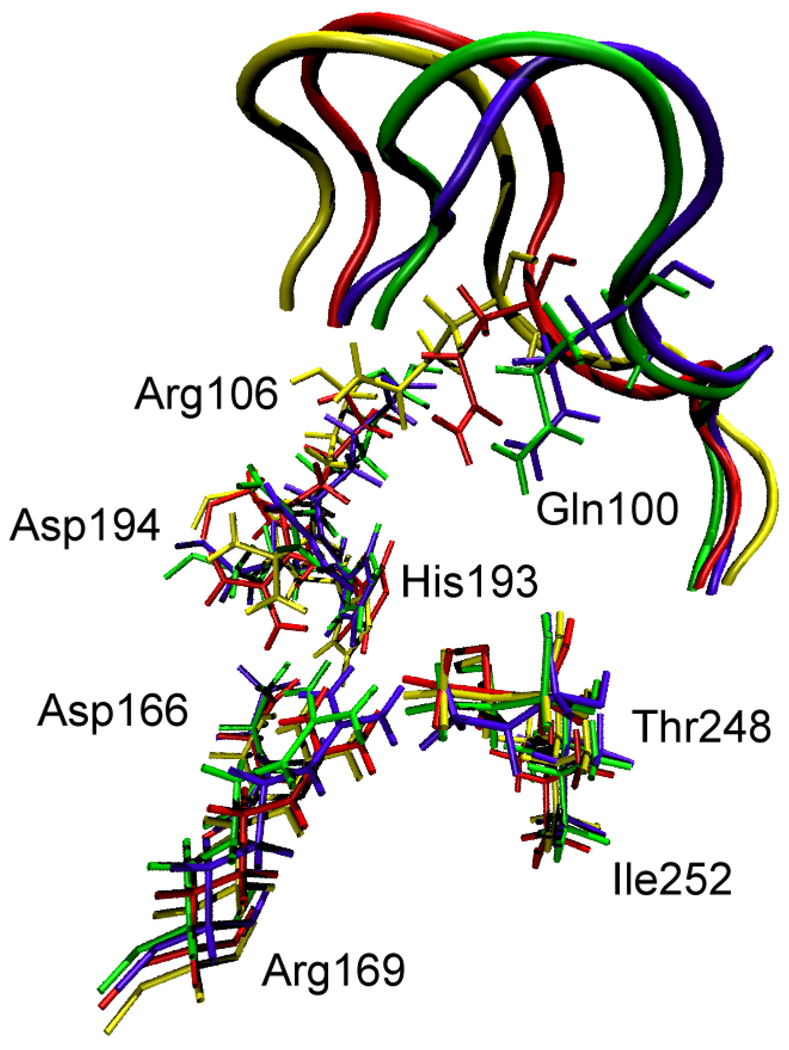
Overlay of the active site residues of the 4 representative conformations of the clusters shown in Figure 2. Residues belonging to the same conformation are shown with the same color. At the top of the picture, the active site loop is shown (residues 96–106, its residues 100 and 106 are shown explicitly) The 4 residues at the bottom of the figure are related to each other by a simple translation. However, the important residues His193, Arg106, Gln100 and Asp194 are being pushed by the active site loop (which has a different closed position in each of the 4 conformations), and their geometric arrangement is different in a non-trivial way among the 4 conformations.
Figure 4
Figure 4
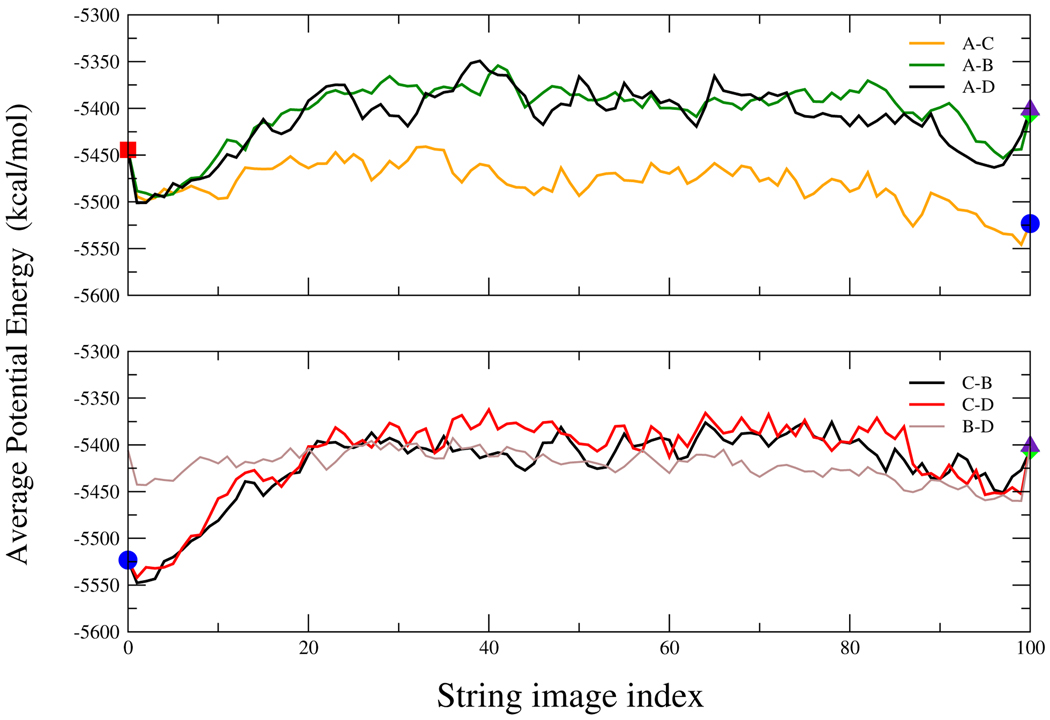
Converged pathways given by the finite-temperature string method for the 6 possible interconversions between the 4 clusters shown in Figure 2.
Figure 5
Figure 5
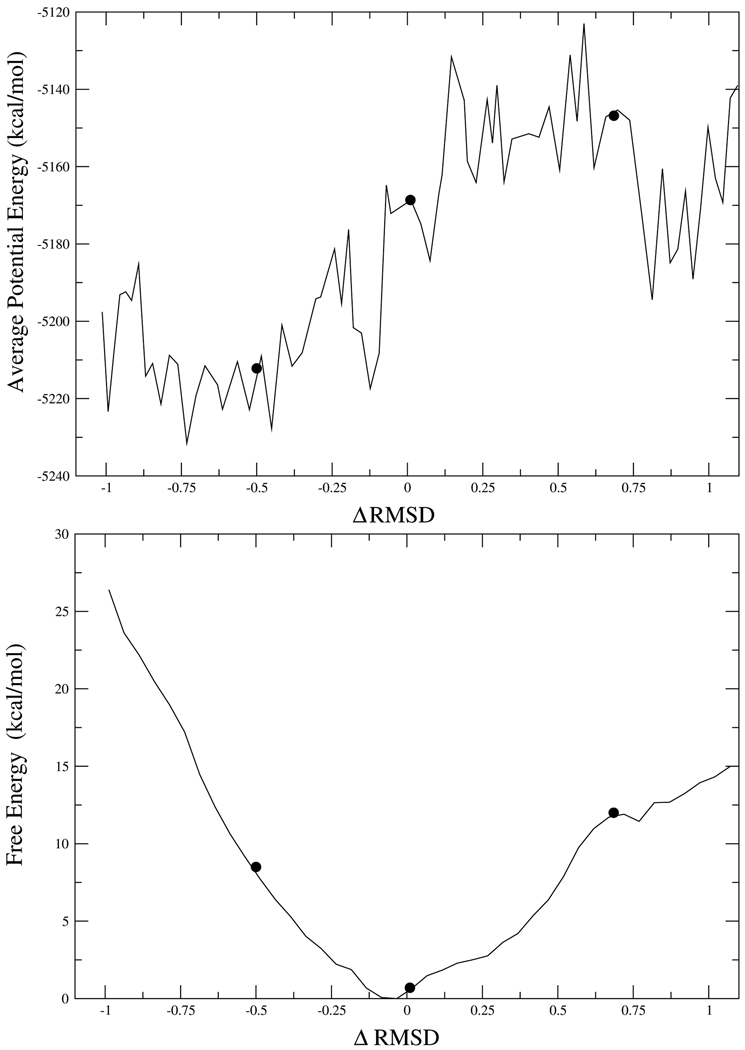
The underlying potential energy profile (top) and the free energy (bottom) for one of the conformational transformations (that between clusters C and D) shown in Figure 4.
Figure 6
Figure 6
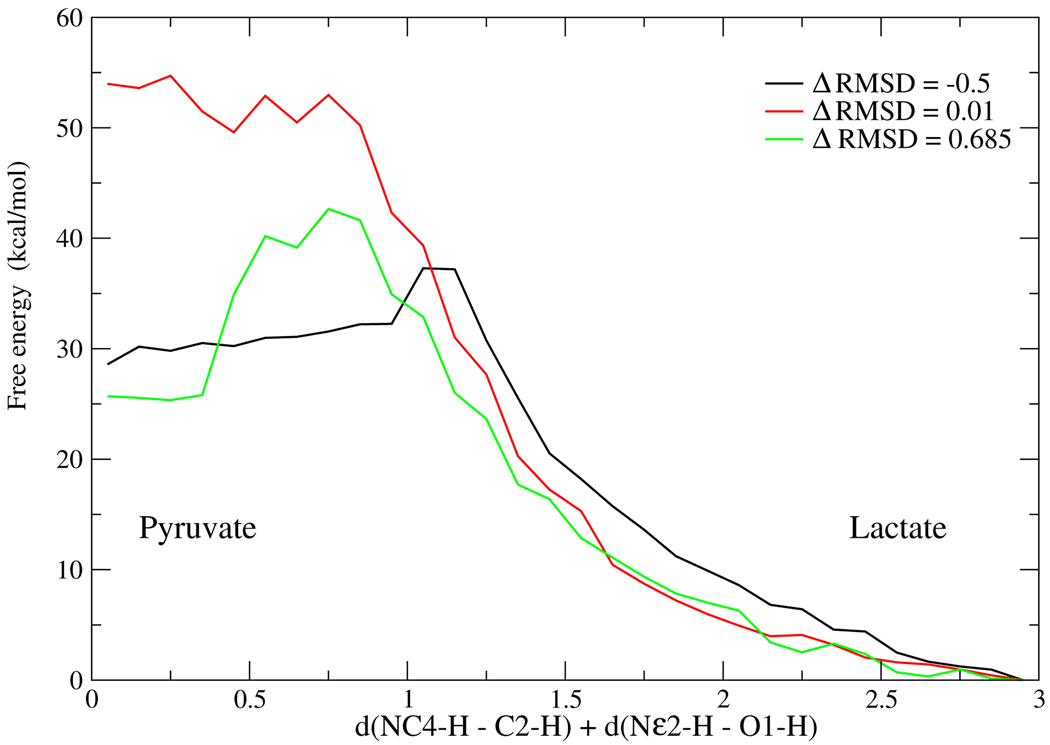
The chemical barrier to reaction along the free energy path of the transformation in Figure 5. The reaction proceeds from right (Lactate) to left (Pyruvate). The lowest chemical barrier is obtained at the end point high free energy (rare) conformations. The 3 conformations for which the chemical barrier was calculated are marked with dots in Figure 5.

References

    1. Sigala P, Kraut D, Caaveiro J, Pybus B, Ruben E, Ringe D, Petsko G, Herschlag D. J. Am. Chem. Soc. 2008;130:13696–13708. - PMC - PubMed
    1. Warshel A, Sharma, Kato M, Y X, Liu H, Olsson M. Chem. Rev. 2006;106:3210–3235. - PubMed
    1. Henzler-Wildman K, Lei M, Thai V, Kerns S, Karplus M, Kern D. Nature. 2007;450:913–916. - PubMed
    2. Henzler-Wildman K, Lei M, Ott M, Wolf-Watz M, Fenn T, Pozharski E, Wilson M, Petsko G, Karplus M, Hübner C, Kern D. Nature. 2007;450:838–844. - PubMed
    3. Agarwal P, Geist A, Gorin A. Biochemistry. 2004;43:10605–10618. - PubMed
    4. Agarwal P. J. Am. Chem. Soc. 2005;127:15248–15256. - PubMed
    1. Frauenfelder H, McMahon B, Austin R, Chu K, Groves J. Proc. Natl. Acad. Sci. USA. 2001;98:2370–2374. - PMC - PubMed
    1. Boehr D, Dyson H, Wright P. Chem. Rev. 2006;106:3055–3079. - PubMed

Publication types

Substances