


Toddlers' prosocial behavior: from instrumental to empathic to altruistic helping
- PMID: 21077866
- PMCID: PMC3088085
- DOI: 10.1111/j.1467-8624.2010.01512.x
Toddlers' prosocial behavior: from instrumental to empathic to altruistic helping
Abstract
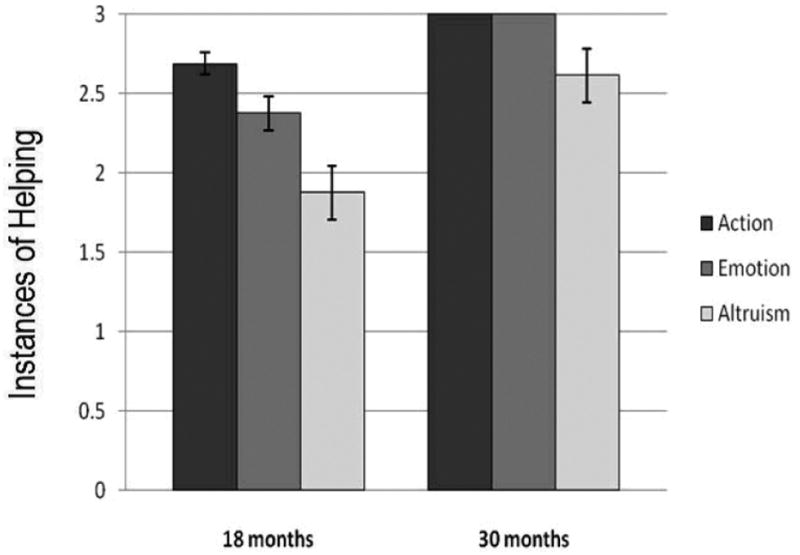
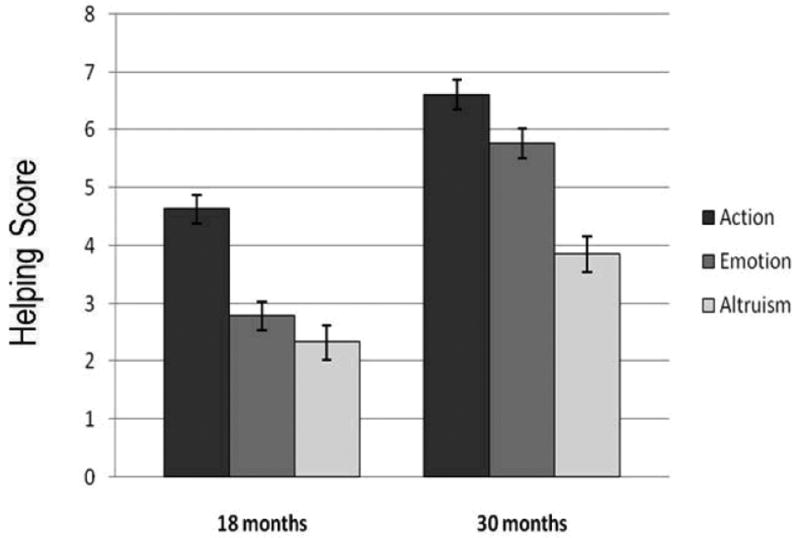
The study explored how the meaning of prosocial behavior changes over toddlerhood. Sixty-five 18- and 30-month-olds could help an adult in 3 contexts: instrumental (action based), empathic (emotion based), and altruistic (costly). Children at both ages helped readily in instrumental tasks. For 18-month-olds, empathic helping was significantly more difficult than instrumental helping and required greater communication from the adult about her needs. Altruistic helping, which involved giving up an object of the child's own, was the most difficult for children at both ages. Findings suggest that over the 2nd year of life, prosocial behavior develops from relying on action understanding and explicit communications to understanding others' emotions from subtle cues. Developmental trajectories of social-cognitive and motivational components of early helping are discussed.
© 2010 The Authors. Child Development © 2010 Society for Research in Child Development, Inc.
Figures
References
-
- Bakeman R, Adamson LB. Coordinating attention to people and objects in mother-infant and peer-infant interaction. Child Development. 1984;55(4):1278–1289. - PubMed
-
- Batson CD, Ahmad N, Powell AA, Stocks EL. Prosocial motivation. In: Shah JY, Gardner WL, editors. Handbook of motivation science. New York, NY: Guilford Press; 2008. pp. 135–149.
-
- Bischof-Kohler D. The development of empathy in infants. In: Lamb ME, Keller H, editors. Infant development: Perspectives from German-speaking countries. Hillsdale, NJ, England: Lawrence Erlbaum Associates, Inc.; 1991. pp. 245–273.
-
- Blake P, Rand D. Evolution and human behavior. Currency value moderates equity preference among young children. in press.
-
- Brownell CA, Carriger MS. Changes in cooperation and self-other differentiation during the second year. Child Development. 1990;61(4):1164–1174. - PubMed
