. 2010 Nov 15:10:247.
doi: 10.1186/1471-2229-10-247.

A tritrophic signal that attracts parasitoids to host-damaged plants withstands disruption by non-host herbivores

Affiliations

A tritrophic signal that attracts parasitoids to host-damaged plants withstands disruption by non-host herbivores

Matthias Erb et al. BMC Plant Biol. .

Abstract

Background: Volatiles emitted by herbivore-infested plants are highly attractive to parasitoids and therefore have been proposed to be part of an indirect plant defense strategy. However, this proposed function of the plant-provided signals remains controversial, and it is unclear how specific and reliable the signals are under natural conditions with simultaneous feeding by multiple herbivores. Phloem feeders in particular are assumed to interfere with plant defense responses. Therefore, we investigated how attack by the piercing-sucking cicadellid Euscelidius variegatus influences signaling by maize plants in response to the chewing herbivore Spodoptera littoralis.

Results: The parasitoid Cotesia marginiventris strongly preferred volatiles of plants infested with its host S. littoralis. Overall, the volatile emissions induced by S. littoralis and E. variegatus were similar, but higher levels of certain wound-released compounds may have allowed the wasps to specifically recognize plants infested by hosts. Expression levels of defense marker genes and further behavioral bioassays with the parasitoid showed that neither the physiological defense responses nor the attractiveness of S. littoralis infested plants were altered by simultaneous E. variegatus attack.

Conclusions: Our findings imply that plant defense responses to herbivory can be more robust than generally assumed and that ensuing volatiles convey specific information about the type of herbivore that is attacking a plant, even in complex situations with multiple herbivores. Hence, the results of this study support the notion that herbivore-induced plant volatiles may be part of a plant's indirect defense stratagem.


Figures
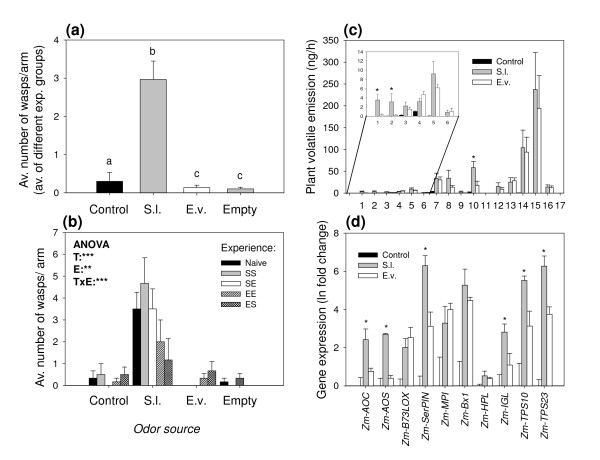
Figure 1
Figure 1
Influence of E. variegatus and S. littoralis infestation on parasitoid attraction, volatile emission and defense gene expression. (a): Choice of C. marginiventris, shown as the average numbers (+SE) of wasps per release (groups of 6) and olfactometer arm. Different experience types are pooled. Control = Uninfested plant; S.l. = S. littoralis infested plant; E.v. = E. variegatus infested plant; Empty = Empty arms. Different letters indicate significant differences between treatments (p < 0.05) (n = 6). (b): Average choice of C. marginiventris parasitoids with different previous host- or non-host experience. Naive = No experience; SS = Host-presence with S. littoralis induced plant odours; SE = Host presence with E. variegatus induced plant odours. EE = Non-host presence with E. variegatus induced plant odours; ES = Non-host presence with S. littoralis induced odours. Stars denote significant effects of treatment (T), experience (E) and the interaction (TxE) (*p < 0.05, **p < 0.01, ***p < 0.001). (c): Average volatile emission (+SE) of herbivore infested maize seedlings. 1 = (Z)-3-hexenal; 2 = (E)-2-hexenal; 3 = (Z)-3-hexen-1-ol; 4 = β-myrcene; 5 = (Z)-3-hexenyl acetate; 6 = (Z)-β-ocimeneN; 7 = linalool; 8 = (3E)-4,8-dimethyl-1,3,7-nonatriene (DMNT); 9 = phenethyl acetate; 10 = indole; 11 = methyl anthranilate; 12 = geranyl acetate; 13 = E- β-caryophyllene; 14 = (E)-α-bergamotene; 15 = E-β-farnesene; 16 = β-sesquiphellandreneN 17 = unknown sesquiterpeneN. Compounds denoted with "N" were only tentatively identified. Stars denote significant differences between S. littoralis and E. variegatus induced plants (p < 0.05). (d): Average change in gene expression (+SE) of herbivore infested maize seedlings relative to uninfested control plants. Stars in graphs (c) and (d) denote significant differences between S. littoralis and E. variegatus induced plants (p < 0.05).
Figure 2
Figure 2
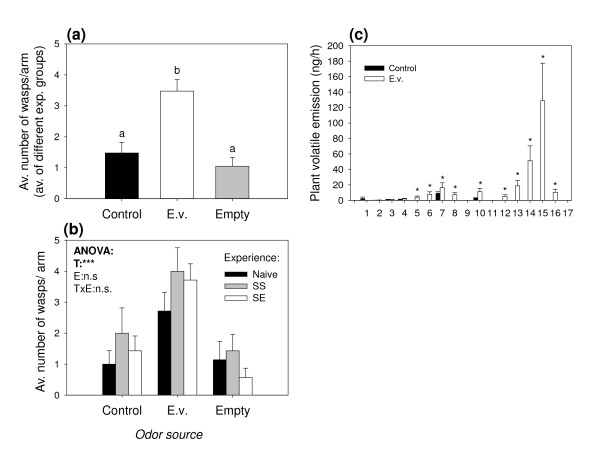
Influence of E. variegatus on parasitoid attraction and plant volatile emission. (a): Choice of C. marginiventris, shown as the average numbers (+SE) of wasps per release (groups of 6) and olfactometer arm. Control = Uninfested plant; E.v. = E. variegatus infested plant; Empty = Empty arms. Different letters indicate significant differences between treatments (p < 0.05). (b): Average choice of C. marginiventris parasitoids with different previous host-experience. Naive = No experience; SS = Host-presence with S. littoralis induced plant odours; SE = Host presence with E. variegatus induced plant odours. Stars denote significant effects of treatment (T), experience (E) and the interaction (TxE) (*p < 0.05, **p < 0.01, ***p < 0.001). (c): Average volatile emission (+SE) of E. variegatus infested maize seedlings. For compound descriptions, see legend in Figure 1. Stars denote significant differences between E. variegatus induced and uninfested plants (p < 0.05). (n = 7)
Figure 3
Figure 3
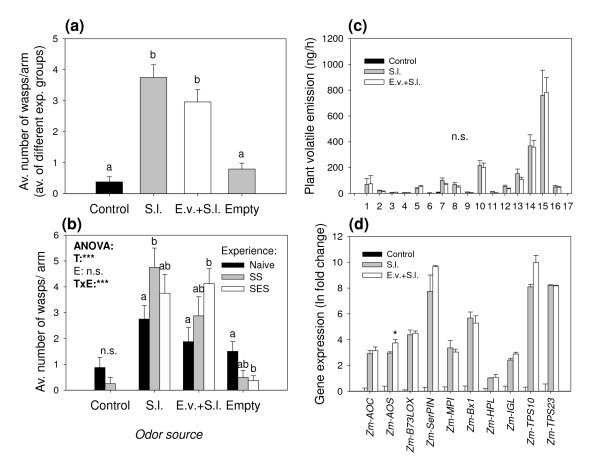
Influence of E. variegatus on S. littoralis induced parasitoid attraction, volatile emission and defense gene expression. (a): Choice of C. marginiventris, shown as the average numbers (+SE) of wasps per release (groups of 6) and olfactometer arm. Control = Uninfested plant; S.l. = S. littoralis infested plant; E.v.+S.l. = E. variegatus and S. littoralis infested plant; Empty = Empty arms. Different letters indicate significant differences between treatments (p < 0.05). (n = 8). (b): Average choice of C. marginiventris parasitoids with different previous host-experience. Naive = No experience; SS = Host-presence with S. littoralis induced plant odours; SES = Host presence with E. variegatus and S. littoralis induced plant odours. Different letters denote a significant difference between experience type within a treatment (p < 0.05). Stars denote significant effects of treatment (T), experience (E) and the interaction (TxE) (*p < 0.05, **p < 0.01, ***p < 0.001). (c): Average volatile emission (+SE) of herbivore infested maize seedlings. For compound descriptions, see legend in Figure 1. (d): Average change in gene expression (+SE) of herbivore infested maize seedlings relative to uninfested control plants. Stars denote significant differences between S. littoralis and E. variegatus and S. littoralis induced plants (p < 0.05) (n = 3).
Figure 4
Figure 4
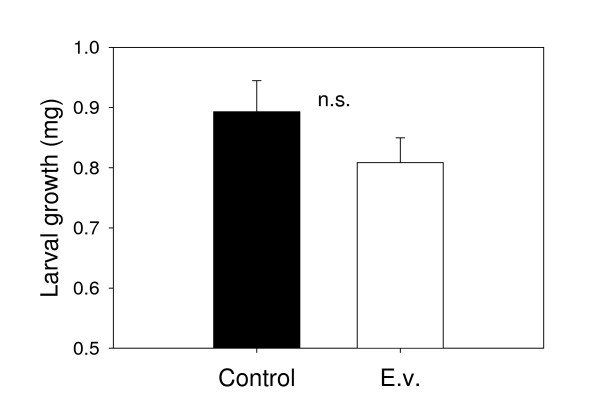
Influence of E. variegatus on maize resistance to S. littoralis. Average S. littoralis growth (+SE) over 18 hours on uninfested (Control) and E. variegatus infested (E.v.) plants (n = 5).

References

    1. Vet LEM, Dicke M. Ecology of infochemical use by natural enemies in a tritrophic context. Annual Review of Entomology. 1992;37:141–172. doi: 10.1146/annurev.en.37.010192.001041. - DOI
    1. Turlings TCJ, Wäckers FL. In: Advances in Insect Chemical Ecologye. Carde RT, Millar J, editor. Cambridge: Cambridge University Press; 2004. Recruitment of predators and parasitoids by herbivore-damaged plants; pp. 21–75. full_text.
    1. Kessler A, Baldwin IT. Defensive function of herbivore-induced plant volatile emissions in nature. Science. 2001;291(5511):2141–2144. doi: 10.1126/science.291.5511.2141. - DOI - PubMed
    1. Allison JD, Hare JD. Learned and naive natural enemy responses and the interpretation of volatile organic compounds as cues or signals. New Phytologist. 2009;184(4):768–782. doi: 10.1111/j.1469-8137.2009.03046.x. - DOI - PubMed
    1. Dicke M, van Loon JJA, Soler R. Chemical complexity of volatiles from plants induced by multiple attack. Nat Chem Biol. 2009;5(5):317–324. doi: 10.1038/nchembio.169. - DOI - PubMed

Publication types

MeSH terms

Substances

LinkOut - more resources