


Coping styles and behavioural flexibility: towards underlying mechanisms
- PMID: 21078654
- PMCID: PMC2992750
- DOI: 10.1098/rstb.2010.0217
Coping styles and behavioural flexibility: towards underlying mechanisms
Abstract
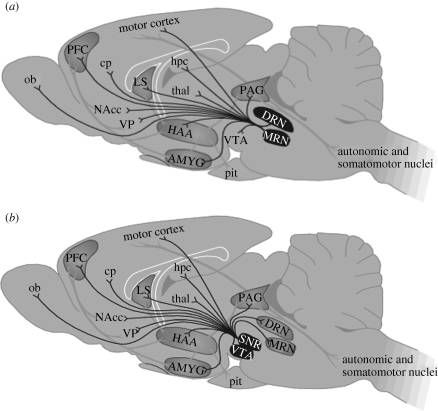
A coping style (also termed behavioural syndrome or personality) is defined as a correlated set of individual behavioural and physiological characteristics that is consistent over time and across situations. This relatively stable trait is a fundamental and adaptively significant phenomenon in the biology of a broad range of species, i.e. it confers differential fitness consequences under divergent environmental conditions. Behavioural flexibility appears to be an important underlying attribute or feature of the coping style that might explain consistency across situations. Proactive coping is characterized by low flexibility expressed as rather rigid, routine-like behavioural tendencies and reduced impulse control (behavioural inhibition) in operant conditioning paradigms. This article summarizes some of the evidence that individual differentiation in behavioural flexibility emerges as a function of underlying variability in the activation of a brain circuitry that includes the prefrontal cortex and its key neurochemical signalling pathways (e.g. dopaminergic and serotonergic input). We argue that the multidimensional nature of animal personality and the terminology used for the various dimensions should reflect the differential pattern of activation of the underlying neuronal network and the behavioural control function of its components. Accordingly, unravelling the molecular mechanisms that give rise to individual differences in the coping style will be an important topic in biobehavioural neurosciences, ecology and evolutionary biology.
Figures
References
-
- Barr C. S., Newman T. K., Becker M. L., Parker C. C., Champoux M., Lesch K. P., Goldman D., Suomi S. J., Higley J. D.2003The utility of the non-human primate; model for studying gene by environment interactions in behavioral research. Genes Brain Behav. 2, 336–34010.1046/j.1601-1848.2003.00051.x (doi:10.1046/j.1601-1848.2003.00051.x) - DOI - DOI - PubMed
-
- Bell A. M.2007Future directions in behavioural syndromes research. Proc. R. Soc. B 274, 755–76110.1098/rspb.2006.0199 (doi:10.1098/rspb.2006.0199) - DOI - DOI - PMC - PubMed
-
- Bell A. M., Backstrom T., Huntingford F. A., Pottinger T. G., Winberg S.2007Variable neuroendocrine responses to ecologically-relevant challenges in sticklebacks. Physiol. Behav. 91, 15–2510.1016/j.physbeh.2007.01.012 (doi:10.1016/j.physbeh.2007.01.012) - DOI - DOI - PubMed
-
- Benus R. F., Koolhaas J. M., van Oortmerssen G. A.1988Aggression and adaptation to the light-dark cycle: role of intrinsic and extrinsic control. Physiol. Behav. 43, 131–13710.1016/0031-9384(88)90228-4 (doi:10.1016/0031-9384(88)90228-4) - DOI - DOI - PubMed
-
- Benus R. F., Den Daas S., Koolhaas J. M., van Oortmerssen G. A.1990Routine formation and flexibility in social and non-social behaviour of aggressive and non-aggressive male mice. Behaviour 112, 176–19310.1163/156853990X00185 (doi:10.1163/156853990X00185) - DOI - DOI
Publication types
MeSH terms
Substances
LinkOut - more resources
Full Text Sources
