


Routine preventive care and cancer surveillance in long-term survivors of colorectal cancer: results from National Surgical Adjuvant Breast and Bowel Project Protocol LTS-01
- PMID: 21079140
- PMCID: PMC3018360
- DOI: 10.1200/JCO.2010.30.1903
Routine preventive care and cancer surveillance in long-term survivors of colorectal cancer: results from National Surgical Adjuvant Breast and Bowel Project Protocol LTS-01
Erratum in
- J Clin Oncol. 2011 Feb 20;29(6):779. Wickerham, Lawrence [corrected to Wickerham, D Lawrence]
Abstract
Purpose: National Surgical Adjuvant Breast and Bowel Project (NSABP) protocol LTS-01 examines routine preventive care and cancer surveillance in long-term colorectal cancer (CRC) survivors previously treated in NSABP adjuvant trials.
Patients and methods: Long-term CRC survivors (≥5 years) from five completed NSABP trials (Protocols C-05, C-06, C-07, R-02, and R-03) at 60 study sites were recruited and surveyed using preventive health care items from the National Health Interview Survey (NHIS). A 3:1 comparison cohort case-matched by age, sex, race, and education was created from the 2005 NHIS. Contingency tables and multivariate models were used to compare cohorts and determine predictors of preventive care and cancer surveillance.
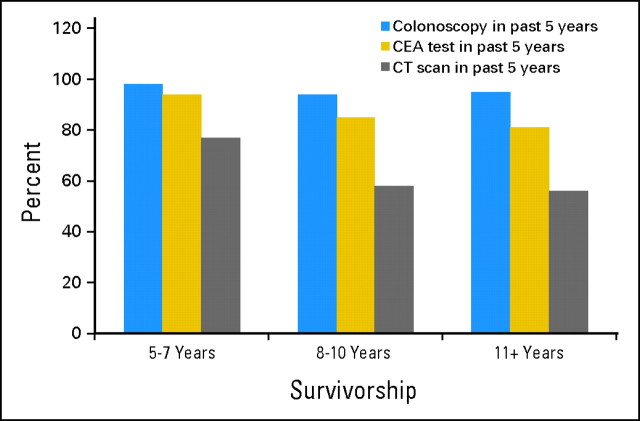
Results: A total of 708 patients in protocol LTS-01 (681 patients with colon cancer, 27 patients with rectal cancer) completed the interview: 57.1% male, mean age 66.2 years (standard deviation=10.6), median survival 8 years. Patients in the LTS-01 protocol were more likely to have a usual source of health care (97.7% v 93.8%, P<.0001), have received a flu shot in the past 12 months (67.5% v 44.3%, P<.0001), and have undergone cancer screening by Pap smear (67.3% v 54.8%, P<.0001), mammogram (80.4% v 70.7%, P<.0001), and prostate-specific antigen test (84.5% v 74.5%, P<.0001) than patients in the NHIS cohort. For CRC surveillance, 96.5% of patients in protocol LTS-01 had a colonoscopy, 88.2% had a carcinoembryonic antigen test, and 66.4% had a computed tomography scan in the previous 5 years. Health insurance was the best predictor of cancer screening for all three methods (odds ratio=2.6 to 4.5). No factor was uniformly associated with CRC surveillance.
Conclusion: This select population of long-term CRC survivors who participated in clinical trials achieved better routine preventive care and cancer screening than the general population and high rates of cancer surveillance.
Conflict of interest statement
Authors' disclosures of potential conflicts of interest and author contributions are found at the end of this article.
Figures
References
-
- Horner M, Ries L, Krapcho M, et al. Bethesda, MD: National Cancer Institute; 2009. SEER Cancer Statistics Review, 1975-2006. http://seer.cancer.gov/csr/1975_2006/
-
- Desch C, Benson A, III, Somerfield M, et al. Colorectal cancer surveillance: 2005 Update of an American Society of Clinical Oncology Practice Guideline. J Clin Oncol. 2005;23:8512–8519. - PubMed
-
- Earle C, Neville B. Underuse of necessary care among cancer survivors. Cancer. 2004;101:1712–1719. - PubMed
-
- Tjandra J, Chan M. Follow-up after curative resection of colorectal cancer: A meta-analysis. Dis Colon Rectum. 2007;50:1783–1799. - PubMed
-
- Khan N, Ward A, Watson E, et al. Long-term survivors of adult cancers and uptake or primary health services: A systematic review. Eur J Cancer. 2008;44:195–204. - PubMed
Publication types
MeSH terms
Grants and funding
LinkOut - more resources
Full Text Sources
Medical
Research Materials
Miscellaneous
