


Review
doi: 10.1038/cr.2010.159.
Epub 2010 Nov 16.
Role of NF-κB in the skeleton
Affiliations
- PMID: 21079651
- PMCID: PMC3193402
- DOI: 10.1038/cr.2010.159
Item in Clipboard
Review
Role of NF-κB in the skeleton
Cell Res.
2011 Jan.
Abstract
Since the discovery that deletion of the NF-κB subunits p50 and p52 causes osteopetrosis in mice, there has been considerable interest in the role of NF-κB signaling in bone. NF-κB controls the differentiation or activity of the major skeletal cell types - osteoclasts, osteoblasts, osteocytes and chondrocytes. However, with five NF-κB subunits and two distinct activation pathways, not all NF-κB signals lead to the same physiologic responses. In this review, we will describe the roles of various NF-κB proteins in basal bone homeostasis and disease states, and explore how NF-κB inhibition might be utilized therapeutically.
Figures
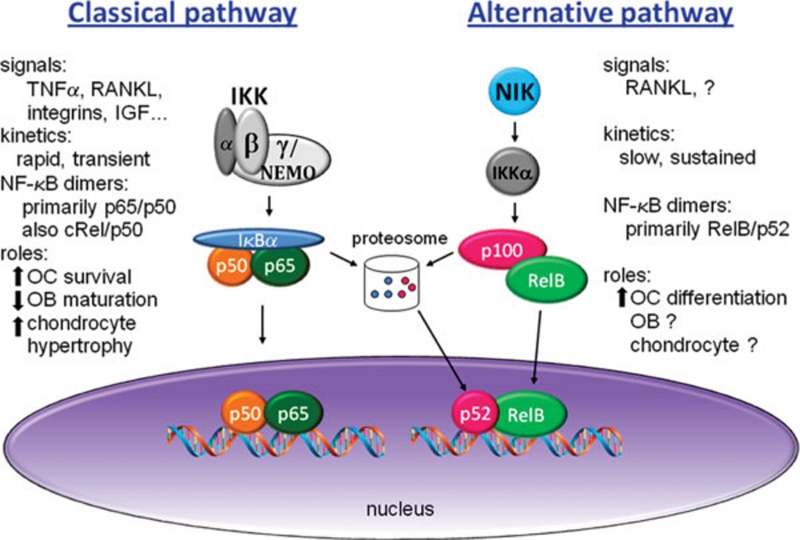
Classical and alternative NF-κB pathways in skeletal cells. The classical pathway is activated by many extracellular signals, and requires IKKβ and IKKγ/NEMO to phosphorylate IκBα, leading to its degradation by the proteosome. The nuclear translocation of NF-κB, predominantly p65/p50 dimers, has rapid (minutes) and transient kinetics. The effects of classical pathway activation, discussed in subsequent sections of this Review, are to increase OC survival, decrease OB maturation and function, and increase chondrocyte hypertrophy. In skeletal cells, the only established activator of the alternative NF-κB pathway is RANKL. The regulatory kinase is NIK, which activates IKKα, leading to processing of p100 to p52 via the proteosome. The nuclear translocation of RelB/p52 dimers is slow (hours) and sustained, and contributes to OC differentiation.
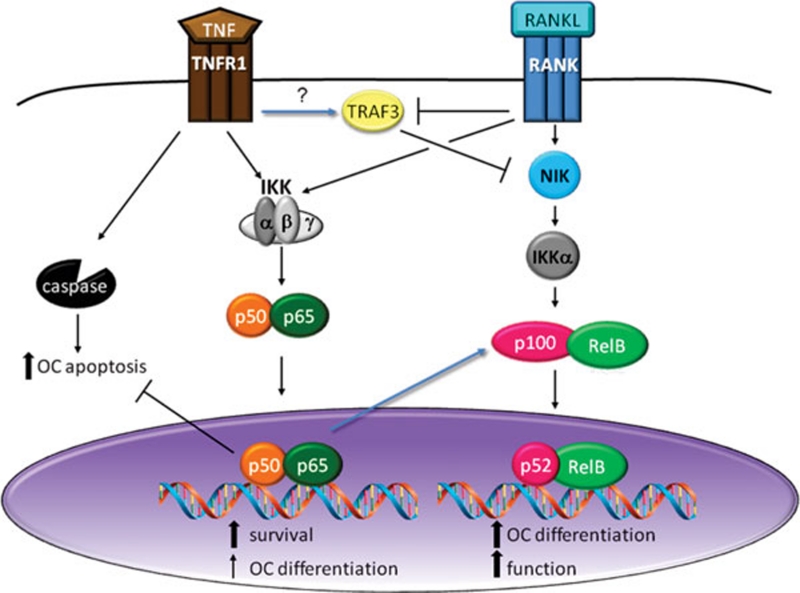
Crosstalk between RANKL- and TNF-induced NF-κB signaling in OCs. RANKL activates the alternative NF-κB pathway by blocking TRAF3-mediated NIK degradation, leading to nuclear translocation of RelB/p52 dimers. Transcriptional targets of this pathway provide signals for OC differentiation and function. RANKL also activates the classical pathway downstream of the IKK complex, supporting OC lineage cell survival downstream of p65/p50. TNF also activates the classical NF-κB pathway, which blocks apoptosis, upregulates p100/RelB expression, and may support OC differentiation. TNF also stabilizes TRAF3, which can inhibit NIK.
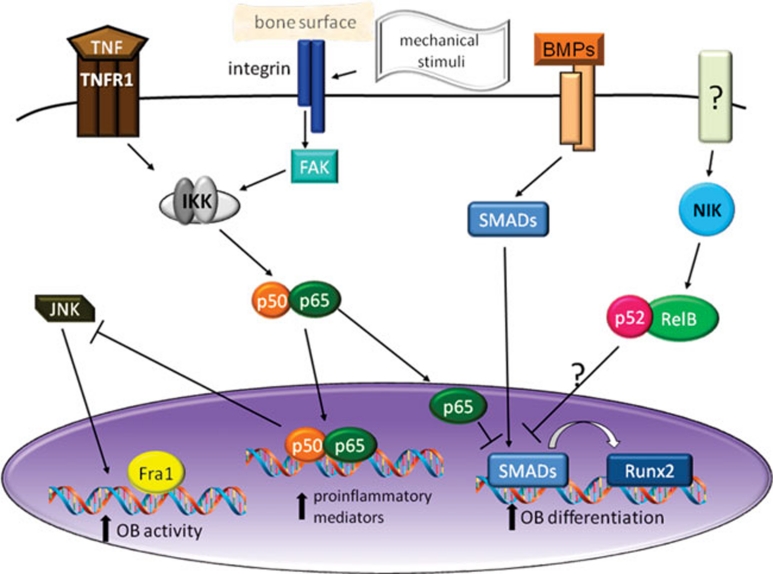
Mechanisms of NF-κB-mediated OB inhibition. Mechanical stimuli, working through integrins and FAK, can activate classical NF-κB, increasing the expression of proinflammatory mediators, including TNF, which also activates classical NF-κB. Nuclear p65 inhibits OB differentiation by blocking induction of Runx2 by SMAD and interferes with OB activity by reducing JNK activity and Fra1 expression. The alternative NF-κB pathway may also inhibit OB differentiation/function but the mechanisms are not established.
References
-
- Iotsova V, Caamano J, Loy J, Yang Y, Lewin A, Bravo R. Osteopetrosis in mice lacking NF-κB1 and NF-κB2. Nat Med. 1997;3:1285–1289. - PubMed
-
- Grigoriadis AE, Wang Z-Q, Cecchini MG, et al. c-Fos: a key regulator of osteoclast-macrophage lineage determination and bone remodeling. Science. 1994;266:443–448. - PubMed
Publication types
MeSH terms
Substances
Grants and funding
LinkOut - more resources
Full Text Sources
Other Literature Sources
Research Materials
