Clinical Trial
. 2010 Nov 5;5(11):e13849.
doi: 10.1371/journal.pone.0013849.

Phase I study of safety and immunogenicity of an Escherichia coli-derived recombinant protective antigen (rPA) vaccine to prevent anthrax in adults

Affiliations
Clinical Trial

Phase I study of safety and immunogenicity of an Escherichia coli-derived recombinant protective antigen (rPA) vaccine to prevent anthrax in adults

Bruce K Brown et al. PLoS One. .

Abstract

Background: The fatal disease caused by Bacillus anthracis is preventable with a prophylactic vaccine. The currently available anthrax vaccine requires a lengthy immunization schedule, and simpler and more immunogenic options for protection against anthrax are a priority for development. In this report we describe a phase I clinical trial testing the safety and immunogenicity of an anthrax vaccine using recombinant Escherichia coli-derived, B. anthracis protective antigen (rPA).

Methodology/principal findings: A total of 73 healthy adults ages 18-40 were enrolled and 67 received 2 injections separated by 4 weeks of either buffered saline placebo, or rPA formulated with or without 704 µg/ml Alhydrogel® adjuvant in increasing doses (5, 25, 50, 100 µg) of rPA. Participants were followed for one year and safety and immunologic data were assessed. Tenderness and warmth were the most common post-injection site reactions. No serious adverse events related to the vaccine were observed. The most robust humoral immune responses were observed in subjects receiving 50 µg of rPA formulated with Alhydrogel® with a geometric mean concentration of anti-rPA IgG antibodies of 283 µg/ml and a toxin neutralizing geometric 50% reciprocal geometric mean titer of 1061. The highest lymphoproliferative peak cellular response (median Lymphocyte Stimulation Index of 29) was observed in the group receiving 25 µg Alhydrogel®-formulated rPA.

Conclusions/significance: The vaccine was safe, well tolerated and stimulated a robust humoral and cellular response after two doses.

Trial registration: ClinicalTrials.gov NCT00057525.


Conflict of interest statement

Competing Interests: Dr. Mallory was previously an employee of DynPort Vaccine Company LLC, a CSC company, and is currently employed by MedImmune LLC, a subsidiary of AstraZeneca. Dr. Kelly T. McKee Jr. was previously an employee of DynPort Vaccine Company LLC, a CSC company, and is currently employed by Quintiles Transnational Corporation. Dr. Josephine Cox was previously an employee of the US Military HIV Research Program and is currently employed by the International AIDS Vaccine Initiative. Dr. Thomas C. VanCott was previously an employee of the US Military HIV Research Program and is currently employed by Advanced BioScience Laboratories. Dr. Deborah Birx was previously an employee of the US Military HIV Research Program and is currently employed by the US Centers for Disease Control. DynPort Vaccine Company LLC was the study sponsor. None of the declared conflicting interests impede data sharing as described in the PLoS sharing guidelines.

Figures

Figure 1
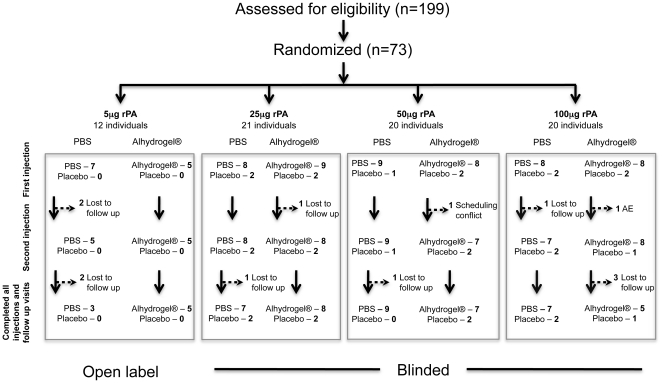
Figure 1. CONSORT flowchart.
Figure 2
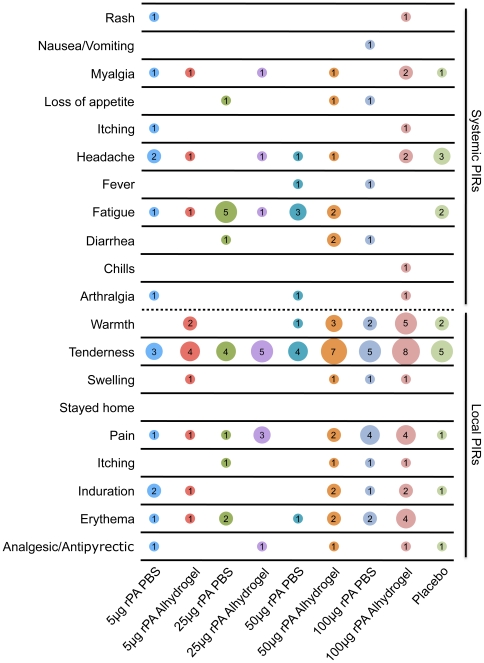
Figure 2. Post-injection reactions (PIRs).
The X axis displays the dosage groups along with all of the placebos, who were combined into one group. The Y axis displays the PIRs that were assessed in the study. The data displayed in the matrix represents the number of individuals who reported a given PIR and the size of the circle is proportional to the reported number. The top half of the graph consists of systemic PIRs while the bottom half of the graph consists of local PIRs.
Figure 3
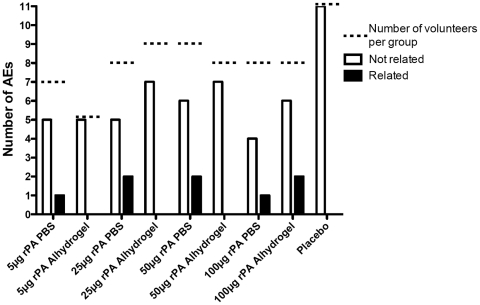
Figure 3. Adverse events (AEs).
The number of AEs was tallied for each dosage group, as well as all of the placebos, who were combined into one group. The empty bars represent AEs that were determined to be not related to the vaccine. The filled bars represent AEs that were determined to be related to the vaccine. The dotted line indicates the total number of volunteers in each group. All AEs that were determined to be related to the vaccine were mild in severity.
Figure 4
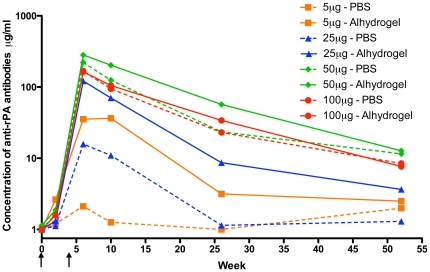
Figure 4. Geometric mean concentration of anti-rPA antibodies over time.
The concentration of anti-rPA antibodies was assessed by ELISA at weeks 0, 2, 6, 10, 26, and 52 over the course of the entire study. Arrows indicate when the two injections occurred.
Figure 5
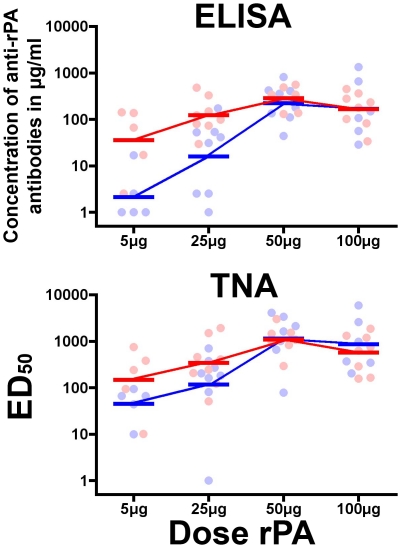
Figure 5. Vaccine induced humoral immunogenicity.
(A) The geometric mean concentrations (GMC) of the anti-rPA antibodies and (B) the geometric mean reciprocal 50% titers (GMT) for the TNA were calculated for each group (horizontal bars) at study visit 8 (2 weeks post second vaccination). The scattergram of the individual responses displays participants who received rPA formulated without Alhydrogel® adjuvant (PBS) in blue and participants whom received rPA formulated with Alhydrogel® in red.
Figure 6
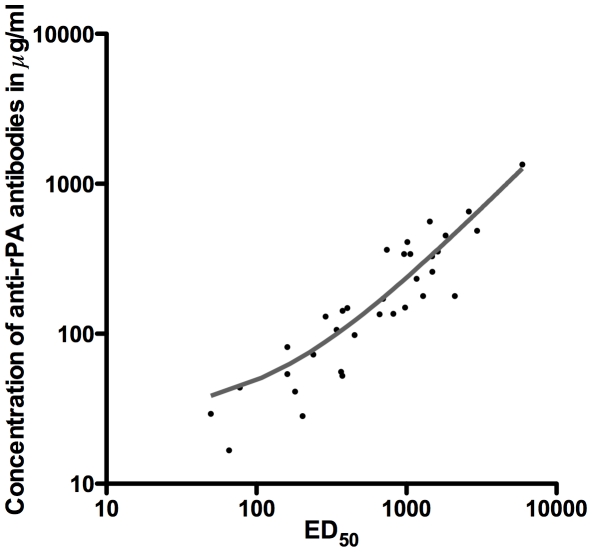
Figure 6. Correlation between the concentration of anti-rPA binding antibodies and the ED50 for the individual samples.
The plot depicts the relationship between the level of anti-rPA antibody binding and the neutralization ED50 in the TNA. A linear regression (grey line) indicates a strong correlation between the two parameters (R2 = 0.86). All samples from rPA recipients are included in the linear regression calculation, however, only the data that were above the limit of quantitation for both assays are displayed.
Figure 7
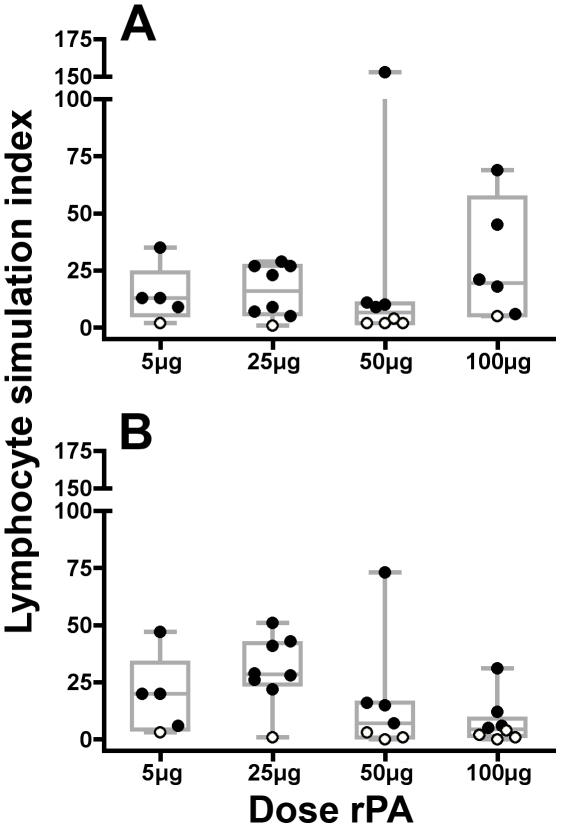
Figure 7. Vaccine induced lymphocyte proliferation.
The LPA was performed on fresh cells obtained the day of the assay from participants at study visit 8 (2 weeks post second vaccination) incubated with 1 µg/ml of rPA. The resultant lymphocyte stimulation index (LSI) is plotted for all rPA-receiving participants. The individual data points are overlaid on box and whiskers plots, which show the median and percentiles for the data within each group. (A) Individuals whom received rPA formulated without Alhydrogel® adjuvant (PBS). (B) Individuals whom received rPA formulated with Alhydrogel®. Negative values (LSI ≤5) are denoted by open circles.

References

    1. Young JA, Collier RJ. Anthrax toxin: receptor binding, internalization, pore formation, and translocation. Annu Rev Biochem. 2007;76:243–265. - PubMed
    1. Fellows PF, Linscott MK, Ivins BE, Pitt ML, Rossi CA, et al. Efficacy of a human anthrax vaccine in guinea pigs, rabbits, and rhesus macaques against challenge by Bacillus anthracis isolates of diverse geographical origin. Vaccine. 2001;19:3241–3247. - PubMed
    1. Ivins BE, Fellows PF, Pitt ML, Estep JE, Welkos SL, et al. Efficacy of a standard human anthrax vaccine against Bacillus anthracis aerosol spore challenge in rhesus macaques. Salisbury Med Bull. 1996;87:125–126.
    1. Ivins BE, Pitt ML, Fellows PF, Farchaus JW, Benner GE, et al. Comparative efficacy of experimental anthrax vaccine candidates against inhalation anthrax in rhesus macaques. Vaccine. 1998;16:1141–1148. - PubMed
    1. Brachman PS, Gold H, Plotkin SA, Fekety FR, Werrin M, et al. Field Evaluation of a Human Anthrax Vaccine. Am J Public Health Nations Health. 1962;52:632–645. - PMC - PubMed

Publication types

MeSH terms

Associated data