


An incomplete TCA cycle increases survival of Salmonella Typhimurium during infection of resting and activated murine macrophages
- PMID: 21079785
- PMCID: PMC2975626
- DOI: 10.1371/journal.pone.0013871
An incomplete TCA cycle increases survival of Salmonella Typhimurium during infection of resting and activated murine macrophages
Abstract
Background: In comparison to the comprehensive analyses performed on virulence gene expression, regulation and action, the intracellular metabolism of Salmonella during infection is a relatively under-studied area. We investigated the role of the tricarboxylic acid (TCA) cycle in the intracellular replication of Salmonella Typhimurium in resting and activated macrophages, epithelial cells, and during infection of mice.
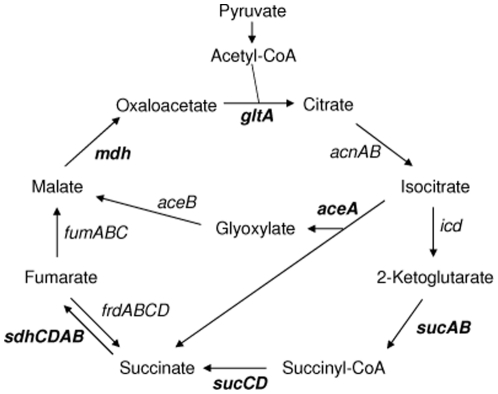
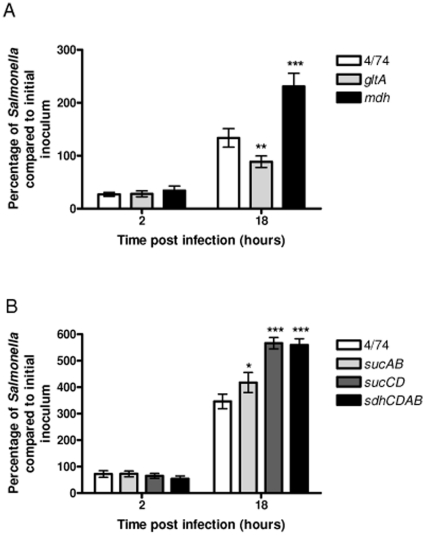
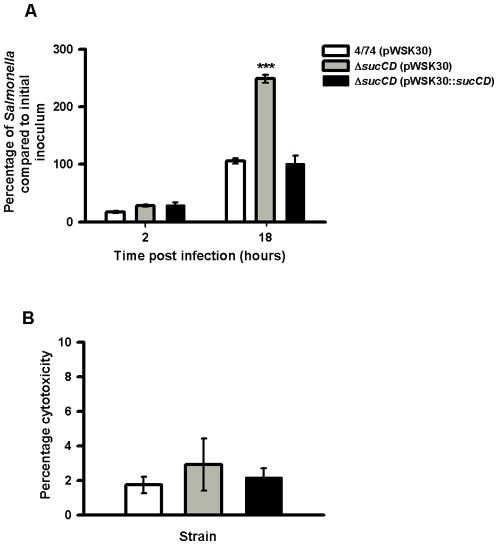
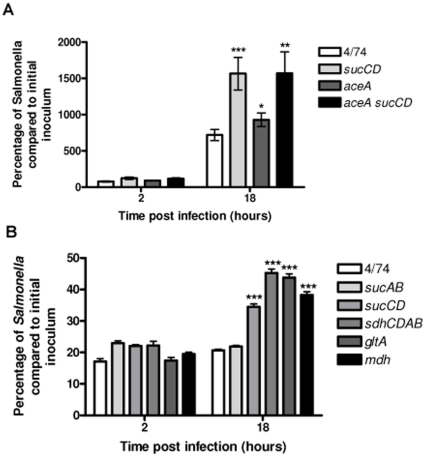
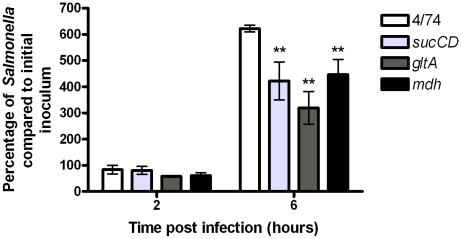
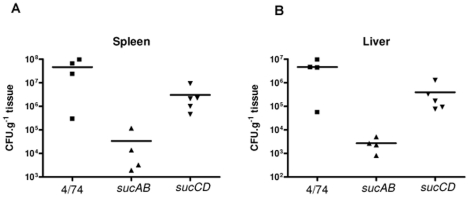
Methodology/principal findings: We constructed deletion mutations of 5 TCA cycle genes in S. Typhimurium including gltA, mdh, sdhCDAB, sucAB, and sucCD. We found that the mutants exhibited increased net intracellular replication in resting and activated murine macrophages compared to the wild-type. In contrast, an epithelial cell infection model showed that the S. Typhimurium ΔsucCD and ΔgltA strains had reduced net intracellular replication compared to the wild-type. The glyoxylate shunt was not responsible for the net increased replication of the TCA cycle mutants within resting macrophages. We also confirmed that, in a murine infection model, the S. Typhimurium ΔsucAB and ΔsucCD strains are attenuated for virulence.
Conclusions/significance: Our results suggest that disruption of the TCA cycle increases the ability of S. Typhimurium to survive within resting and activated murine macrophages. In contrast, epithelial cells are non-phagocytic cells and unlike macrophages cannot mount an oxidative and nitrosative defence response against pathogens; our results show that in HeLa cells the S. Typhimurium TCA cycle mutant strains show reduced or no change in intracellular levels compared to the wild-type. The attenuation of the S. Typhimurium ΔsucAB and ΔsucCD mutants in mice, compared to their increased net intracellular replication in resting and activated macrophages suggest that Salmonella may encounter environments within the host where a complete TCA cycle is advantageous.
Conflict of interest statement
Figures
References
-
- Hautefort I, Thompson A, Eriksson-Ygberg S, Parker ML, Lucchini S, et al. During infection of epithelial cells Salmonella enterica serovar Typhimurium undergoes a time-dependent transcriptional adaptation that results in simultaneous expression of three type 3 secretion systems. Cellular microbiology. 2008;10:958–984. - PMC - PubMed
-
- Galan JE. Salmonella interactions with host cells: type III secretion at work. Annual review of cell and developmental biology. 2001;17:53–86. - PubMed
-
- Garcia-del Portillo F. Salmonella intracellular proliferation: where, when and how? Microbes and infection/Institut Pasteur. 2001;3:1305–1311. - PubMed
-
- Abrahams GL, Hensel M. Manipulating cellular transport and immune responses: dynamic interactions between intracellular Salmonella enterica and its host cells. Cellular microbiology. 2006;8:728–737. - PubMed
Publication types
MeSH terms
Substances
Grants and funding
LinkOut - more resources
Full Text Sources
