. 2011 Apr;181(3):403-12.
doi: 10.1007/s00360-010-0527-1. Epub 2010 Nov 16.

Glibenclamide increases post-fatigue tension in slow skeletal muscle fibers of the chicken

Affiliations

Glibenclamide increases post-fatigue tension in slow skeletal muscle fibers of the chicken

Felipa Andrade et al. J Comp Physiol B. 2011 Apr.

Abstract

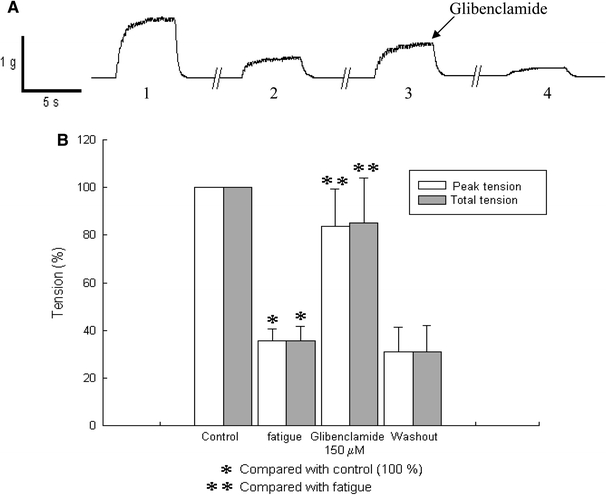
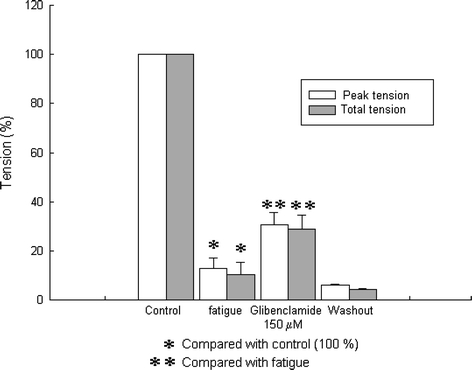
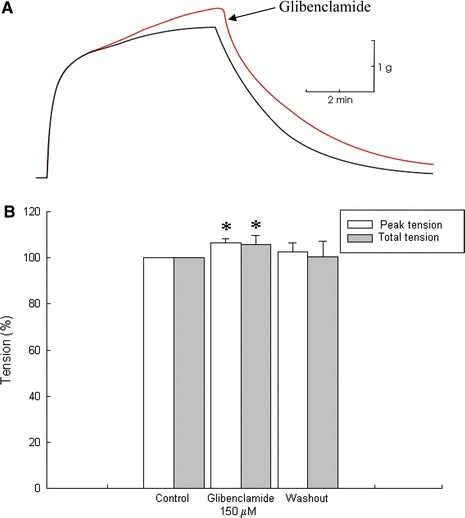
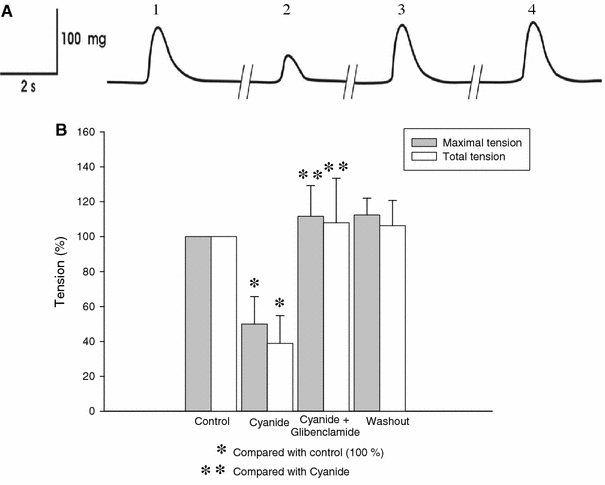
In contrast to fast-twitch skeletal muscle fibers of the chicken, slow-twitch fibers are fatigue-resistant. In fast fibers, the fatigue process has been related to K(ATP) channels. In the present study, we investigated the action of glibenclamide (an anti-diabetic sulphonylurea that acts on K(ATP) channels) on fatigued slow skeletal muscle, studying twitch and tetanus tension after inducing the muscle to fatigue by continuous electrical stimulation. Our results showed that glibenclamide (150 μM) increased post-fatigue twitch tension by about 25% with respect to the fatigued condition (P < 0.05). In addition, glibenclamide (150 μM) increased post-fatigue tetanic tension (83.61 ± 15.7% in peak tension, and 85.0 ± 19.0% in tension-time integral, P = 0.02, and 0.04, respectively; n = 3). Moreover, after exposing the muscle to a condition that inhibits mitochondrial ATP formation in order to activate K(ATP) channels with cyanide (10 mM), tension also diminished, but in the presence of glibenclamide the effect produced by cyanide was abolished. To determine a possible increase in intracellular calcium concentration, the effects of glibenclamide on caffeine-evoked contractures were explored. After muscle pre-incubation with glibenclamide (150 μM), tension of caffeine-evoked contractures increased (6.5 ± 1.5% in maximal tension, and 5.9 ± 3.8% in tension-time integral, P < 0.05). These results suggest a possible role of K(ATP) channels in the fatigue process, since glibenclamide increases twitch and tetanus tension in fatigued slow muscle of the chicken and during metabolic inhibition, possibly by increasing intracellular calcium.


Figures
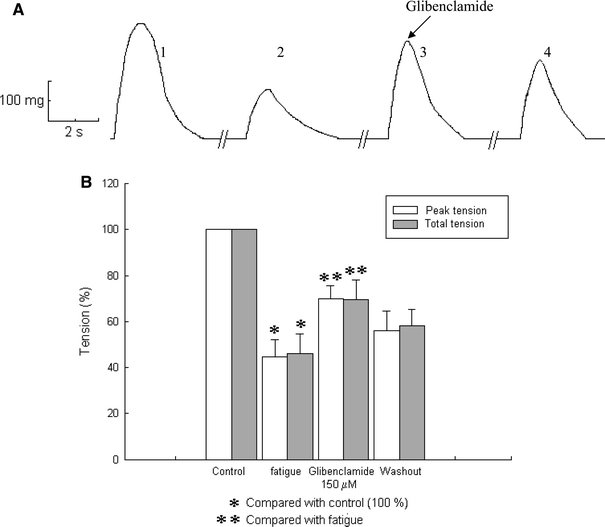
Fig. 1
Fig. 1
Effects of 150 μM glibenclamide on twitch at 60% of fatigue. a In representative trace 1, the recorded tension at the start of the experiment. In trace 2, the recorded tension approximately 1 h after stimulating at a frequency of 0.2 Hz. In trace 3, 5 min in the presence of glibenclamide increased the tension in the fatigued muscle. Trace 4 shows the recorded tension 10 min after glibenclamide washout. b Graphs showing the effects of glibenclamide on single twitch tension. Glibenclamide produced a significant increase in both total and maximal tension of twitches in fatigued muscle fibers (n = 4). Asterisks indicate P < 0.05
Fig. 2
Fig. 2
Effects of glibenclamide on tetanic force. a Representative traces showing the effect of glibenclamide (150 μM) on tetanic tension of fatigued muscle fibers. The stimulation frequency used was 5 Hz. 1 Tetanic tension at the start of the experiment (control). 2 Tetanic tension after 10 min of stimulation, muscle fibers were fatigued at this point. 3 When glibenclamide was added to the bath the tetanic tension of the fatigued muscle increased. 4 Tetanic tension after 5 min of glibenclamide washout in which tetanic tension was further decreased is shown. b Graphs showing the effect of glibenclamide on peak tension and tension-time integral of fatigued muscle fibers. Asterisks indicate P < 0.05
Fig. 3
Fig. 3
Effects of glibenclamide on tetanic force generated with 50 Hz of stimulation pulses. Glibenclamide increased tetanic tension of fatigued muscle fibers. Asterisks indicate P < 0.05
Fig. 4
Fig. 4
Effects of glibenclamide on caffeine contractures. a Representative traces obtained by inducing contractures with caffeine 8 mM before and after the addition of glibenclamide. Inferior trace corresponds to control caffeine contracture and superior trace corresponds to caffeine contracture in the presence of glibenclamide (150 μM). b Graphs showing the effect of glibenclamide (150 μM) on caffeine contractures. Presence of glibenclamide increases caffeine-induced tension with respect to the control (P < 0.05; n = 3). Asterisks indicate P < 0.05
Fig. 5
Fig. 5
Effects of glibenclamide on twitch tension in skeletal muscle fibers during metabolic inhibition by cyanide. a In trace 1 a twitch at the start of the experiment (control) is shown. Trace 2 shows the twitch after 5 min in the presence of cyanide 10 mM (metabolic inhibition). This effect was totally reversible after cyanide washout. In trace 3, the presence of glibenclamide in the bath avoided the diminution in tension produced by cyanide. In trace 4, the twitch tension at the end of the experiment is similar to that recorded at the start. b Graphs for the effect of glibenclamide on twitch in metabolic inhibition. Twitch tension notably diminished in the presence of cyanide with respect to the control (P < 0.05). Presence of glibenclamide avoided the effect of metabolic inhibition with cyanide. Asterisks indicate P < 0.05
Fig. 6
Fig. 6
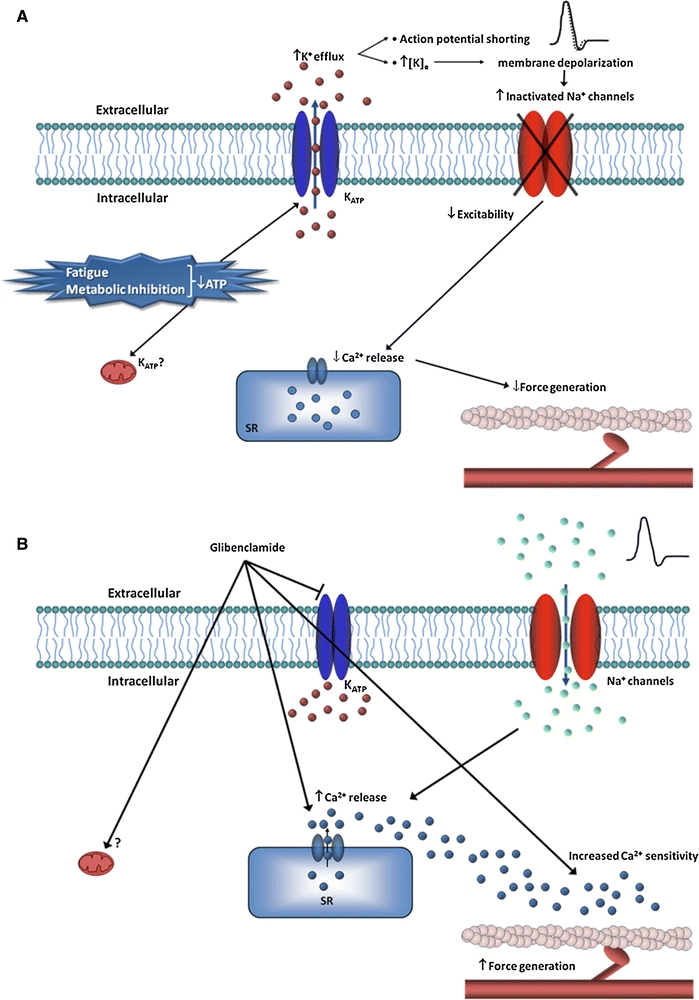
Possible role of KATP channels in skeletal muscle. a During fatigue or metabolic inhibition a reduction in ATP is produced leading to the opening of KATP channels. This causes an increase in K+ efflux in turn causing a shortening in the action potential. This excess in K+ efflux also increases the external K+ concentration, depolarizing the membrane. Both of these processes cause Na+ channel inactivation, reducing excitability. The reduction in excitability is reflected in a smaller Ca2+ release from the sarcoplasmic reticulum, causing less force generation. b In the presence of glibenclamide, there is a blocking of KATP channels at the cell membrane and possibly at the mitochondria. This blocking at the cell surface avoids the shortening of the action potential and enough Na+ channels can be activated causing normal Ca2+ release from the sarcoplasmic reticulum. These Ca2+ ions reach their binding sites at Troponin C, allowing for the formation of cross bridges generating muscle contraction. Moreover, glibenclamide may increase Ca2+ release from the sarcoplasmic reticulum and increase Ca2+ sensitivity of Troponin C, increasing force generation

References

    1. Adler M, Lebeda FJ, Kauffman FC, Deshpande SS. Mechanism of action of sodium cyanide on rat diaphragm muscle. J Appl Toxicol. 1999;19:411–419. doi: 10.1002/(SICI)1099-1263(199911/12)19:6<411::AID-JAT597>3.0.CO;2-1. - DOI - PubMed
    1. Allen DG, Lee JA, Westerblad H (2001) Intracellular calcium and tension during fatigue in isolated single muscle fibres from Xenopus laevis. J Physiol 415:433–458 - PMC - PubMed
    1. American Veterinary Medical Association AVMA (2007) Guidelines on Euthanasia Formerly Report of the AVMA Panel on Euthanasia. American Veterinary Medical Association http://www.avma.org/issues/animal_welfare/euthanasia.pdf accessed 26 Jan 2010
    1. Ashcroft FM, Harrison DE, Ashcroft SJ. Glucose induces closure of single potassium channels in isolated rat pancreatic beta-cells. Nature. 1984;312:446–448. doi: 10.1038/312446a0. - DOI - PubMed
    1. Ashford ML, Sturgess NC, Trout NJ, Gardner NJ, Hales CN. Adenosine 5′-triphosphate-sensitive ion channels in neonatal rat cultured central neurones. Pflugers Arch. 1988;412:297–304. doi: 10.1007/BF00582512. - DOI - PubMed

Publication types

LinkOut - more resources