


Palmitoylation of pulmonary surfactant protein SP-C is critical for its functional cooperation with SP-B to sustain compression/expansion dynamics in cholesterol-containing surfactant films
- PMID: 21081071
- PMCID: PMC2980709
- DOI: 10.1016/j.bpj.2010.08.070
Palmitoylation of pulmonary surfactant protein SP-C is critical for its functional cooperation with SP-B to sustain compression/expansion dynamics in cholesterol-containing surfactant films
Abstract
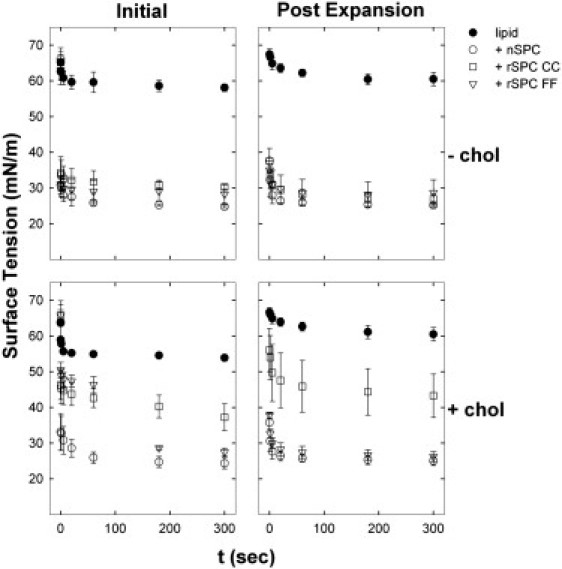
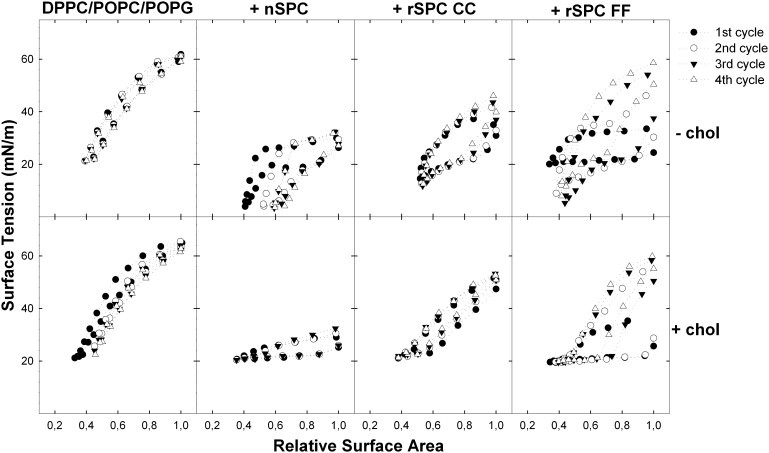
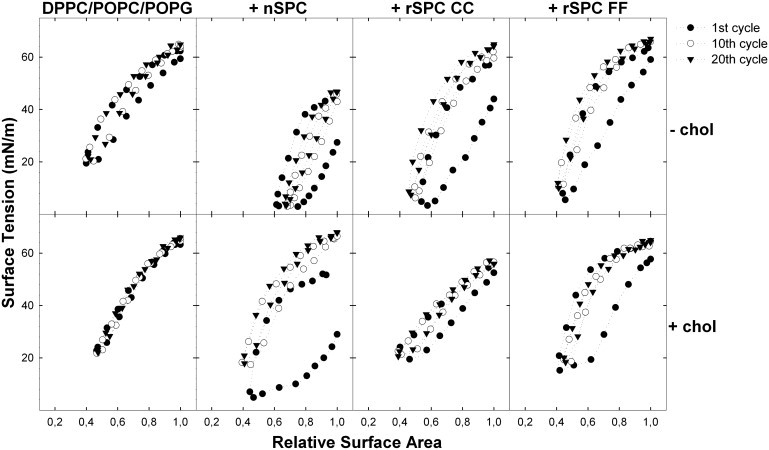
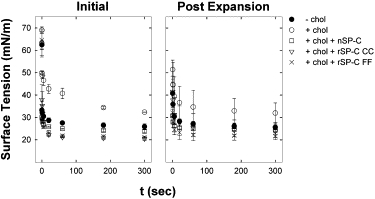
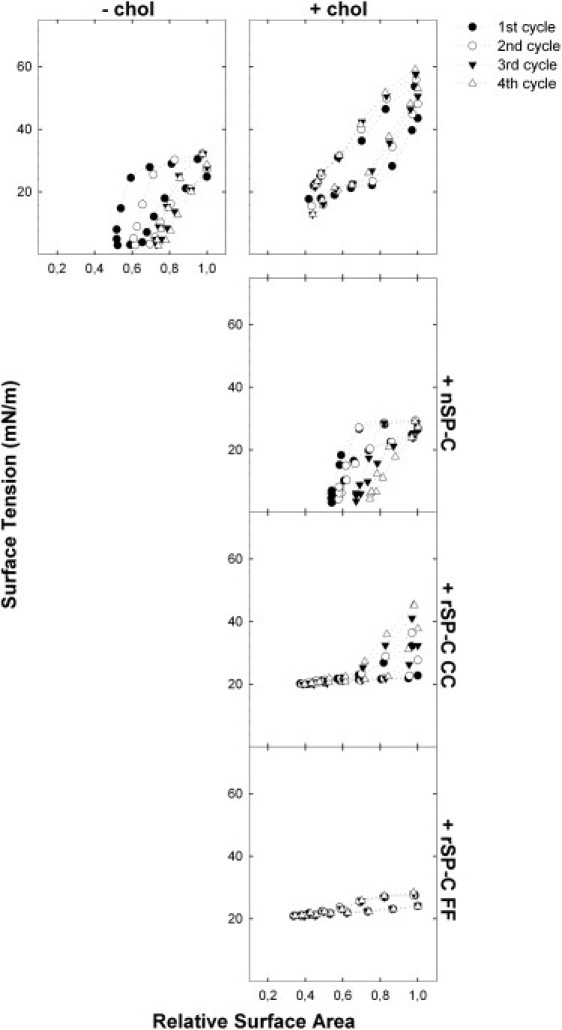
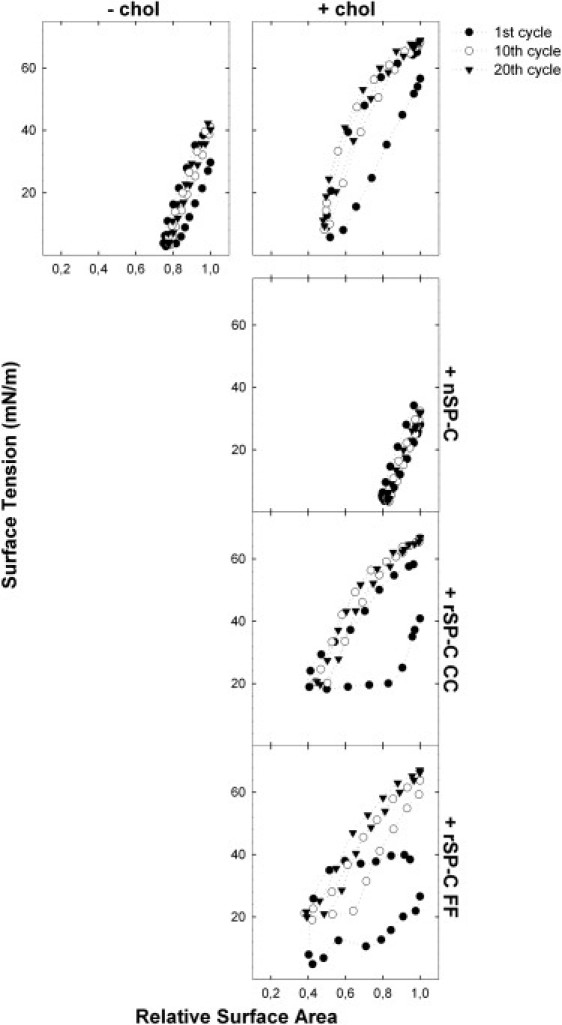
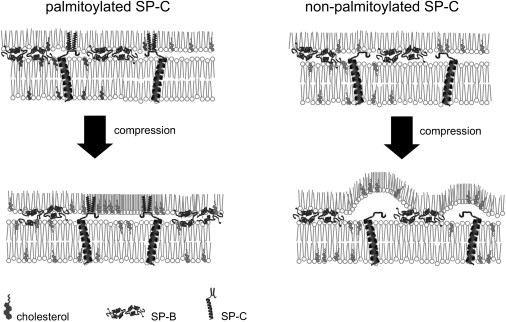
Recent data suggest that a functional cooperation between surfactant proteins SP-B and SP-C may be required to sustain a proper compression-expansion dynamics in the presence of physiological proportions of cholesterol. SP-C is a dually palmitoylated polypeptide of 4.2 kDa, but the role of acylation in SP-C activity is not completely understood. In this work we have compared the behavior of native palmitoylated SP-C and recombinant nonpalmitoylated versions of SP-C produced in bacteria to get a detailed insight into the importance of the palmitic chains to optimize interfacial performance of cholesterol-containing surfactant films. We found that palmitoylation of SP-C is not essential for the protein to promote rapid interfacial adsorption of phospholipids to equilibrium surface tensions (∼22 mN/m), in the presence or absence of cholesterol. However, palmitoylation of SP-C is critical for cholesterol-containing films to reach surface tensions ≤1 mN/m at the highest compression rates assessed in a captive bubble surfactometer, in the presence of SP-B. Interestingly, the ability of SP-C to facilitate reinsertion of phospholipids during expansion was not impaired to the same extent in the absence of palmitoylation, suggesting the existence of palmitoylation-dependent and -independent functions of the protein. We conclude that palmitoylation is key for the functional cooperation of SP-C with SP-B that enables cholesterol-containing surfactant films to reach very low tensions under compression, which could be particularly important in the design of clinical surfactants destined to replacement therapies in pathologies such as acute respiratory distress syndrome.
Copyright © 2010 Biophysical Society. Published by Elsevier Inc. All rights reserved.
Figures
References
-
- Pérez-Gil J. Structure of pulmonary surfactant membranes and films: the role of proteins and lipid-protein interactions. Biochim. Biophys. Acta. 2008;1778:1676–1695. - PubMed
-
- Zuo Y.Y., Veldhuizen R.A., Possmayer F. Current perspectives in pulmonary surfactant—inhibition, enhancement and evaluation. Biochim. Biophys. Acta. 2008;1778:1947–1977. - PubMed
-
- Hallman M., Glumoff V., Rämet M. Surfactant in respiratory distress syndrome and lung injury. Comp. Biochem. Physiol. A Mol. Integr. Physiol. 2001;129:287–294. - PubMed
-
- Possmayer F., Nag K., Schürch S. Surface activity in vitro: role of surfactant proteins. Comp. Biochem. Physiol. A Mol. Integr. Physiol. 2001;129:209–220. - PubMed
-
- Almlén A., Stichtenoth G., Curstedt T. Surfactant proteins B and C are both necessary for alveolar stability at end expiration in premature rabbits with respiratory distress syndrome. J. Appl. Physiol. 2008;104:1101–1108. - PubMed
Publication types
MeSH terms
Substances
LinkOut - more resources
Full Text Sources
Other Literature Sources
Medical
