. 2011 Jan;155(1):209-21.
doi: 10.1104/pp.110.168161. Epub 2010 Nov 16.

Unraveling the evolution of auxin signaling

Affiliations

Unraveling the evolution of auxin signaling

Ive De Smet et al. Plant Physiol. 2011 Jan.

Abstract

Auxin signaling is central to plant growth and development, yet hardly anything is known about its evolutionary origin. While the presence of key players in auxin signaling has been analyzed in various land plant species, similar analyses in the green algal lineages are lacking. Here, we survey the key players in auxin biology in the available genomes of Chlorophyta species. We found that the genetic potential for auxin biosynthesis and AUXIN1 (AUX1)/LIKE AUX1- and P-GLYCOPROTEIN/ATP-BINDING CASSETTE subfamily B-dependent transport is already present in several single-celled and colony-forming Chlorophyta species. In addition, our analysis of expressed sequence tag libraries from Coleochaete orbicularis and Spirogyra pratensis, green algae of the Streptophyta clade that are evolutionarily closer to the land plants than those of the Chlorophyta clade, revealed the presence of partial AUXIN RESPONSE FACTORs and/or AUXIN/INDOLE-3-ACETIC ACID proteins (the key factors in auxin signaling) and PIN-FORMED-like proteins (the best-characterized auxin-efflux carriers). While the identification of these possible AUXIN RESPONSE FACTOR- and AUXIN/INDOLE-3-ACETIC ACID precursors and putative PIN-FORMED orthologs calls for a deeper investigation of their evolution after sequencing more intermediate genomes, it emphasizes that the canonical auxin response machinery and auxin transport mechanisms were, at least in part, already present before plants "moved" to land habitats.


Figures
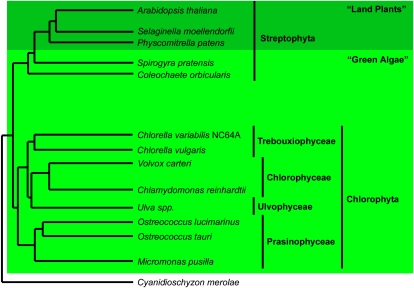
Figure 1.
Figure 1.
Schematic tree indicating the relationships within the supergroup Plantae. The included species are used in our analyses, except for Ulva species and Cyanidioschyzon merolae (Rhodophyta outgroup). [See online article for color version of this figure.]
Figure 2.
Figure 2.
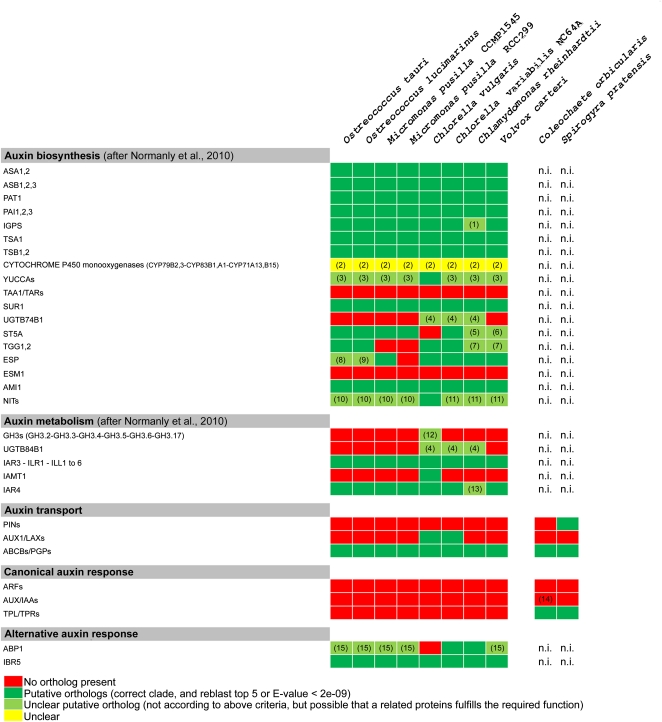
Scheme indicating the presence or absence of putative orthologs of various auxin-related genes that were investigated in Chlorophyta species. The color code is explained in the legend. Notes in squares are as follows: (1) related based on tree, but unrelated based on ReBlast; (2) difficult to pinpoint precise orthologs, but clear orthologs very likely absent; (3) ReBlast with good E-value, but not in correct clade or outgrouped; (4) difficult to assess, but very likely a putative ortholog present; (5) wrong clade, but ReBlast position 2, E-value = 1.7; (6) related to distant orthologs from C. reinhardtii; (7) good ReBlast with E-value < 2e-09; (8) outgrouped, but with ReBlast E-value = 3e-05; (9) outgrouped, but with ReBlast E-value = 6e-07; (10) closely related to PUTATIVE NITRILASE (AT4G08790); (11) closely related to NITRILASE-LIKE PROTEIN1 (NLP1; AT2G27450); (12) outgrouped, ReBlast only hit, but E-value = 2.2; (13) outgrouped, but with ReBlast E-value = 1e-30 and first hit; (14) putative ancestral, incomplete AUX/IAA similar to AtIAA33; (15) fall within clade, in ReBlast top five but very poor E-value. n.i., Presence of putative orthologs not investigated.
Figure 3.
Figure 3.
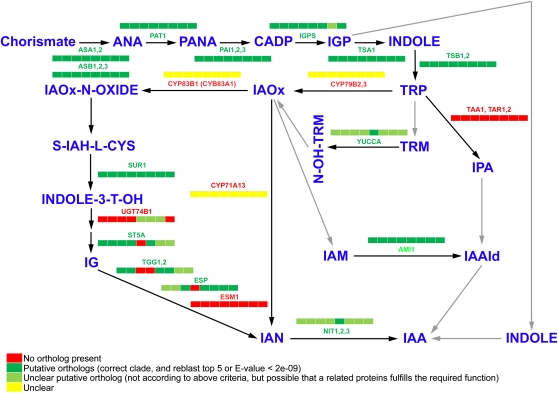
Auxin biosynthesis as described by Normanly (2010) with absence/presence of key components in Chlorophyta. From left to right on the color coded bars: O. tauri, O. lucimarinus, M. pusilla CCMP1545, M. pusilla RCC299, C. vulgaris, C. variabilis NC64A, C. reinhardtii, and V. carteri. The color code is explained in the legend.
Figure 4.
Figure 4.
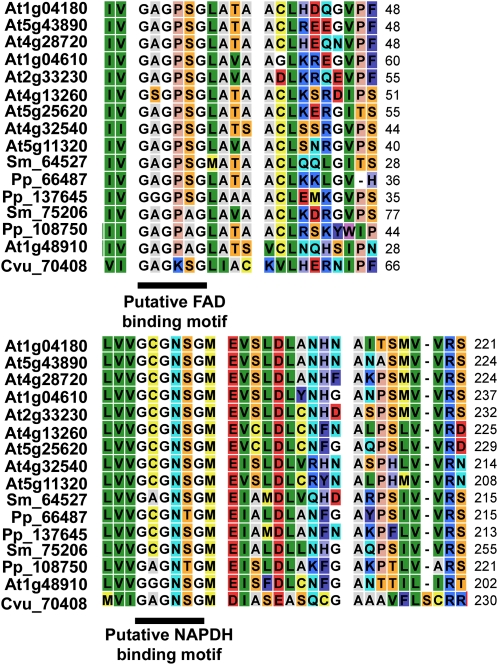
Conserved motifs and residues in YUC proteins. Alignment of the FAD-binding and NADPH-binding motifs in the putative YUC in C. vulgaris is shown. Residue colors are according to the rasmol color scheme, which is consistent with traditional amino acid properties. At, Arabidopsis; Cvu, C. vulgaris; Pp, P. patens; Sm, S. moellendorffii. [See online article for color version of this figure.]
Figure 5.
Figure 5.
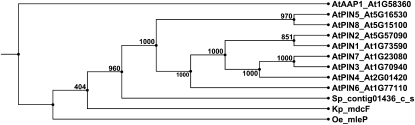
UPGMA tree of PIN proteins in Arabidopsis and a PIN-like protein in S. pratensis. At, Arabidopsis; Kp, K. pneumoniae; Oe, O. oeni; Sp, S. pratensis.
Figure 6.
Figure 6.
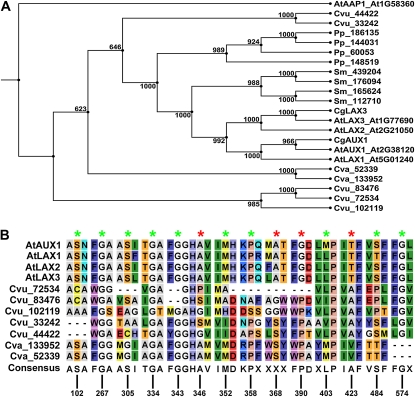
A, Phylogenetic analyses of AUX1-LAX orthologs in land plants and Chlorella species. B, Alignment of AUX1/LAX proteins, highlighting the conserved residues in C. vulgaris (Cvu) and C. variabilis (Cva). Asterisks indicate residues conserved in at least one putative ortholog (green) or not conserved (red). Residue colors are according to the rasmol color scheme, which is consistent with traditional amino acid properties. At, Arabidopsis; Cg, Casuarina glauca; Pp, P. patens; Sm, S. moellendorffii. [See online article for color version of this figure.]
Figure 7.
Figure 7.
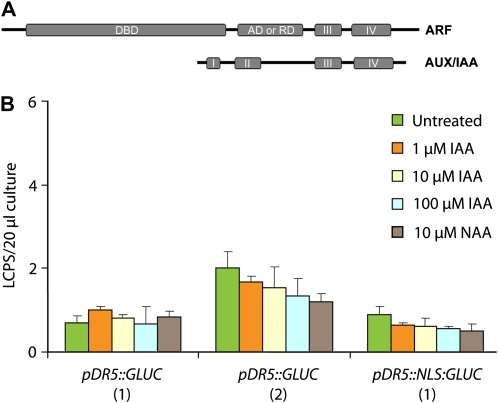
Auxin response in Chlorophyta. A, Schematic representation of important domains of ARFs and AUX/IAAs. ARFs contain domains for the interaction with AUX-IAAs and ARFs (III and IV), an activation or repression domain (AD or RD), and a B3 DNA-binding domain (DBD). AUX-IAAs contain domains for the interaction with ARFs (III and IV), a repression domain (I), and a domain that contains a degron sequence (II). B, Effect of auxin on the expression of GLUC from the DR5 promoter in C. reinhardtii. As an example, representative data for two transgenic clones expressing the pDR5::GLUC construct (1 and 2) and one clone expressing the pDR5::NLS:GLUC construct (1) are shown. Luciferase activity was measured 7 h after auxin addition (for details, see “Materials and Methods”). No auxin-induced expression of pDR5::GLUC or pDR5::NLS:GLUC is detectable in C. reinhardtii. The luminescence units are presented as luminescence counts per second (LCPS). Control strains lacking the Luc gene had very low luminescence (0.1 LCPS per 20 μL of culture). Bars represent means of three independent experiments, and sd is indicated. [See online article for color version of this figure.]
Figure 8.
Figure 8.
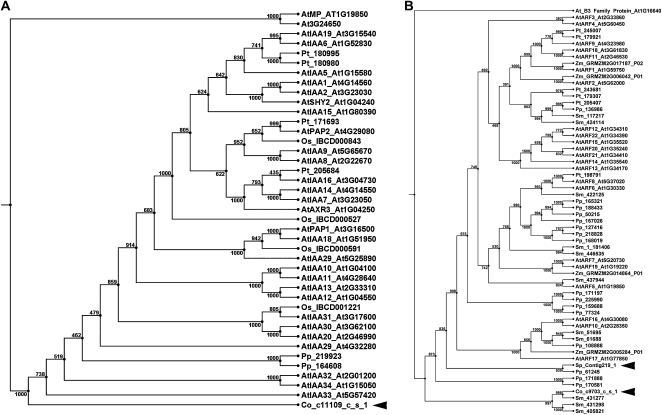
Phylogenetic analysis of the putative AUX/IAAs and ARFs in Streptophyta. UPGMA trees show subsets of the AUX/IAA (A) and ARF (B) families. The sequences from C. orbicularis and S. pratensis are indicated with arrowheads. At, Arabidopsis; Co, C. orbicularis; Os, Oryza sativa; Pp, P. patens; Pt, Populus trichocarpa; Sp, S. pratensis; Sm, S. moellendorffii; Zm, Zea mays.

References

    1. Basu S, Sun H, Brian L, Quatrano RL, Muday GK. (2002) Early embryo development in Fucus distichus is auxin sensitive. Plant Physiol 130: 292–302 - PMC - PubMed
    1. Becker B, Marin B. (2009) Streptophyte algae and the origin of embryophytes. Ann Bot (Lond) 103: 999–1004 - PMC - PubMed
    1. Beer LL, Boyd ES, Peters JW, Posewitz MC. (2009) Engineering algae for biohydrogen and biofuel production. Curr Opin Biotechnol 20: 264–271 - PubMed
    1. Benková E, Michniewicz M, Sauer M, Teichmann T, Seifertová D, Jürgens G, Friml J. (2003) Local, efflux-dependent auxin gradients as a common module for plant organ formation. Cell 115: 591–602 - PubMed
    1. Bennett MJ, Marchant A, Green HG, May ST, Ward SP, Millner PA, Walker AR, Schulz B, Feldmann KA. (1996) Arabidopsis AUX1 gene: a permease-like regulator of root gravitropism. Science 273: 948–950 - PubMed

Publication types

LinkOut - more resources