


Population structure and genetic differentiation associated with breeding history and selection in tomato (Solanum lycopersicum L.)
- PMID: 21081965
- PMCID: PMC3186243
- DOI: 10.1038/hdy.2010.139
Population structure and genetic differentiation associated with breeding history and selection in tomato (Solanum lycopersicum L.)
Abstract
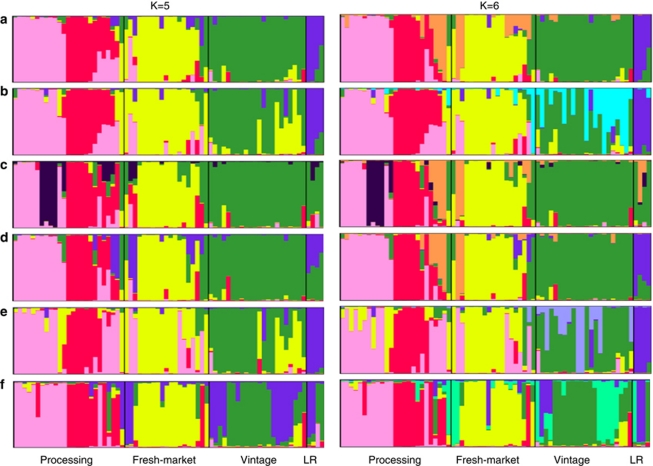
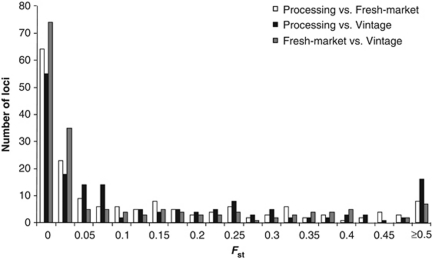
Tomato (Solanum lycopersicum L.) has undergone intensive selection during and following domestication. We investigated population structure and genetic differentiation within a collection of 70 tomato lines representing contemporary (processing and fresh-market) varieties, vintage varieties and landraces. The model-based Bayesian clustering software, STRUCTURE, was used to detect subpopulations. Six independent analyses were conducted using all marker data (173 markers) and five subsets of markers based on marker type (single-nucleotide polymorphisms, simple sequence repeats and insertion/deletions) and location (exon and intron sequences) within genes. All of these analyses consistently separated four groups predefined by market niche and age into distinct subpopulations. Furthermore, we detected at least two subpopulations within the processing varieties. These subpopulations correspond to historical patterns of breeding conducted for specific production environments. We found no subpopulation within fresh-market varieties, vintage varieties and landraces when using all marker data. High levels of admixture were shown in several varieties representing a transition in the demarcation between processing and fresh-market breeding. The genetic clustering detected by using the STRUCTURE software was confirmed by two statistics, pairwise F(st) (θ) and Nei's standard genetic distance. We also identified a total of 19 loci under positive selection between processing, fresh-market and vintage germplasm by using an F(st)-outlier method based on the deviation from the expected distribution of F(st) and heterozygosity. The markers and genome locations we identified are consistent with known patterns of selection and linkage to traits that differentiate the market classes. These results demonstrate how human selection through breeding has shaped genetic variation within cultivated tomato.
Figures
References
-
- Barrero LS, Tanksley SD. Evaluating the genetic basis of multiple-locule fruit in a broad cross section of tomato cultivars. Theor Appl Genet. 2004;109:669–679. - PubMed
-
- Beaumont MA, Nichols RA. Evaluating loci for use in the genetic analysis of population structure. Proc R Soc London Ser B. 1996;263:1619–1626.
-
- Berry SZ, Wiese KL, Gould W. Ohio 7983 Processing Tomato. HortScience. 1992;27:939.
Publication types
MeSH terms
LinkOut - more resources
Full Text Sources
Other Literature Sources
Miscellaneous
