. 2010 Oct 27:5:103-18.
doi: 10.4137/BMI.S5740.

Breast cancer biomarker discovery in the functional genomic age: a systematic review of 42 gene expression signatures

Affiliations

Breast cancer biomarker discovery in the functional genomic age: a systematic review of 42 gene expression signatures

M C Abba et al. Biomark Insights. .

Abstract

In this review we provide a systematic analysis of transcriptomic signatures derived from 42 breast cancer gene expression studies, in an effort to identify the most relevant breast cancer biomarkers using a meta-analysis method. Meta-data revealed a set of 117 genes that were the most commonly affected ranging from 12% to 36% of overlap among breast cancer gene expression studies. Data mining analysis of transcripts and protein-protein interactions of these commonly modulated genes indicate three functional modules significantly affected among signatures, one module related with the response to steroid hormone stimulus, and two modules related to the cell cycle. Analysis of a publicly available gene expression data showed that the obtained meta-signature is capable of predicting overall survival (P < 0.0001) and relapse-free survival (P < 0.0001) in patients with early-stage breast carcinomas. In addition, the identified meta-signature improves breast cancer patient stratification independently of traditional prognostic factors in a multivariate Cox proportional-hazards analysis.

Keywords: biomarkers; breast cancer; gene expression signatures.


Figures
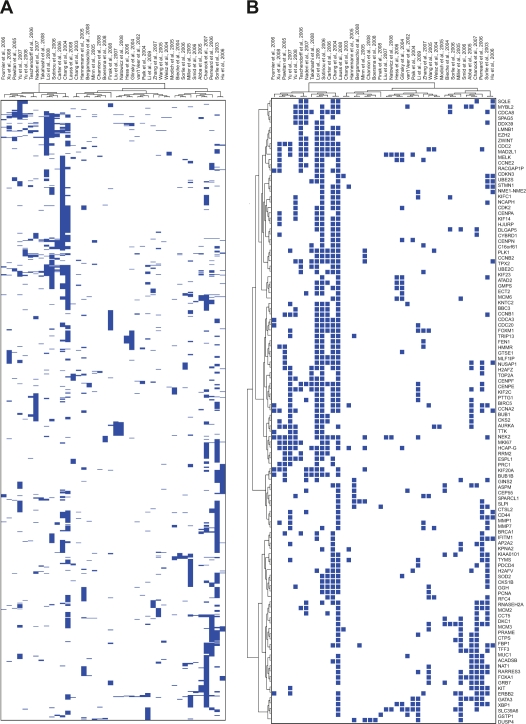
Figure 1.
Figure 1.
Overlap beween gene identifiers across 42 breast cancer gene expression signatures. A) Heatmap representation of 946 genes overlapping in more than one gene expression signature. B) Heatmap representation of 117 genes overlapping in at least 5 out of 42 gene expression signatures analyzed. Easch row is a gene and each column is a breast cancer gene expression signature. Presence of a gene is indicated by a blue box, and absence is white.
Figure 2.
Figure 2.
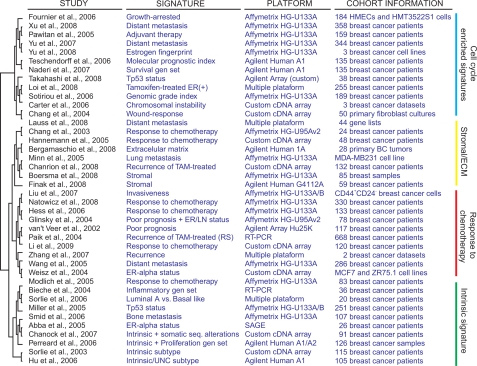
Hierarchical clustering analysis of the 42 breast cancer gene expression studies, classified them in four groups: the intrinsic subtypes, response to chemotherapy, stromal/extracellular matrix (ECM) and signatures enriched in cell cycle genes. It can clearly be seen that related signatures such us intrinsic subtype and ER-alpha status on the one hand, or stromal and extracellular matrix signatures on the other hand, have a large overlap relative to other gene expression signatures.
Figure 3.
Figure 3.
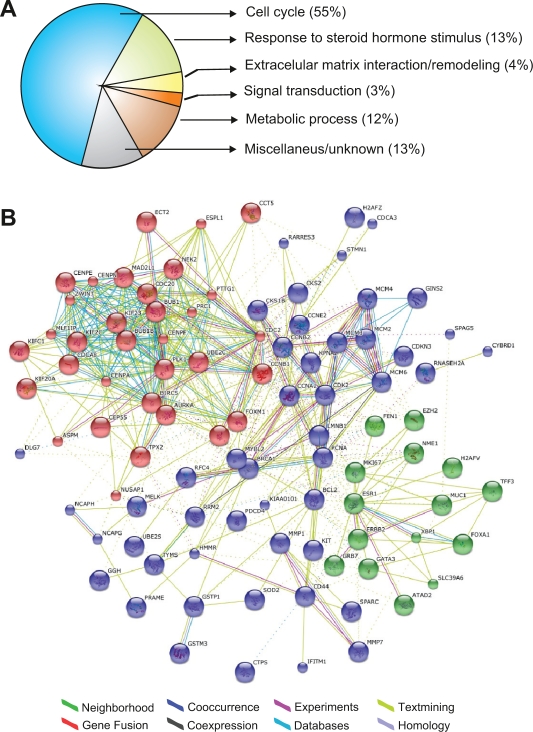
Data mining analysis of the gene expression meta-signature. A) Gene ontology (GO) classification of the 117 gene list meta-signature with specific gene ontology annotations based on biological processes or molecular function terms. B) Graph of protein-protein interactions among the 117 gene expression metasignature generated using the STRING database. In the network: links between proteins means the various interactions data supporting the network, colored by evidence type.
Figure 4.
Figure 4.
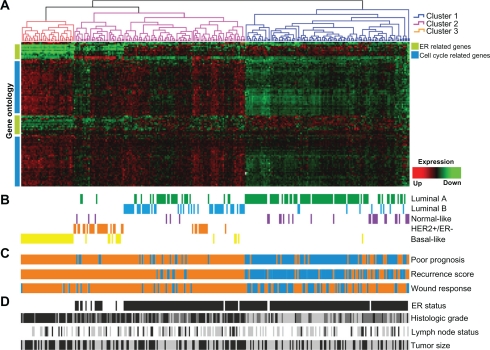
Cross-validation of the gene meta-signature with a single data set of 295 breast cancer samples and integration with 4 pronostic or predictive gene expression signatures. A) Meta-signature hierarchical clustering, cluster 1 (blue), cluster 2 (pink), cluster 3 (orange). Gene ontology clustering (left of the graph), the green bar indicates genes related to steroid hormone stimulus, the blue bar indicates cell cycle related genes. B) Intrinsic Subtype signature. C) Poor prognosis signature: good prognosis (blue), poor prognosis (orange); Recurrence score: high (orange); intermediate (blue light), low recurrence score (blue) and Wound response: activated (orange); quiescent (blue). D) Clinicopathological data. Estrogen Receptor (ER) status: positive (black) and negative (white). Histological grade: high (black); moderate (grey) and low grade (light grey). Lymph node (LN) status: negative (white); 1–3 positive (grey); >3 positive (black). Tumor size: ≤2 cm (grey) and >2 cm (black).
Figure 5.
Figure 5.
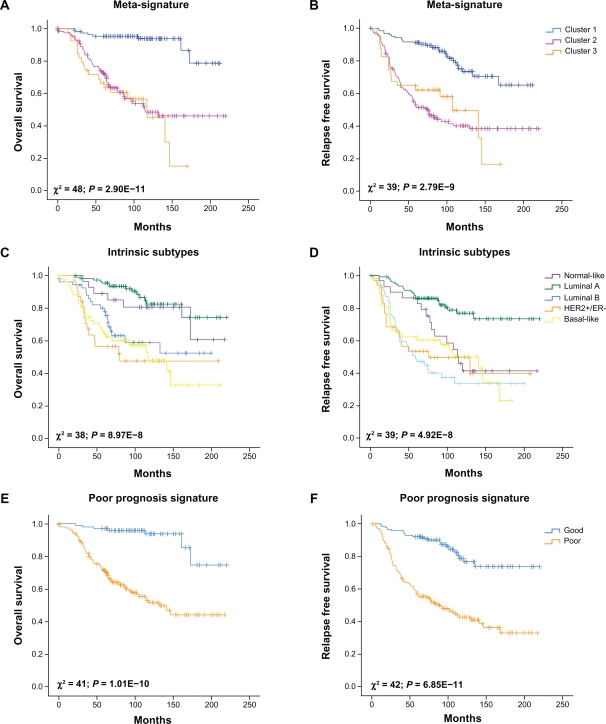
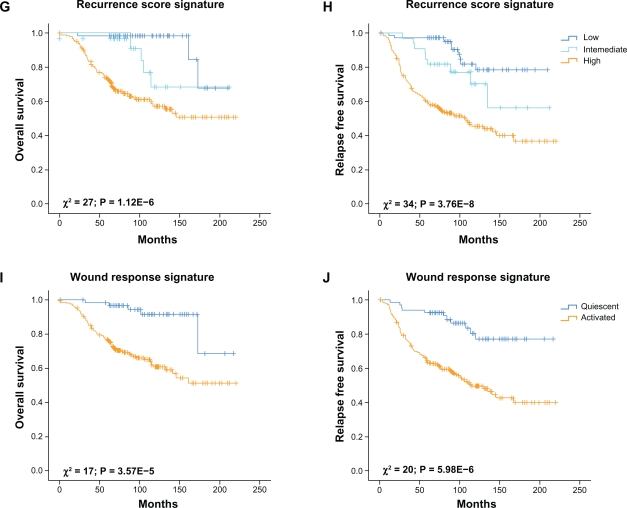
Kaplan–Meier curves of overall and relapse-free survival among the 295 early-stage breast cancer patients obtained from van de Vijver et al study (2002) according to the meta-signature (A and B), Intrinsic Subtypes (C and D), Poor Prognosis Signature (E and F), Recurrence Score (G and H) and Wound Response (I and J).
Figure 5.
Figure 5.
Kaplan–Meier curves of overall and relapse-free survival among the 295 early-stage breast cancer patients obtained from van de Vijver et al study (2002) according to the meta-signature (A and B), Intrinsic Subtypes (C and D), Poor Prognosis Signature (E and F), Recurrence Score (G and H) and Wound Response (I and J).

References

    1. Perou CM, Sørlie T, Eisen MB, et al. Molecular portraits of human breast tumours. Nature. 2000;406(6797):747–52. - PubMed
    1. Sørlie T, Perou CM, Tibshirani R, et al. Gene expression patterns of breast carcinomas distinguish tumor subclasses with clinical implications. Proc Natl Acad Sci U S A. 2001;98(19):10869–74. - PMC - PubMed
    1. Sorlie T, Tibshirani R, Parker J, et al. Repeated observation of breast tumor subtypes in independent gene expression data sets. Proc Natl Acad Sci U S A. 2003;100(14):8418–23. - PMC - PubMed
    1. Weisz A, Basile W, Scafoglio C, et al. Molecular identification of ERalpha-positive breast cancer cells by the expression profile of an intrinsic set of estrogen regulated genes. J Cell Physiol. 2004;200(3):440–50. - PubMed
    1. Abba MC, Hu Y, Sun H, et al. Gene expression signature of estrogen receptor alpha status in breast cancer. BMC Genomics. 2005;6(1):37. - PMC - PubMed

LinkOut - more resources