


An option for measuring maternal mortality in developing countries: a survey using community informants
- PMID: 21083883
- PMCID: PMC2998457
- DOI: 10.1186/1471-2393-10-74
An option for measuring maternal mortality in developing countries: a survey using community informants
Abstract
Background: The maternal mortality ratio (MMR) remains high in most developing countries. Local, recent estimates of MMR are needed to motivate policymakers and evaluate interventions. But, estimating MMR, in the absence of vital registration systems, is difficult. This paper describes an efficient approach using village informant networks to capture maternal death cases (Maternal Deaths from Informants/Maternal Death Follow on Review or MADE-IN/MADE-FOR) developed to address this gap, and examines its validity and efficiency.
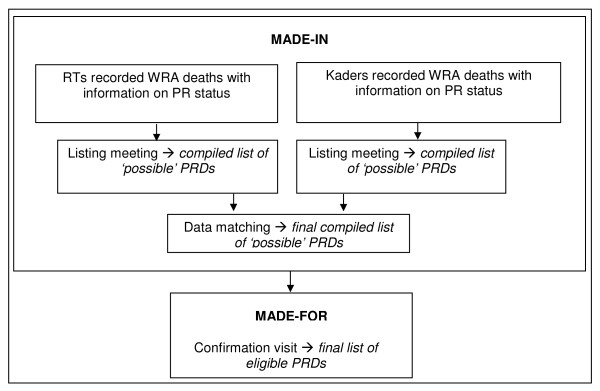
Methods: MADE-IN used two village informant networks - heads of neighbourhood units (RTs) and health volunteers (Kaders). Informants were invited to attend separate network meetings - through the village head (for the RT) and through health centre for the kaders. Attached to the letter was a form with written instructions requesting informants list deaths of women of reproductive age (WRA) in the village during the previous two years. At a 'listing meeting' the informants' understanding on the form was checked, informants could correct their forms, and then collectively agreed a consolidated list. MADE-FOR consisted of visits relatives of likely pregnancy related deaths (PRDs) identified from MADE-IN, to confirm the PRD status and gather information about the cause of death. Capture-recapture (CRC) analysis enabled estimation of coverage rates of the two networks, and of total PRDs.
Results: The RT network identified a higher proportion of PRDs than the kaders (estimated 0.85 vs. 0.71), but the latter was easier and cheaper to access. Assigned PRD status amongst identified WRA deaths was more accurate for the kader network, and seemingly for more recent deaths, and for deaths from rural areas. Assuming information on live births from an existing source to calculate the MMR, MADE-IN/MADE-FOR cost only $0.1 (US) per women-year risk of exposure, substantially cheaper than alternatives.
Conclusions: This study shows that reliable local, recent estimates of MMR can be obtained relatively cheaply using two independent informant networks to identify cases. Neither network captured all PRDs, but capture-recapture analysis allowed self-calibration. However, it requires careful avoidance of false-positives, and matching of cases identified by both networks, which was achieved by the home visit.
Figures
References
-
- WHO, UNICEF, UNFPA, the World Bank. Maternal mortality in 2005. Estimates Developed by WHO, UNICEF, UNFPA and the World Bank. Geneva. 2007.
-
- Statistics Indonesia (BPS) and Macro International. Indonesia demographic and health survey 2007. Calverton, Maryland, USA; 2008.
-
- Central Bureau of Statistics/CBS and ORC Macro. Indonesia 2002/2003 Demographic and Health Survey. BKKBN, Depkes RI dan ORC Macro. Jakarta, Indonesia, Calverton, Maryland, USA; 2003.
Publication types
MeSH terms
LinkOut - more resources
Full Text Sources
Miscellaneous
