. 2010 Nov 17:10:251.
doi: 10.1186/1471-2229-10-251.

Functionally relevant microsatellites in sugarcane unigenes

Affiliations

Functionally relevant microsatellites in sugarcane unigenes

Swarup K Parida et al. BMC Plant Biol. .

Abstract

Background: Unigene sequences constitute a rich source of functionally relevant microsatellites. The present study was undertaken to mine the microsatellites in the available unigene sequences of sugarcane for understanding their constitution in the expressed genic component of its complex polyploid/aneuploid genome, assessing their functional significance in silico, determining the extent of allelic diversity at the microsatellite loci and for evaluating their utility in large-scale genotyping applications in sugarcane.

Results: The average frequency of perfect microsatellite was 1/10.9 kb, while it was 1/44.3 kb for the long and hypervariable class I repeats. GC-rich trinucleotides coding for alanine and the GA-rich dinucleotides were the most abundant microsatellite classes. Out of 15,594 unigenes mined in the study, 767 contained microsatellite repeats and for 672 of these putative functions were determined in silico. The microsatellite repeats were found in the functional domains of proteins encoded by 364 unigenes. Its significance was assessed by establishing the structure-function relationship for the beta-amylase and protein kinase encoding unigenes having repeats in the catalytic domains. A total of 726 allelic variants (7.42 alleles per locus) with different repeat lengths were captured precisely for a set of 47 fluorescent dye labeled primers in 36 sugarcane genotypes and five cereal species using the automated fragment analysis system, which suggested the utility of designed primers for rapid, large-scale and high-throughput genotyping applications in sugarcane. Pair-wise similarity ranging from 0.33 to 0.84 with an average of 0.40 revealed a broad genetic base of the Indian varieties in respect of functionally relevant regions of the large and complex sugarcane genome.

Conclusion: Microsatellite repeats were present in 4.92% of sugarcane unigenes, for most (87.6%) of which functions were determined in silico. High level of allelic diversity in repeats including those present in the functional domains of proteins encoded by the unigenes demonstrated their use in assay of useful variation in the genic component of complex polyploid sugarcane genome.


Figures
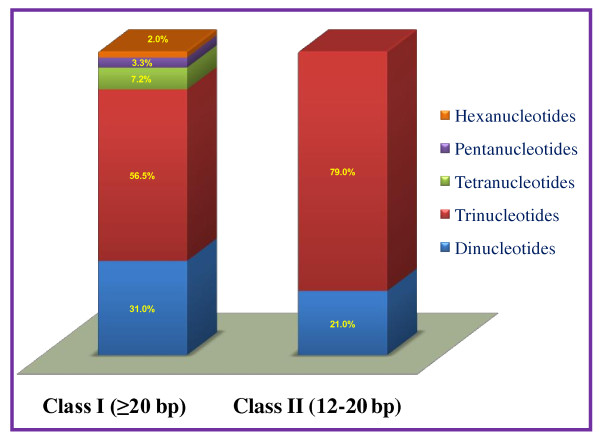
Figure 1
Figure 1
Frequency and relative distribution of class I and class II microsatellite repeats in sugarcane unigenes. Comparative distribution of long hypervariable class I and potentially variable class II microsatellite repeats in the unigenes of sugarcane. Trinucleotide was the most abundant repeat-motif in both class I (56.5%) and class II (79%) category, which was followed by dinucleotide motifs.
Figure 2
Figure 2
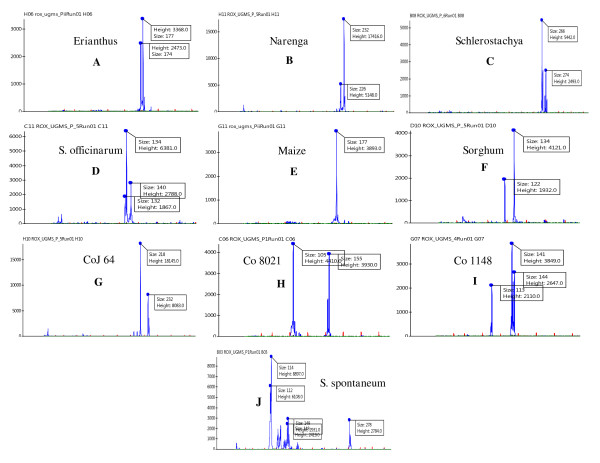
Different UGMS allele types detected by automated fragment analysis. Distribution of various allele types detected in Saccharum species, genera, commercial varieties and five cereal species using the automated fragment analysis. A, C, D, F and H: Multiple alleles in a single locus showing step-wise distribution, B, G and I: Multiple alleles in a single locus showing mixed distribution, E: Single allele in a unique locus, and J: Multiple loci showing both stepwise and mixed distribution in different loci.
Figure 3
Figure 3
Fragment length polymorphism detected among Indian sugarcane varieties using fluorescent dye labeled primers. Allelic variation in a representative set of 14 commercial Indian tropical and sub-tropical sugarcane varieties. Fourteen alleles were amplified by a class I UGMS marker (UGSuM17) designed from the unigene encoding Abcisic acid inducible protein kinase that contained (AG)18 repeat-motif. The amplicons generated by the fluorescent dye labeled primers were resolved in MegaBACE automated DNA sequencer and analyzed in Fragment Profiler software. Fragment size (bp) and average peak height for all the amplified alleles are indicated.
Figure 4
Figure 4
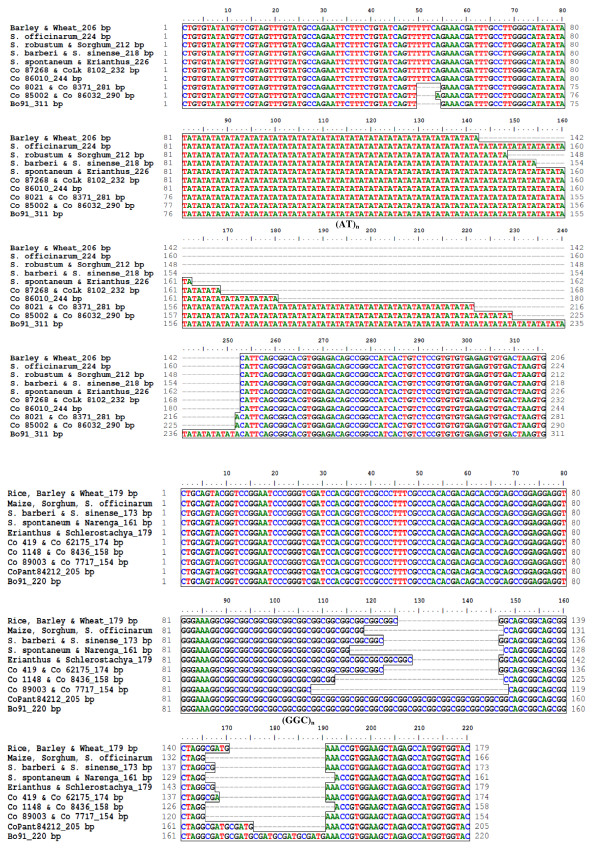
DNA sequence alignment depicting the molecular basis of UGMS fragment length polymorphism among Saccharum complex, varieties and five cereals. Multiple sequence alignment of 10 size variant alleles showing both stepwise and mixed distributions amplified from sugarcane species, genera, varieties and five cereals for the two UGMS marker loci namely, UGSuM2 (A) and UGSuM27 (B). Variation in the number of repeats of (AT)n and (GGC)n microsatellite motifs at UGSuM2 and UGSuM27 loci, respectively and additional nucleotide insertions/deletions in the flanking sequences of the repeats are highlighted.
Figure 5
Figure 5
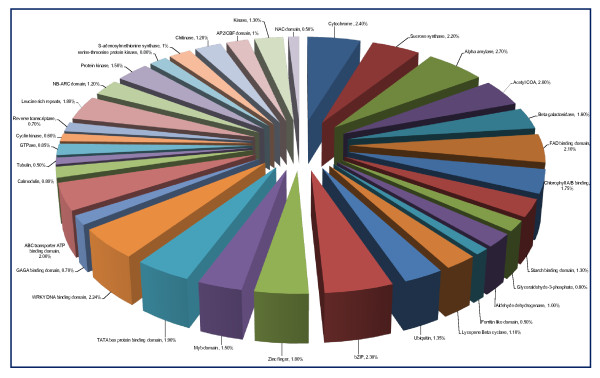
Functional annotation of unigenes carrying microsatellites in their functional domains. Functional annotation of 364 unigenes carrying microsatellites in the functional domains of encoded proteins. These unigenes corresponded maximum (47.7%) to the domains responsible for photosynthesis (cytochrome b/c and chlorophyll A/B binding domains) and carbohydrate metabolism (sucrose synthase and alpha amylase domains) followed by transcription factor associated basic leucine zipper, zinc finger, TATA box, Myb and WRKY DNA binding domains (22%), and minimum to the abiotic and biotic stress related leucine rich repeat, protein kinase and chitinase domains (5%).
Figure 6
Figure 6
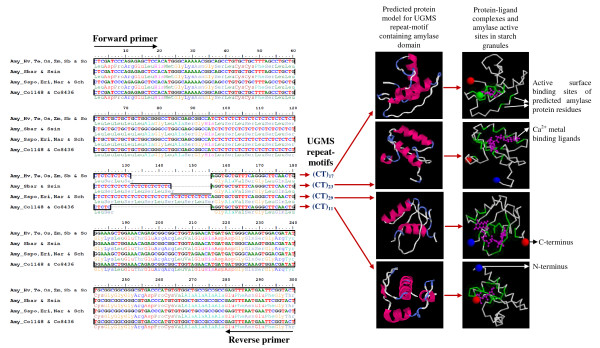
Alignment, and predicted protein structure and catalytic domain binding sites depicting the functional relevance of microsatellite carrying unigenes. Multiple sequence alignment of the four size variant alleles showing step-wise distribution in the amylase catalytic domain amplified from sugarcane species, genera, varieties and five cereals using primer (UGSuM26) for β-amylase unigene. Variation in the number of repeat-units of CT and the encoding repeated tracts of Leucine-Serine aminoacid residues at a microsatellite locus predicted different three dimensional protein structures and protein-ligand complex binding sites which are highlighted.
Figure 7
Figure 7
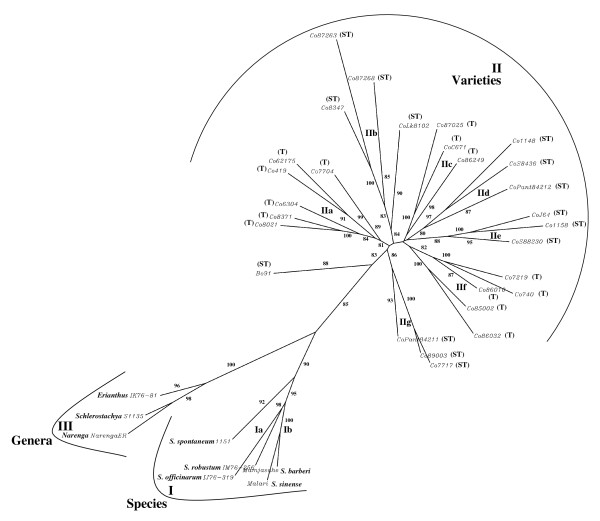
Phylogenetic tree depicting genetic relationships among Saccharum complex and Indian varieties. Unrooted phylogenetic tree depicting the genetic relationships among the Saccharum species, related genera and 28 commercial Indian tropical and sub-tropical sugarcane varieties based on Nei and Li's similarity coefficient using 47 fluorescent dye labeled primers. Bootstrap values are indicated at the corresponding node for each cluster. Molecular classification corresponded to the known evolutionary and pedigree relationship as well as the adaptive environment. T and ST denote the tropical and sub-tropical region of adaptation, respectively.

References

    1. Grivet L, Arruda P. Sugarcane genomics: depicting the complex genome of an important tropical crop. Curr Opin Plant Biol. 2002;5:122–127. doi: 10.1016/S1369-5266(02)00234-0. - DOI - PubMed
    1. Cordeiro GM, Taylor GO, Henry RJ. Characterization of microsatellite markers from sugarcane (Saccharum spp.), a highly polyploid species. Plant Sci. 2000;155:161–168. doi: 10.1016/S0168-9452(00)00208-9. - DOI - PubMed
    1. Cordeiro GM, Casu R, McIntyre CL, Manners JM, Henry RJ. Microsatellite markers from sugarcane (Saccharum spp.) ESTs cross-transferable to Erianthus and Sorghum. Plant Sci. 2001;160:1115–1123. doi: 10.1016/S0168-9452(01)00365-X. - DOI - PubMed
    1. Parida SK, Kalia SK, Kaul S, Dalal V, Hemaprabha G, Selvi A, Pandit A, Singh A, Gaikwad K, Sharma TR, Srivastava PS, Singh NK, Mohapatra T. Informative genomic microsatellite markers for efficient genotyping applications in sugarcane. Theor Appl Genet. 2009;118:327–338. doi: 10.1007/s00122-008-0902-4. - DOI - PubMed
    1. Pinto LR, Oliveira KM, Ulian EC, Garcia AA, De Souza AP. Survey in the sugarcane expressed sequence tag database (SUCEST) for simple sequence repeats. Genome. 2004;47:795–804. doi: 10.1139/g04-055. - DOI - PubMed

Publication types

LinkOut - more resources