


Nonlinear speech analysis algorithms mapped to a standard metric achieve clinically useful quantification of average Parkinson's disease symptom severity
- PMID: 21084338
- PMCID: PMC3104343
- DOI: 10.1098/rsif.2010.0456
Nonlinear speech analysis algorithms mapped to a standard metric achieve clinically useful quantification of average Parkinson's disease symptom severity
Abstract
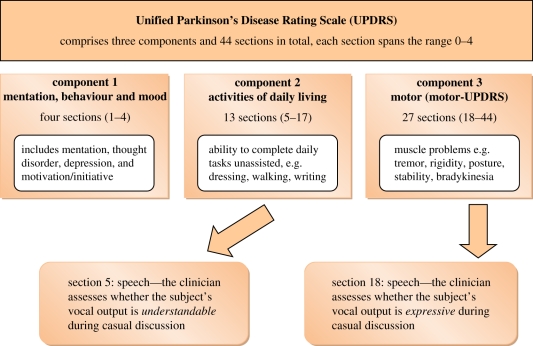
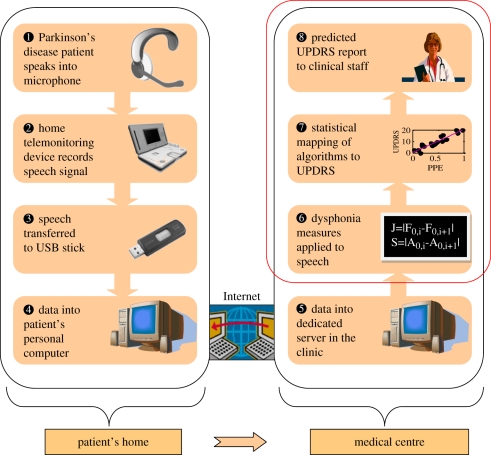
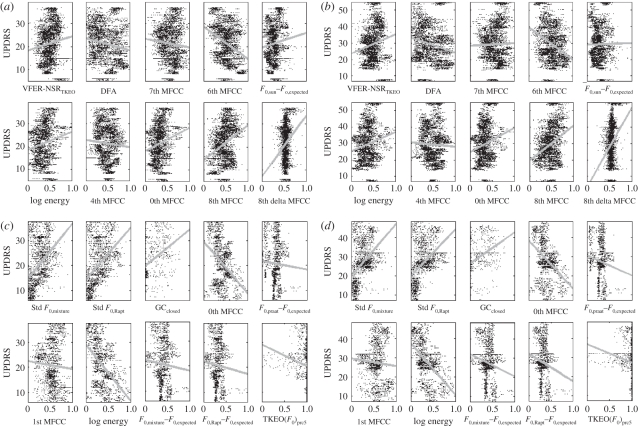
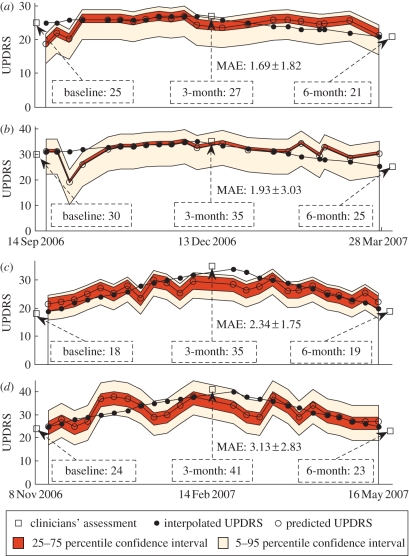
The standard reference clinical score quantifying average Parkinson's disease (PD) symptom severity is the Unified Parkinson's Disease Rating Scale (UPDRS). At present, UPDRS is determined by the subjective clinical evaluation of the patient's ability to adequately cope with a range of tasks. In this study, we extend recent findings that UPDRS can be objectively assessed to clinically useful accuracy using simple, self-administered speech tests, without requiring the patient's physical presence in the clinic. We apply a wide range of known speech signal processing algorithms to a large database (approx. 6000 recordings from 42 PD patients, recruited to a six-month, multi-centre trial) and propose a number of novel, nonlinear signal processing algorithms which reveal pathological characteristics in PD more accurately than existing approaches. Robust feature selection algorithms select the optimal subset of these algorithms, which is fed into non-parametric regression and classification algorithms, mapping the signal processing algorithm outputs to UPDRS. We demonstrate rapid, accurate replication of the UPDRS assessment with clinically useful accuracy (about 2 UPDRS points difference from the clinicians' estimates, p<0.001). This study supports the viability of frequent, remote, cost-effective, objective, accurate UPDRS telemonitoring based on self-administered speech tests. This technology could facilitate large-scale clinical trials into novel PD treatments.
© 2010 The Royal Society
Figures
References
-
- von Campenhausen S., et al. 2005. Prevalence and incidence of Parkinson's disease in Europe. Eur. Neuropsychopharmacol. 15, 473–490 10.1016/j.euroneuro.2005.04.007 (doi:10.1016/j.euroneuro.2005.04.007) - DOI - PubMed
-
- Schrag A., Ben-Schlomo Y., Quinn N. 2002. How valid is the clinical diagnosis of Parkinson's disease in the community? J. Neurol. Neurosurg. Psychiatry 73, 529–535 10.1136/jnnp.73.5.529 (doi:10.1136/jnnp.73.5.529) - DOI - PMC - PubMed
-
- Elbaz A., Bower J. H., Maraganore D. M., McDonnell S. K., Peterson B. J., Ahlskog J. E., Schaid D. J., Rocca W. A. 2002. Risk tables for Parkinsonism and Parkinson's disease. J. Clin. Epidemiol. 55, 25–31 10.1016/S0895-4356(01)00425-5 (doi:10.1016/S0895-4356(01)00425-5) - DOI - PubMed
-
- Pahwa R., Lyons E. 2007. Handbook of Parkinson's disease, 4th edn New York, NY: Informa Healthcare
-
- Harel B., Cannizzaro M., Snyder P. J. 2004. Variability in fundamental frequency during speech in prodromal and incipient Parkinson's disease: a longitudinal case study. Brain Cogn. 56, 24–29 10.1016/j.bandc.2004.05.002 (doi:10.1016/j.bandc.2004.05.002) - DOI - PubMed
Publication types
MeSH terms
LinkOut - more resources
Full Text Sources
Other Literature Sources
Medical
