Increased pulmonary tumor necrosis factor alpha, interleukin-6 (IL-6), and IL-17A responses compensate for decreased gamma interferon production in anti-IL-12 autovaccine-treated, Mycobacterium bovis BCG-vaccinated mice
- PMID: 21084465
- PMCID: PMC3019790
- DOI: 10.1128/CVI.00352-10
Increased pulmonary tumor necrosis factor alpha, interleukin-6 (IL-6), and IL-17A responses compensate for decreased gamma interferon production in anti-IL-12 autovaccine-treated, Mycobacterium bovis BCG-vaccinated mice
Abstract
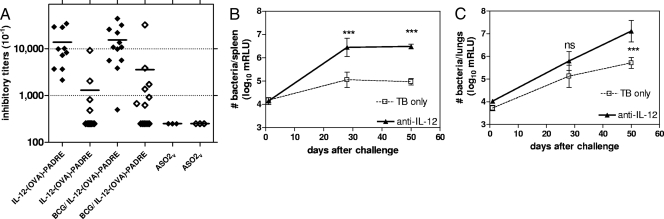
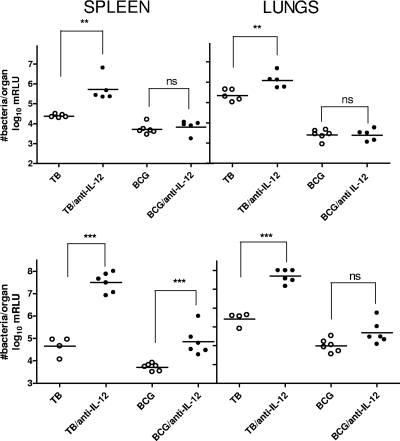
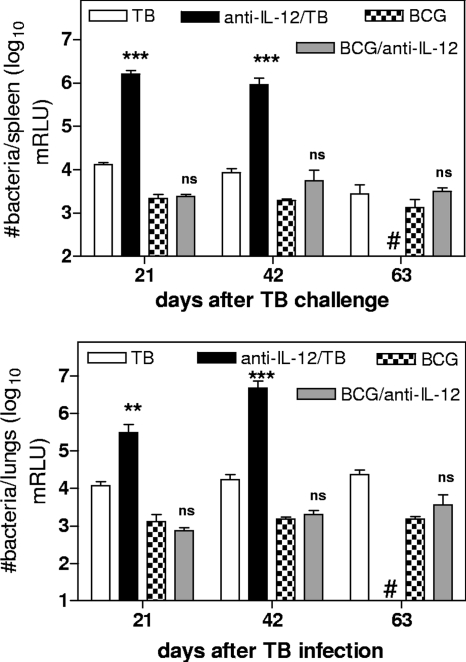
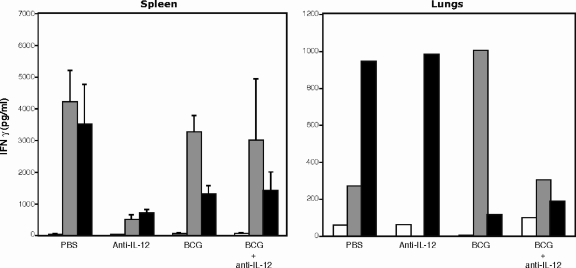
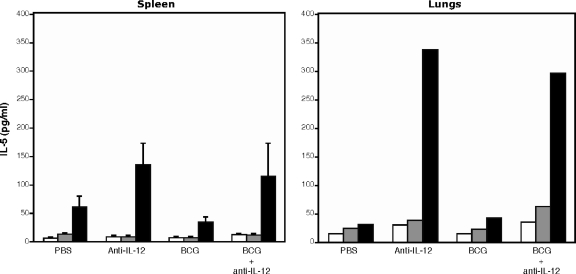
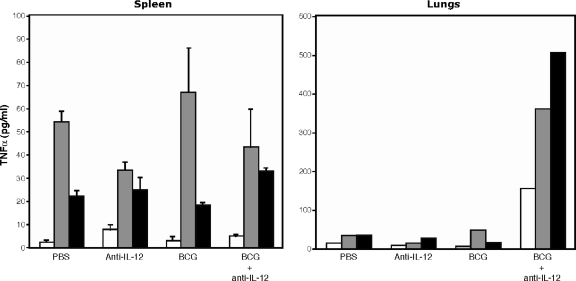
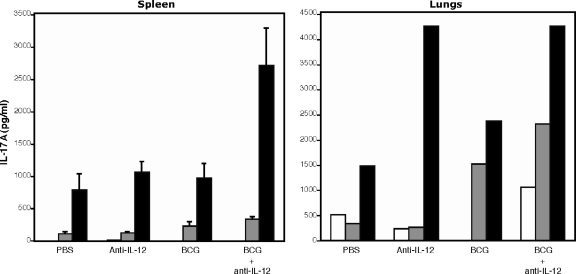
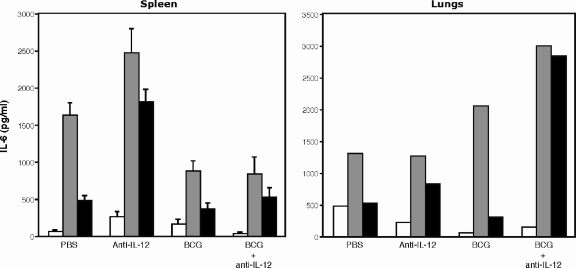
Interleukin-12 (IL-12) and IL-23 (which share a p40 subunit) are pivotal cytokines in the generation of protective Th1/Th17-type immune responses upon infection with the intracellular pathogen Mycobacterium tuberculosis. The role of IL-12 and IL-23 in protection conferred by the tuberculosis vaccine Mycobacterium bovis bacillus Calmette-Guérin (BCG) is, however, less well documented. By using an autovaccine approach, i.e., IL-12p70 cross-linked with ovalbumin and PADRE peptide formulated with the GSK proprietary adjuvant system AS02(V), we could specifically neutralize IL-12 while leaving the IL-23 axis intact. Neutralization of IL-12 before M. tuberculosis challenge rendered C57BL/6 mice highly susceptible, resulting in 30-fold-higher CFU in spleen and lungs and accelerated mortality. In contrast, neutralization of IL-12 in BCG-vaccinated mice prior to M. tuberculosis challenge only marginally affected vaccine-mediated protection. Analysis of cytokine production in spleen and lungs 3 weeks post-TB challenge by enzyme-linked immunosorbent assay and functional and flow cytometric assays showed significantly reduced mycobacterium-specific gamma interferon (IFN-γ) responses in M. tuberculosis-infected and BCG-vaccinated mice that had been treated with the autovaccine. Purified protein derivative-induced tumor necrosis factor alpha (TNF-α), IL-6, and IL-17A levels, however, were highest in lungs from BCG-vaccinated/IL-12-neutralized animals, and even unstimulated lung cells from these mice produced significant levels of the three cytokines. Mycobacterium-specific IL-4 and IL-5 production levels were overall very low, but IL-12 neutralization resulted in increased concanavalin A-triggered polyclonal secretion of these Th2-type cytokines. These results suggest that TNF-α, IL-6, and IL-17A may be more important pulmonary effector molecules of BCG-mediated protection than IFN-γ in a context of IL-12 deficiency.
Figures
References
-
- Aggarwal, S., N. Ghilardi, M. H. Xie, F. J. de Sauvage, and A. L. Gurney. 2003. Interleukin-23 promotes a distinct CD4+ cell activation state characterized by the production of interleukin-17. J. Biol. Chem. 278:1910-1914. - PubMed
-
- Alexander, J., et al. 1994. Development of high potency universal DR-restricted helper epitopes by modification of high affinity DR-blocking peptides. Immunity 1:751-761. - PubMed
-
- Andersen, P., B. Gicquel, and K. Huygen. 2004. Tuberculosis vaccine science, p. 885-898. In W. N. Rom and S. M. Garay (ed.), Tuberculosis, 2nd ed. Lippincott Williams & Wilkins, Philadelphia, PA.
-
- Bean, A. G., et al. 1999. Structural deficiencies in granuloma formation in TNF gene-targeted mice underlie the heightened susceptibility to aerosol Mycobacterium tuberculosis infection, which is not compensated for by lymphotoxin. J. Immunol. 162:3504-3511. - PubMed
Publication types
MeSH terms
Substances
LinkOut - more resources
Full Text Sources