


Review
doi: 10.1128/JVI.01369-10.
Epub 2010 Nov 17.
Viral serine/threonine protein kinases
Affiliations
- PMID: 21084474
- PMCID: PMC3020496
- DOI: 10.1128/JVI.01369-10
Item in Clipboard
Review
Viral serine/threonine protein kinases
J Virol.
2011 Feb.
Abstract
Phosphorylation represents one the most abundant and important posttranslational modifications of proteins, including viral proteins. Virus-encoded serine/threonine protein kinases appear to be a feature that is unique to large DNA viruses. Although the importance of these kinases for virus replication in cell culture is variable, they invariably play important roles in virus virulence. The current review provides an overview of the different viral serine/threonine protein kinases of several large DNA viruses and discusses their function, importance, and potential as antiviral drug targets.
Figures
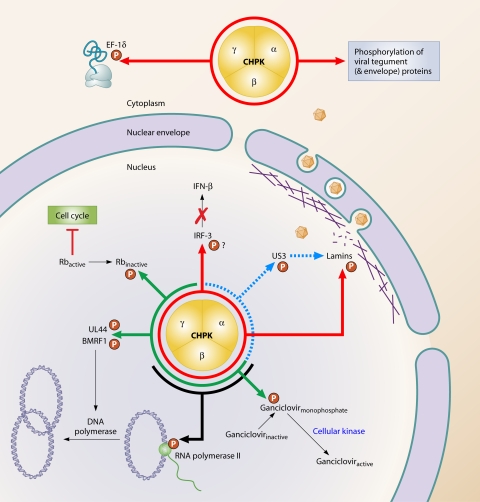
Some of the major functions associated with the conserved herpesvirus protein kinase (CHPK). Red lines indicate functions that are conserved over the three herpesvirus subfamilies. Green lines indicate functions that are common to beta- and gammaherpesviruses. Blue and black lines indicate functions that have been reported only for alpha- and betaherpesviruses, respectively.
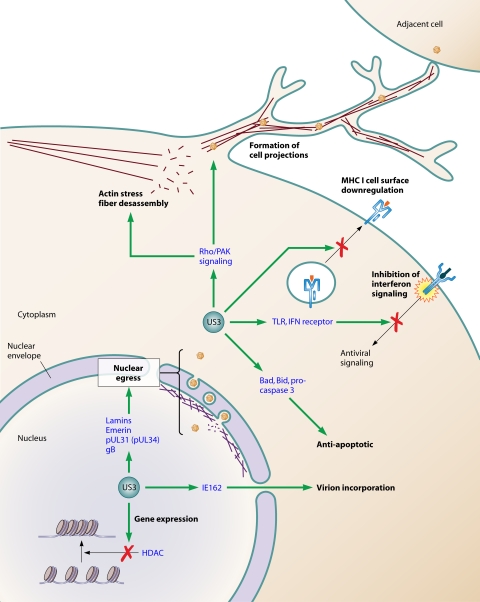
Major functions associated with US3 kinase orthologs of alphaherpesviruses. Proteins in blue represent US3 substrates that may be involved in the different functions of US3.
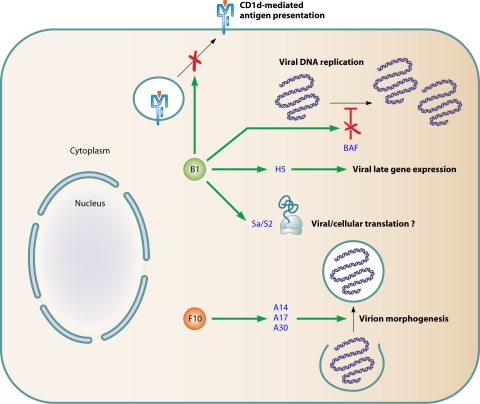
Major functions associated with B1 and F10 kinases of poxviruses. Proteins in orange represent phosphorylation substrates that may be involved in the different functions of B1 and F10.
References
-
- Advani, S. J., R. Brandimarti, R. R. Weichselbaum, and B. Roizman. 2000. The disappearance of cyclins A and B and the increase in activity of the G(2)/M-phase cellular kinase cdc2 in herpes simplex virus 1-infected cells require expression of the alpha22/U(S)1.5 and U(L)13 viral genes. J. Virol. 74:8-15. - PMC - PubMed
-
- Andrei, G., E. De Clercq, and R. Snoeck. 2009. Drug targets in cytomegalovirus infection. Infect. Disord. Drug Targets 9:201-222. - PubMed
Publication types
MeSH terms
Substances
LinkOut - more resources
Full Text Sources
