


Development and characterization of a highly specific and sensitive SYBR green reverse transcriptase PCR assay for detection of the 2009 pandemic H1N1 influenza virus on the basis of sequence signatures
- PMID: 21084522
- PMCID: PMC3020443
- DOI: 10.1128/JCM.01142-10
Development and characterization of a highly specific and sensitive SYBR green reverse transcriptase PCR assay for detection of the 2009 pandemic H1N1 influenza virus on the basis of sequence signatures
Abstract
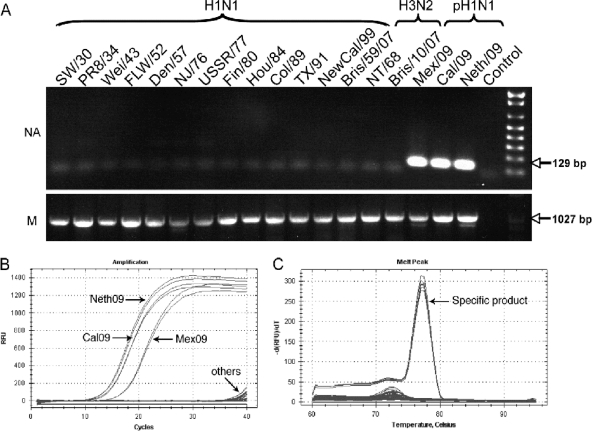
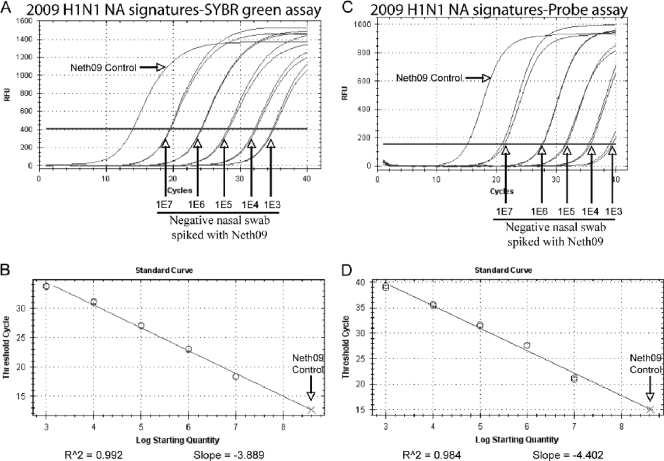
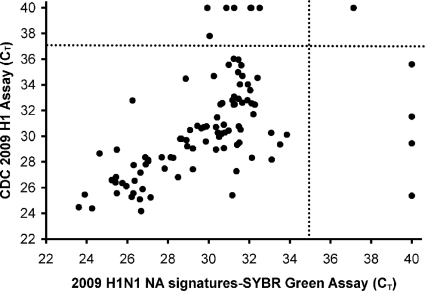
The emergence and rapid spread of the 2009 H1N1 pandemic influenza virus showed that many diagnostic tests were unsuitable for detecting the novel virus isolates. In most countries the probe-based TaqMan assay developed by the U.S. Centers for Disease Control and Prevention was used for diagnostic purposes. The substantial sequence data that became available during the course of the pandemic created the opportunity to utilize bioinformatics tools to evaluate the unique sequence properties of this virus for the development of diagnostic tests. We used a comprehensive computational approach to examine conserved 2009 H1N1 sequence signatures that are at least 20 nucleotides long and contain at least two mismatches compared to any other known H1N1 genome. We found that the hemagglutinin (HA) and neuraminidase (NA) genes contained sequence signatures that are highly conserved among 2009 H1N1 isolates. Based on the NA gene signatures, we used Visual-OMP to design primers with optimal hybridization affinity and we used ThermoBLAST to minimize amplification artifacts. This procedure resulted in a highly sensitive and discriminatory 2009 H1N1 detection assay. Importantly, we found that the primer set can be used reliably in both a conventional TaqMan and a SYBR green reverse transcriptase (RT)-PCR assay with no loss of specificity or sensitivity. We validated the diagnostic accuracy of the NA SYBR green assay with 125 clinical specimens obtained between May and August 2009 in Chile, and we showed diagnostic efficacy comparable to the CDC assay. Our approach highlights the use of systematic computational approaches to develop robust diagnostic tests during a viral pandemic.
Figures
References
-
- Altschul, S. F., W. Gish, W. Miller, E. W. Myers, and D. J. Lipman. 1990. Basic local alignment search tool. J. Mol. Biol. 215:403-410. - PubMed
-
- Centers for Disease Control and Prevention. 2009. Evaluation of rapid influenza diagnostic tests for detection of novel influenza A (H1N1) virus—United States, 2009. MMWR Morb. Mortal. Wkly. Rep. 58:826-829. - PubMed
-
- Centers for Disease Control and Prevention. 2009. Human infection with new influenza A (H1N1) virus: clinical observations from Mexico and other affected countries, May 2009. Wkly. Epidemiol. Rec. 84:185-189. - PubMed
-
- Centers for Disease Control and Prevention. 2009. Outbreak of swine-origin influenza A (H1N1) virus infection—Mexico, March-April 2009. MMWR Morb. Mortal. Wkly. Rep. 58:467-470. - PubMed
Publication types
MeSH terms
Substances
Grants and funding
LinkOut - more resources
Full Text Sources
Medical
Molecular Biology Databases
