. 2010 Nov;2(11):875-83.
doi: 10.18632/aging.100231.

A novel insight into aging: are there pluripotent very small embryonic-like stem cells (VSELs) in adult tissues overtime depleted in an Igf-1-dependent manner?

Affiliations

A novel insight into aging: are there pluripotent very small embryonic-like stem cells (VSELs) in adult tissues overtime depleted in an Igf-1-dependent manner?

Mariusz Z Ratajczak et al. Aging (Albany NY). 2010 Nov.

Abstract

Tissue and organ rejuvenation and senescence/aging are closely related to the function of stem cells. Recently, we demonstrated that a population of pluripotent Oct-4+ SSEA-1+Sca-1+Lin-CD45- very small embryonic-like stem cells (VSELs) resides in the adult murine bone marrow (BM) and other murine tissues. We hypothesize that these pluripotent stem cells play an important role in tissue/organ rejuvenation, and have demonstrated that their proliferation and potentially premature depletion is negatively controlled by epigenetic changes of some imprinted genes that regulate insulin factor signaling (Igf2-H19 locus, Igf2R and RasGRF1). Since the attenuation of insulin/insulin growth factor (Ins/Igf) signaling positively correlates with longevity, we propose, based on our experimental data, that gradual decrease in the number of VSELs deposited in adult tissues, which occurs throughout life in an Ins/Igf signaling-dependent manner is an important mechanism of aging. In contrast, a decrease in Ins/Igf stimulation of VSELs that extends the half life of these cells in adult organs would have a beneficial effect on life span. Our preliminary data in long-living Igf-1-signaling-deficient mice show that these animals possess a 3-4 times higher number of VSELs deposited in adult BM, lending support to this novel hypothesis.


Conflict of interest statement

The authors of this manuscript have no conflict of interests to declare.

Figures
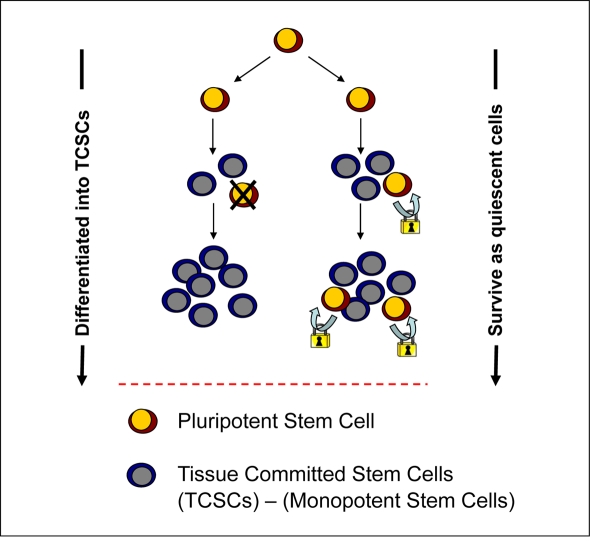
Figure 1.
Figure 1.. Potential VSEL contribution to tissue rejuvenation.
VSELs deposited in adult tissues during embryogenesis/gastrulation may become eliminated after giving rise to TCSCs. Conversely, they may survive among TCSCs and serve as a potential backup/reserve source of TCSCs. Under homoestatic conditions, primitive VSELs should be protected from unleashing their own proliferation.
Figure 2.
Figure 2.. Reprogramming of genomic imprinting controls the pluripotentiality and quiescence of VSELs.
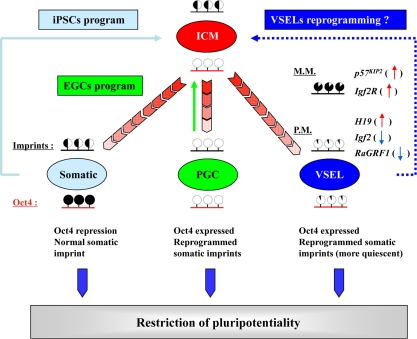
During development, PGCs and VSELs undergo similar epigenetic reprogramming of genomic imprinted genes (black bar above the indicated cells); however, they also retain expression of some pluripotent genes (e.g., Oct4) through maintaining the corresponding promoter's DNA demethylation (red bar below the indicated cells). Intriguingly, VSELs undergo the parent-of-origin-specific reprogramming of somatic imprints, resulting in upregulated maternally expressed/proliferation-repressing imprinted genes (H19, p57KIP2, and Igf2R, up-red arrow) and down-regulated paternally expressed/proliferation-promoting genes (Igf2 and RasGRF1, blue-down arrow). In particular, the erasure of genomic imprints in these cells is responsible for preventing them from aberrant teratoma formation, but at the same time restrains their pluripotentiality. In contrast, differentiated somatic cells lose their pluripotency by turning off the transcription of pluripotent genes through stable DNA methylation of their promoters (e.g., Oct4). However, they retain the somatic pattern of the genomic imprint. Thus, somatic cells may be dedifferentiated to PSCs by expression of pluripotent genes (blue box: iPSC protocol). In contrast, PGCs that express pluripotential genes, but erase the somatic imprint, may become pluripotent embryonic germ cells (EGCs) by proper remethylation of some of the erased imprinted genes (green box: EGC protocol). We hypothesize that similar modulation of parent-of-origin-specific reprogramming of somatic imprints in VSELs that enforces their quiescent state in tissues may “unleash” their pluripotentiality and reverse them to a fully pluripotent state (dark blue box: VSEL protocol). M.M.: maternally methylated loci; P.M.: paternally methylated loci.
Figure 3.
Figure 3.. Insulin/Igf signaling and imprinted genes.
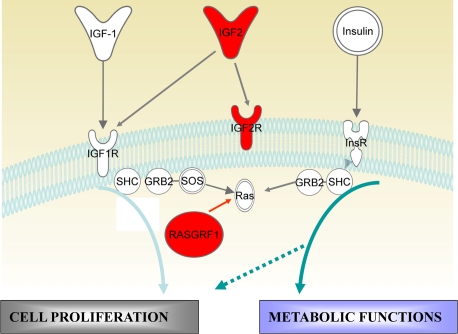
In mammals there are three insulin factors (Insulin, Igf-1, and Igf2) that bind to two tyrosine kinase receptors, insulin receptor (InsR) and Igf-1 receptor (Igf-1R). Igf2R is a non-signaling mannose-type sink receptor for Igf2. Activation of InsR and Igf-1R lead, depending on cell type, to metabolic and proliferative responses. RasGRF1 is a small GTP exchange factor (GEF) that is involved in signaling from InsR and Igf-1R. VSELs show a decrease in Igf2 and RasGRF1 expression (blue) and overexpression of Igf2R (red) due to changes in the epigenetic state of imprinted genes. These epigenetic changes in genes regulating Insulin/Igf signaling keep VSELs quiescent in adult tissues. We hypothesize that chronic exposure to Igf/Insulin accelerates premature depletion of VSELs.
Figure 4.
Figure 4.. Hypothesis of developmental deposition of Oct4+ epiblast-derived VSELs in adult tissues and their depletion by chronic Insulin/Igf signaling.
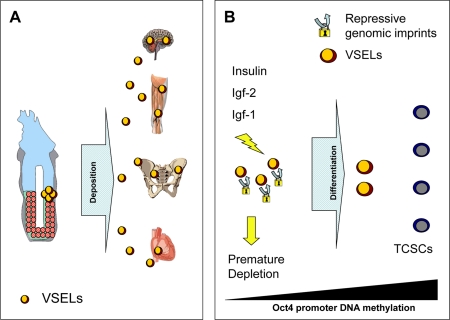
(A) Epiblast-derived VSELs are deposited in developing tissues as a backup population of SCs for production of TCSCs. (B) VSELs play a role in rejuvenation of tissues and organs as a source of TCSCs. Prolonged signaling by Insulin, Igf-1, and Igf-2 may lead to premature depletion of these cells (e.g., due to high caloric uptake). By contrast, a decrease in Insulin/Igf signaling (e.g., by caloric restriction) may ameliorate the age-related decrease in the number and pluripotency (e.g., as indicated by the Oct4 promoter state) of these cells.

References

    1. Oberdoerffer P, Sinclair DA. The role of nuclear architecture in genomic instability and ageing. Nat Rev Mol Cell Biol. 2007;8:692–702. - PubMed
    1. Sharpless NE, DePinho RA. How stem cells age and why this makes us grow old. Nat Rev Mol Cell Biol. 2007;8:703–713. - PubMed
    1. Kucia M, Reca R, Campbell FR, Zuba-Surma E, Majka M, Ratajczak J, Ratajczak MZ. A population of very small embryonic-like (VSEL) CXCR4+SSEA-1+Oct-4+ stem cells identified in adult bone marrow. Leukemia. 2006;20:857–869. - PubMed
    1. Ratajczak MZ, Zuba-Surma EK, Shin D-M, Ratajczak J, Kucia M. Very small embryonic-like (VSEL) stem cells in adult organs and their potential role in rejuvenation of tissues and longevity. Experimental Gerontology. 2008;43:1009–1017. - PMC - PubMed
    1. Shin DM, Zuba-Surma EK, Wu W, Ratajczak J, Wysoczynski M, Ratajczak MZ, Kucia M. Novel epigenetic mechanisms that control pluripotency and quiescence of adult bone marrow-derived Oct4+ very small embryonic-like stem cells. Leukemia. 2009;23:2042–2051. - PMC - PubMed

Publication types

Substances