. 2011 May;5(5):866-78.
doi: 10.1038/ismej.2010.172. Epub 2010 Nov 18.

Metatranscriptomic analysis of ammonia-oxidizing organisms in an estuarine bacterioplankton assemblage

Affiliations

Metatranscriptomic analysis of ammonia-oxidizing organisms in an estuarine bacterioplankton assemblage

James T Hollibaugh et al. ISME J. 2011 May.

Abstract

Quantitative PCR (qPCR) analysis revealed elevated relative abundance (1.8% of prokaryotes) of marine group 1 Crenarchaeota (MG1C) in two samples of southeastern US coastal bacterioplankton, collected in August 2008, compared with samples collected from the same site at different times (mean 0.026%). We analyzed the MG1C sequences in metatranscriptomes from these samples to gain an insight into the metabolism of MG1C population growing in the environment, and for comparison with ammonia-oxidizing bacteria (AOB) in the same samples. Assemblies revealed low diversity within sequences assigned to most individual MG1C open reading frames (ORFs) and high homology with 'Candidatus Nitrosopumilus maritimus' strain SCM1 genome sequences. Reads assigned to ORFs for ammonia uptake and oxidation accounted for 37% of all MG1C transcripts. We did not recover any reads for Nmar_1354-Nmar_1357, proposed to encode components of an alternative, nitroxyl-based ammonia oxidation pathway; however, reads from Nmar_1259 and Nmar_1667, annotated as encoding a multicopper oxidase with homology to nirK, were abundant. Reads assigned to two homologous ORFs (Nmar_1201 and Nmar_1547), annotated as hypothetical proteins were also abundant, suggesting that their unknown function is important to MG1C. Superoxide dismutase and peroxiredoxin-like transcripts were more abundant in the MG1C transcript pool than in the complete metatranscriptome, suggesting an enhanced response to oxidative stress by the MG1C population. qPCR indicated low AOB abundance (0.0010% of prokaryotes), and we found no transcripts related to ammonia oxidation and only one RuBisCO transcript among the transcripts assigned to AOB, suggesting they were not responding to the same environmental cues as the MG1C population.


Figures
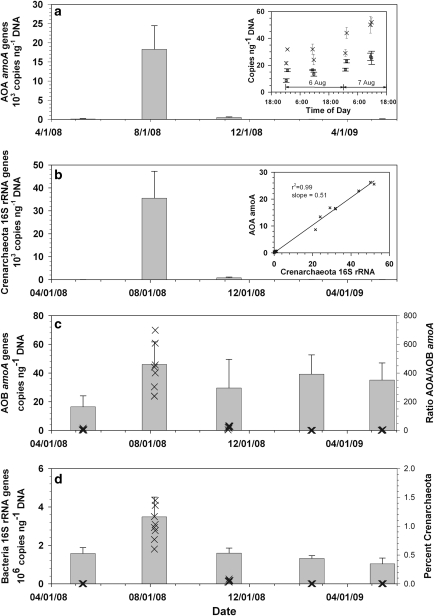
Figure 1
Figure 1
Time series of quantitative, real-time PCR (qPCR) estimates of the abundance of amoA and 16S rRNA genes at the sampling site. Means (wide bars) and s.d.'s (vertical lines) of eight samples collected over 2-day periods are shown. In some cases, the bars are smaller than the abcissa. (a) Archaeal amoA genes. Inset shows the time series of changes in amoA (□) and Crenarchaeota 16S rRNA (X) gene abundance on 6–7 August. Vertical bars are s.d.'s of triplicate qPCR determinations for each sample. (b) Marine Group 1 Crenarchaeota 16S rRNA gene abundance. Inset shows Archaeal amoA versus Crenarchaeota 16S rRNA gene abundance for each sample (regression line slope=0.51, r2=0.99). (c) Bacterial amoA gene abundance. Crosses show the ratio of Archaeal amoA to Bacterial amoA for each sample. (d) Bacteria 16S rRNA gene abundance. Crosses show the relative abundance of Crenarchaeota as a percentage of the prokaryotes (Bacteria + Crenarchaeota) in each sample assuming a gene dosage of 1 16S rRNA gene per genome for Marine Group 1 Crenarchaeota (from genomes annotated in DOE's IMG database) and 1.8 16S rRNA genes per genome as an average for marine bacteria (Biers et al., 2009).
Figure 2
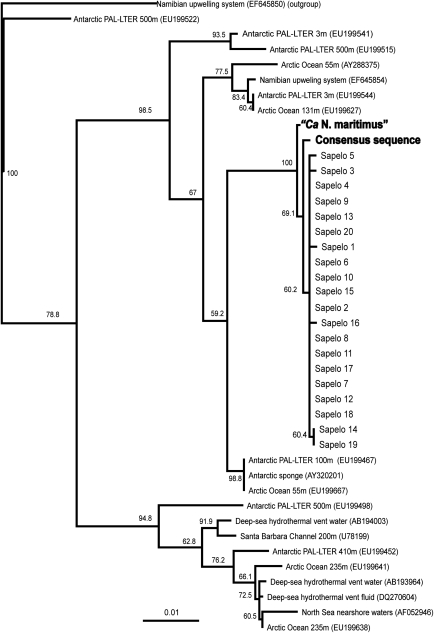
Figure 2
Phylogenetic analysis of the marine group 1 Crenarchaeota 16S rRNA sequences. The consensus sequence (bold) was obtained by assembling MG1C 16S rRNA reads contaminating the metatranscriptome. Sequences labeled ‘Sapelo' are from cloned PCR amplicons produced with DNA from the same sample. The 16S rRNA gene sequence for ‘Candidatus Nitrosopumilus maritimus' strain SCM1 (Nmar_R0029, DQ085097) is shown in Bold. GenBank accession numbers for reference sequences are given in parentheses. This is a neighbor-joining tree based on 876 nt. Bootstrap analysis was used to estimate the reliability of phylogenetic reconstructions and support is shown if >50% (100 iterations).
Figure 3
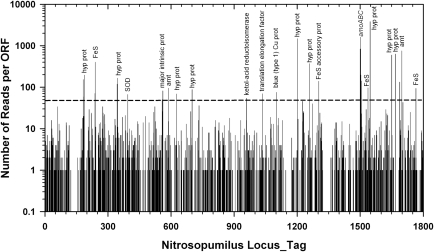
Figure 3
Distribution of pyrosequencing reads among Nitrosopumilus ORFs. The horizontal line is positioned at 50 hits per ORF and indicates the cutoff used to define highly expressed ORFs. Text over the longest bars identifies the annotation for that ORF: amoABC, ammonia monooxygenase subunits; amt, ammonium transporter; FeS, 4Fe–4S ferredoxin iron-sulfur binding domain-containing protein; FeS accessory protein, iron–sulfur cluster assembly accessory protein; hyp prot, hypothetical protein; SOD, superoxide dismutase; see Table 2 and Supplementary Tables 3 and 4 for a complete list.
Figure 4
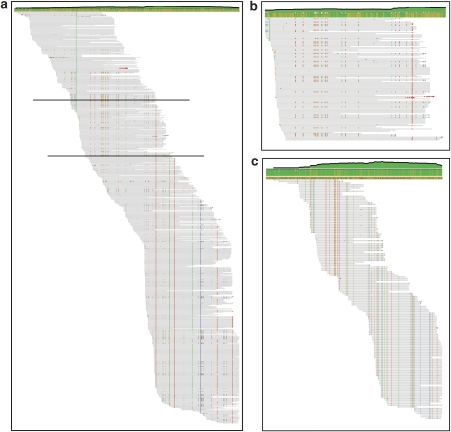
Figure 4
Assembly of 836 of 836 reads assigned to the ‘Ca. N. maritimus' strain SCM1 amoA ORF (Nmar_1500) against the Nmar_1500 sequence as a scaffold. (a) Coverage curve and assembly. (b). Close-up of a portion of the assembly (region between horizontal lines in a) showing primary and secondary sequence variants. (c) Assembly of 147 minority sequence variants. Objects from top to bottom: coverage curve (green shape, 0–558); identity at each position (green and olive bar, 0–100%), reference sequence (not shown in panel b), aligned reads. Highlighted positions in the aligned reads indicate disagreements with the reference sequence (code: red—A, blue—C, orange—G, green—T).
Figure 5
Figure 5
Phylogenetic analysis of marine group 1 Crenarchaeota amoA sequences in metatranscriptome and DNA samples. Consensus sequences (bold italics, 1=dominant, 2=minority) were obtained by assembling 16S amoA reads in the metatranscriptome. Sequences labeled ‘Sapelo' are from cloned PCR amplicons produced with DNA from the same sample. Sequences were aligned with reference sequences using Clustal W. Minimum evolutionary distances were calculated using the Kimura two-parameter model. The ‘Candidatus Nitrosopumilus maritimus' strain SCM1 sequence (Nmar_1500, ABX13396). GenBank accession numbers of reference sequences are given in parentheses. This is a neighbor-joining tree based on 595 nt. Bootstrap analysis was used to estimate the reliability of phylogenetic reconstructions and support is shown if >50% (100 iterations).

References

    1. Agogue H, Brink M, Dinasquet J, Herndl GJ. Major gradients in putatively nitrifying and non-nitrifying Archaea in the deep North Atlantic. Nature. 2008;456:788–791. - PubMed
    1. Altschul SF, Madden TL, Schaffer AA, Zhang J, Zhang Z, Miller W, et al. Gapped BLAST and PSI-BLAST: a new generation of protein database search programs. Nucleic Acids Res. 1997;25:3389–3402. - PMC - PubMed
    1. Bartossek R, Nicol GW, Lanzen A, Klenk H-P, Schleper C. Homologues of nitrite reductases in ammonia-oxidizing archaea: diversity and genomic context. Environ Microbiol. 2010;12:1075–1088. - PubMed
    1. Beman JM, Francis CA. Diversity of ammonia-oxidizing Archaea and Bacteria in the sediments of a hypernutrified subtropical estuary: Bahia del Tobari, Mexico. Appl Environ Microbiol. 2006;72:7767–7777. - PMC - PubMed
    1. Beman JM, Popp BN, Francis CA. Molecular and biogeochemical evidence for ammonia oxidation by marine Crenarchaeota in the Gulf of California. ISME J. 2008;2:429–441. - PubMed

Publication types