Pneumolysin activates the NLRP3 inflammasome and promotes proinflammatory cytokines independently of TLR4
- PMID: 21085613
- PMCID: PMC2978728
- DOI: 10.1371/journal.ppat.1001191
Pneumolysin activates the NLRP3 inflammasome and promotes proinflammatory cytokines independently of TLR4
Abstract
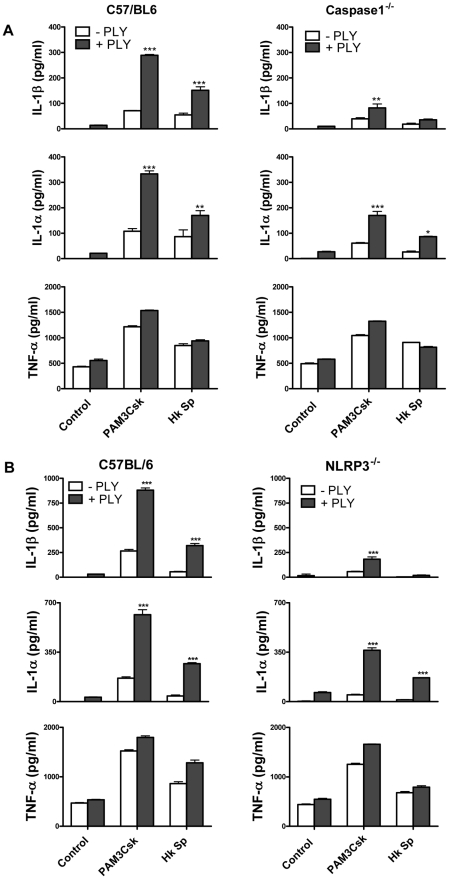
Pneumolysin (PLY) is a key Streptococcus pneumoniae virulence factor and potential candidate for inclusion in pneumococcal subunit vaccines. Dendritic cells (DC) play a key role in the initiation and instruction of adaptive immunity, but the effects of PLY on DC have not been widely investigated. Endotoxin-free PLY enhanced costimulatory molecule expression on DC but did not induce cytokine secretion. These effects have functional significance as adoptive transfer of DC exposed to PLY and antigen resulted in stronger antigen-specific T cell proliferation than transfer of DC exposed to antigen alone. PLY synergized with TLR agonists to enhance secretion of the proinflammatory cytokines IL-12, IL-23, IL-6, IL-1β, IL-1α and TNF-α by DC and enhanced cytokines including IL-17A and IFN-γ by splenocytes. PLY-induced DC maturation and cytokine secretion by DC and splenocytes was TLR4-independent. Both IL-17A and IFN-γ are required for protective immunity to pneumococcal infection and intranasal infection of mice with PLY-deficient pneumococci induced significantly less IFN-γ and IL-17A in the lungs compared to infection with wild-type bacteria. IL-1β plays a key role in promoting IL-17A and was previously shown to mediate protection against pneumococcal infection. The enhancement of IL-1β secretion by whole live S. pneumoniae and by PLY in DC required NLRP3, identifying PLY as a novel NLRP3 inflammasome activator. Furthermore, NLRP3 was required for protective immunity against respiratory infection with S. pneumoniae. These results add significantly to our understanding of the interactions between PLY and the immune system.
Conflict of interest statement
The authors have declared that no competing interests exist.
Figures




Comment in
-
Pneumolysin: stimulating protection.Nat Rev Microbiol. 2011 Jan;9(1):4. doi: 10.1038/nrmicro2497. Nat Rev Microbiol. 2011. PMID: 21204310 No abstract available.
Similar articles
-
Critical roles of ASC inflammasomes in caspase-1 activation and host innate resistance to Streptococcus pneumoniae infection.J Immunol. 2011 Nov 1;187(9):4890-9. doi: 10.4049/jimmunol.1100381. Epub 2011 Sep 28. J Immunol. 2011. PMID: 21957143 Free PMC article.
-
Expression of Toll-Like Receptor 2 by Dendritic Cells Is Essential for the DnaJ-ΔA146Ply-Mediated Th1 Immune Response against Streptococcus pneumoniae.Infect Immun. 2018 Feb 20;86(3):e00651-17. doi: 10.1128/IAI.00651-17. Print 2018 Mar. Infect Immun. 2018. PMID: 29229733 Free PMC article.
-
Detoxified pneumolysin derivative Plym2 directly protects against pneumococcal infection via induction of inflammatory cytokines.Immunol Invest. 2014;43(7):717-26. doi: 10.3109/08820139.2014.930478. Epub 2014 Jul 14. Immunol Invest. 2014. PMID: 25020076
-
Pneumolysin activates macrophage lysosomal membrane permeabilization and executes apoptosis by distinct mechanisms without membrane pore formation.mBio. 2014 Oct 7;5(5):e01710-14. doi: 10.1128/mBio.01710-14. mBio. 2014. PMID: 25293758 Free PMC article.
-
Mucosal immunization with recombinant fusion protein DnaJ-ΔA146Ply enhances cross-protective immunity against Streptococcus pneumoniae infection in mice via interleukin 17A.Infect Immun. 2014 Apr;82(4):1666-75. doi: 10.1128/IAI.01391-13. Epub 2014 Feb 3. Infect Immun. 2014. PMID: 24491576 Free PMC article.
Cited by
-
ADP-ribosylation of NLRP3 by Mycoplasma pneumoniae CARDS toxin regulates inflammasome activity.mBio. 2014 Dec 23;5(6):e02186-14. doi: 10.1128/mBio.02186-14. mBio. 2014. PMID: 25538194 Free PMC article.
-
The Role of Neutrophils and Neutrophil Elastase in Pneumococcal Pneumonia.Front Cell Infect Microbiol. 2021 Mar 16;11:615959. doi: 10.3389/fcimb.2021.615959. eCollection 2021. Front Cell Infect Microbiol. 2021. PMID: 33796475 Free PMC article. Review.
-
Peptidoglycan Branched Stem Peptides Contribute to Streptococcus pneumoniae Virulence by Inhibiting Pneumolysin Release.PLoS Pathog. 2015 Jun 26;11(6):e1004996. doi: 10.1371/journal.ppat.1004996. eCollection 2015 Jun. PLoS Pathog. 2015. PMID: 26114646 Free PMC article.
-
Host response and bacterial virulence factor expression in Pseudomonas aeruginosa and Streptococcus pneumoniae corneal ulcers.PLoS One. 2013 Jun 4;8(6):e64867. doi: 10.1371/journal.pone.0064867. Print 2013. PLoS One. 2013. PMID: 23750216 Free PMC article.
-
NLRP3 protects alveolar barrier integrity by an inflammasome-independent increase of epithelial cell adherence.Sci Rep. 2016 Aug 1;6:30943. doi: 10.1038/srep30943. Sci Rep. 2016. PMID: 27476670 Free PMC article.
References
-
- Canvin JR, Marvin AP, Sivakumaran M, Paton JC, Boulnois GJ, et al. The role of pneumolysin and autolysin in the pathology of pneumonia and septicemia in mice infected with a type 2 pneumococcus. J Infect Dis. 1995;172:119–123. - PubMed
Publication types
MeSH terms
Substances
Grants and funding
LinkOut - more resources
Full Text Sources
Other Literature Sources
Medical
Molecular Biology Databases
Research Materials