


Comparison of 18F- and 11C-labeled aryloxyanilide analogs to measure translocator protein in human brain using positron emission tomography
- PMID: 21085954
- PMCID: PMC3159870
- DOI: 10.1007/s00259-010-1622-y
Comparison of 18F- and 11C-labeled aryloxyanilide analogs to measure translocator protein in human brain using positron emission tomography
Abstract
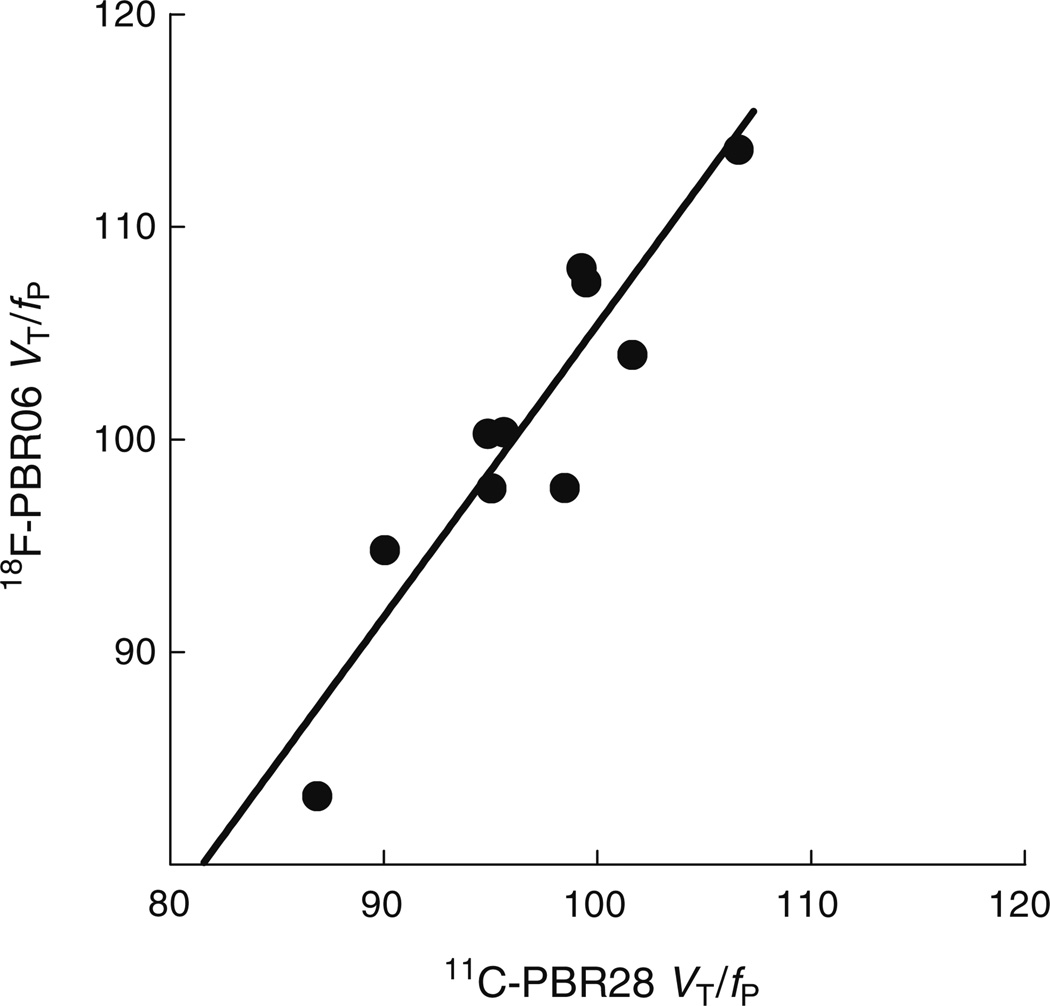
Purpose: Translocator protein (TSPO) is a promising biomarker for neuroinflammation. We developed two new PET ligands, (18)F-PBR06 and (11)C-PBR28, to image TSPOs. Although our prior studies suggest that either of the two ligands could be used to quantify TSPOs in human brain, the studies were done in different sets of subjects. In this study, we directly compared (18)F-PBR06 and (11)C-PBR28 in eight human subjects to determine (1) whether either ligand provides more precise measurements of TSPOs and (2) whether the higher in vitro affinity of PBR06 compared to PBR28 led to higher in vivo binding of (18)F-PBR06 compared to (11)C-PBR28.
Methods: In vivo binding was calculated as total distribution volume (V(T)), using an unconstrained two-tissue compartment model. V(T) was corrected for plasma free fraction (f (P)) to measure ligand binding based on free ligand concentration in brain.
Results: Both ligands measured V(T) with similar precision, as evidenced by similarly good identifiability. However, V(T) for both radioligands increased with increasing lengths of data acquisition, consistent with the accumulation of radiometabolites in brain. Despite its higher lipophilicity and higher in vitro affinity, V(T)/f(P) of (18)F-PBR06 was similar to that of (11)C-PBR28.
Conclusion: Both (18)F-PBR06 and (11)C-PBR28 are similar in terms of precision, sensitivity to accumulation of radiometabolites, and magnitude of in vivo binding. Thus, selection between the two radioligands will be primarily determined by the logistical impact of the different half-lives of the two radionuclides (110 vs 20 min).
Conflict of interest statement
Figures


References
-
- Papadopoulos V, Baraldi M, Guilarte TR, Knudsen TB, Lacapère JJ, Lindemann P, et al. Translocator protein (18 kDa): new nomenclature for the peripheral-type benzodiazepine receptor based on its structure and molecular function. Trends Pharmacol Sci. 2006;27:402–409. - PubMed
-
- Chauveau F, Boutin H, Van Camp N, Dollé F, Tavitian B. Nuclear imaging of neuroinflammation: a comprehensive review of [11C] PK11195 challengers. Eur J Nucl Med Mol Imaging. 2008;35:2304–2319. - PubMed
-
- Briard E, Zoghbi SS, Imaizumi M, Gourley JP, Shetty HU, Hong J, et al. Synthesis and evaluation in monkey of two sensitive 11C-labeled aryloxyanilide ligands for imaging brain peripheral benzodiazepine receptors in vivo. J Med Chem. 2008;51:17–30. - PubMed
Publication types
MeSH terms
Substances
Grants and funding
LinkOut - more resources
Full Text Sources
Other Literature Sources
