


Body mass index is associated with brain metabolite levels in alcohol dependence--a multimodal magnetic resonance study
- PMID: 21087290
- PMCID: PMC3058677
- DOI: 10.1111/j.1530-0277.2010.01305.x
Body mass index is associated with brain metabolite levels in alcohol dependence--a multimodal magnetic resonance study
Abstract
Background: Recent studies demonstrated that alcohol dependence and excessive alcohol consumption are associated with increased rates of obesity. In healthy light-drinkers, we and others have observed associations between elevated body mass index (BMI) and reductions in brain volumes, lower concentrations of N-acetyl-aspartate (NAA, marker of neuronal viability) and choline-containing compounds (Cho, involved in membrane turnover), and lower glucose utilization, particularly in frontal lobe-a brain region that is particularly vulnerable to the effects of alcohol dependence. Here, we evaluated whether BMI in alcohol-dependent individuals was independently associated with regional measures of brain structure, metabolite concentrations, and neocortical blood flow.
Methods: As part of a study on the effects of alcohol dependence on neurobiology, we analyzed retrospectively data from 54 alcohol-dependent males, abstinent from alcohol for about 1 month and with BMI between 20 and 37 kg/m(2) by structural MRI, perfusion MRI (blood flow), and proton magnetic resonance spectroscopic imaging.
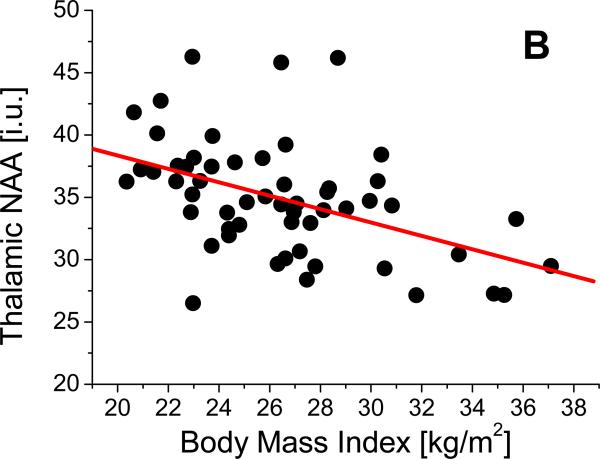
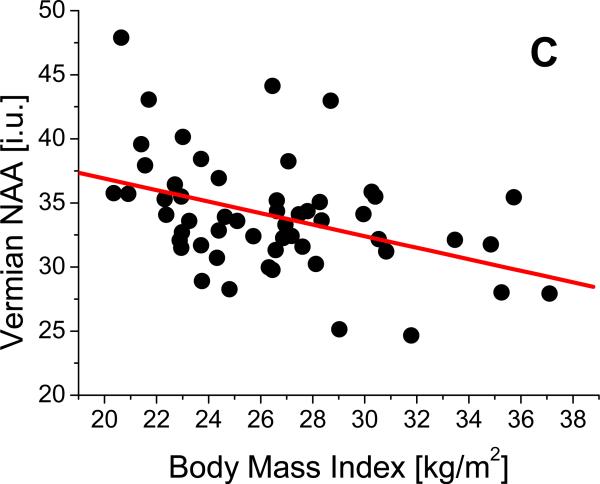
Results: After correction for age, smoking status, and various measures of alcohol consumption, higher BMI was associated with lower concentrations of NAA, Cho, creatine and phosphocreatine (Cr, involved in high energy metabolism), and myo-inositol (m-Ino, a putative marker of astrocytes) primarily in the frontal lobe, in subcortical nuclei, and cerebellar vermis (p < 0.004). Regional brain volumes and perfusion were not significantly related to BMI. Furthermore, comorbid conditions, clinical laboratory measures, and nutritional assessments were not significant predictors of these MR-based measures.
Conclusions: The results suggest that BMI, independent of age, alcohol consumption, and common comorbidities, is related to regional NAA, Cho, Cr, and m-Ino concentrations in this cohort of alcohol-dependent individuals. Additionally, as some common comorbid conditions in alcohol dependence such as cigarette smoking are associated with BMI, their associations with regional brain metabolite levels in alcohol-dependent individuals may also be influenced by BMI.
Copyright © 2010 by the Research Society on Alcoholism.
Figures



References
-
- Addolorato G, Capristo E, Caputo F, Greco AV, Ceccanti M, Stefanini GF, Gasbarrini G. Nutritional status and body fluid distribution in chronic alcoholics compared with controls. Alcohol Clin Exp Res. 1999;23:1232–1237. - PubMed
-
- Baler RD, Volkow ND. Drug addiction: the neurobiology of disrupted self-control. Trends Mol Med. 2006;12:559–566. - PubMed
-
- Bartsch AJ, Homola G, Biller A, Smith SM, Weijers HG, Wiesbeck GA, Jenkinson M, De Stefano N, Solymosi L, Bendszus M. Manifestations of early brain recovery associated with abstinence from alcoholism. Brain. 2007;130:36–47. - PubMed
-
- Baslow MH. N-acetylaspartate in the vertebrate brain: metabolism and function. Neurochem Res. 2003;28:941–953. - PubMed
-
- Bendszus M, Weijers HG, Wiesbeck G, Warmuth-Metz M, Bartsch AJ, Engels S, Boning J, Solymosi L. Sequential MR imaging and proton MR spectroscopy in patients who underwent recent detoxification for chronic alcoholism: correlation with clinical and neuropsychological data. AJNR Am J Neuroradiol. 2001;22:1926–1932. - PMC - PubMed
Publication types
MeSH terms
Substances
Grants and funding
LinkOut - more resources
Full Text Sources
Medical
Research Materials
