. 2010 Nov 18:10:357.
doi: 10.1186/1471-2148-10-357.

Predicting genome-wide redundancy using machine learning

Affiliations

Predicting genome-wide redundancy using machine learning

Huang-Wen Chen et al. BMC Evol Biol. .

Abstract

Background: Gene duplication can lead to genetic redundancy, which masks the function of mutated genes in genetic analyses. Methods to increase sensitivity in identifying genetic redundancy can improve the efficiency of reverse genetics and lend insights into the evolutionary outcomes of gene duplication. Machine learning techniques are well suited to classifying gene family members into redundant and non-redundant gene pairs in model species where sufficient genetic and genomic data is available, such as Arabidopsis thaliana, the test case used here.

Results: Machine learning techniques that combine multiple attributes led to a dramatic improvement in predicting genetic redundancy over single trait classifiers alone, such as BLAST E-values or expression correlation. In withholding analysis, one of the methods used here, Support Vector Machines, was two-fold more precise than single attribute classifiers, reaching a level where the majority of redundant calls were correctly labeled. Using this higher confidence in identifying redundancy, machine learning predicts that about half of all genes in Arabidopsis showed the signature of predicted redundancy with at least one but typically less than three other family members. Interestingly, a large proportion of predicted redundant gene pairs were relatively old duplications (e.g., Ks > 1), suggesting that redundancy is stable over long evolutionary periods.

Conclusions: Machine learning predicts that most genes will have a functionally redundant paralog but will exhibit redundancy with relatively few genes within a family. The predictions and gene pair attributes for Arabidopsis provide a new resource for research in genetics and genome evolution. These techniques can now be applied to other organisms.


Figures
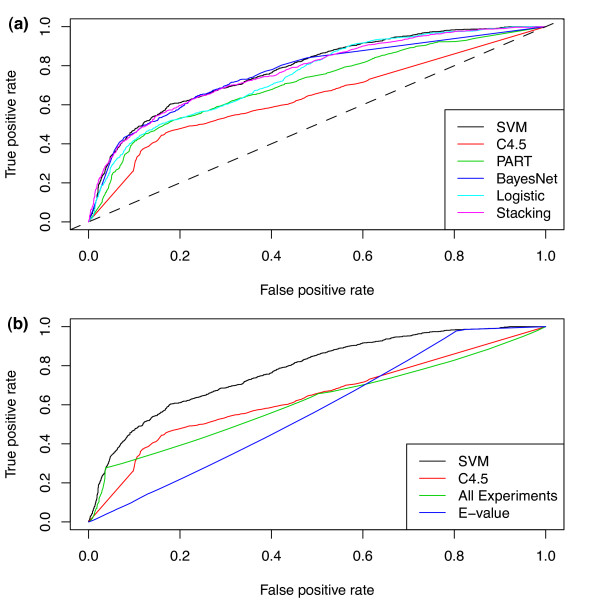
Figure 1
Figure 1
Performance analysis of machine learning and single attribute classifiers. Receiver Operating Characteristic (ROC) curve for comparing (A) 5 different machine learning algorithms and one meta-algorithm (StackingC); The hashed diagonal line is the performance of a simple betting classifier, which represents probabilistic classification based on the frequency of positive and negative cases in the training set. (B) single-attribute classifiers using correlation of gene pairs across all microarray experiments (All Experiments) and BLAST E-values.
Figure 2
Figure 2
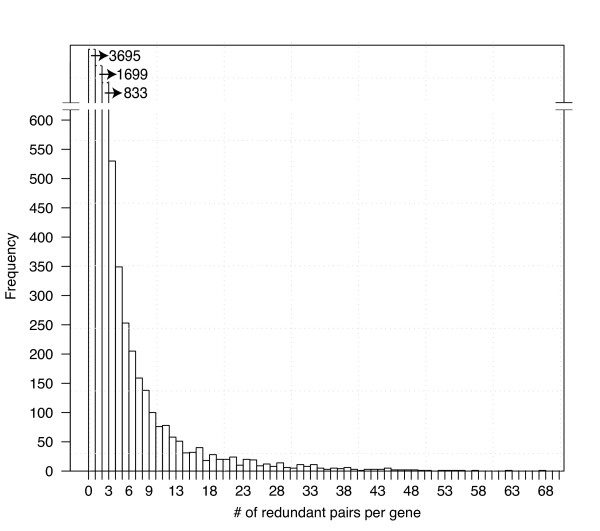
The predicted depth of redundancy genome-wide. Genes are grouped into bins based on the number of paralogs with which they are predicted to be redundant. The first bin represents the number of genes that were predicted to have exactly one redundant paralog, using the cutoff of 0.4. The frequency distribution shows that most genes have relatively few predicted redundant duplicates.
Figure 3
Figure 3
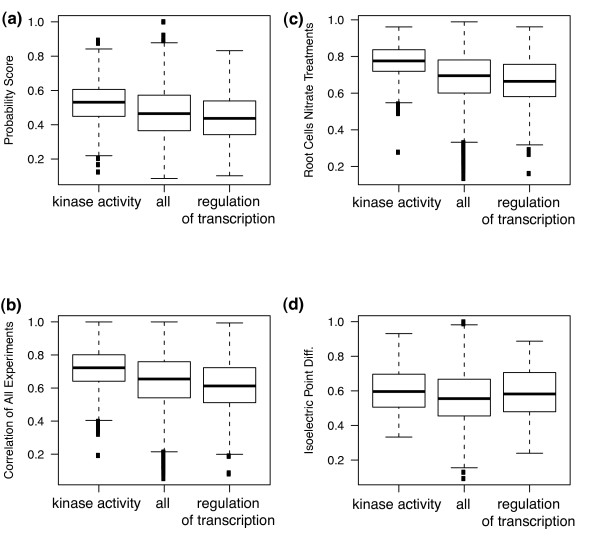
Trends in redundancy predictions and attributes in different functional categories. Box and whisker plots show landmarks in the distribution of values, where the horizontal line represents the median value, the bottom and top of the box represent the 25th and 75th percentile values, respectively, and the whisker line represents the most extreme value that is within 1.5 interquartile range from the box. Points outside the whisker represent more extreme outliers. The category "all" represents all genes in the large size class (see text) and is used as a background distribution. The two other categories represent genes in the GO functional category named.

References

    1. Blanc G, Wolfe KH. Widespread paleopolyploidy in model plant species inferred from age distributions of duplicate genes. Plant Cell. 2004;16:1667–1678. doi: 10.1105/tpc.021345. - DOI - PMC - PubMed
    1. Briggs GC, Osmont KS, Shindo C, Sibout R, Hardtke CS. Unequal genetic redundancies in Arabidopsis--a neglected phenomenon? Trends Plant Sci. 2006;11:492–498. doi: 10.1016/j.tplants.2006.08.005. - DOI - PubMed
    1. Fawcett JA, Maere S, Van de Peer Y. Plants with double genomes might have had a better chance to survive the Cretaceous-Tertiary extinction event. P Natl Acad Sci USA. 2009;106:5737–5742. doi: 10.1073/pnas.0900906106. - DOI - PMC - PubMed
    1. Van de Peer Y, Fawcett JA, Proost S, Sterck L, Vandepoele K. The flowering world: a tale of duplications. Trends in Plant Science. 2009;14:680–688. doi: 10.1016/j.tplants.2009.09.001. - DOI - PubMed
    1. Cutler S, McCourt P. Dude, where's my phenotype? Dealing with redundancy in signaling networks. Plant Physiol. 2005;138:558–559. doi: 10.1104/pp.104.900152. - DOI - PMC - PubMed

Publication types