. 2010 Dec 7;107(49):21193-8.
doi: 10.1073/pnas.1000191107. Epub 2010 Nov 18.

Ca2+ signaling by plant Arabidopsis thaliana Pep peptides depends on AtPepR1, a receptor with guanylyl cyclase activity, and cGMP-activated Ca2+ channels

Affiliations

Ca2+ signaling by plant Arabidopsis thaliana Pep peptides depends on AtPepR1, a receptor with guanylyl cyclase activity, and cGMP-activated Ca2+ channels

Zhi Qi et al. Proc Natl Acad Sci U S A. .

Abstract

A family of peptide signaling molecules (AtPeps) and their plasma membrane receptor AtPepR1 are known to act in pathogen-defense signaling cascades in plants. Little is currently known about the molecular mechanisms that link these signaling peptides and their receptor, a leucine-rich repeat receptor-like kinase, to downstream pathogen-defense responses. We identify some cellular activities of these molecules that provide the context for a model for their action in signaling cascades. AtPeps activate plasma membrane inwardly conducting Ca(2+) permeable channels in mesophyll cells, resulting in cytosolic Ca(2+) elevation. This activity is dependent on their receptor as well as a cyclic nucleotide-gated channel (CNGC2). We also show that the leucine-rich repeat receptor-like kinase receptor AtPepR1 has guanylyl cyclase activity, generating cGMP from GTP, and that cGMP can activate CNGC2-dependent cytosolic Ca(2+) elevation. AtPep-dependent expression of pathogen-defense genes (PDF1.2, MPK3, and WRKY33) is mediated by the Ca(2+) signaling pathway associated with AtPep peptides and their receptor. The work presented here indicates that extracellular AtPeps, which can act as danger-associated molecular patterns, signal by interaction with their receptor, AtPepR1, a plasma membrane protein that can generate cGMP. Downstream from AtPep and AtPepR1 in a signaling cascade, the cGMP-activated channel CNGC2 is involved in AtPep- and AtPepR1-dependent inward Ca(2+) conductance and resulting cytosolic Ca(2+) elevation. The signaling cascade initiated by AtPeps leads to expression of pathogen-defense genes in a Ca(2+)-dependent manner.


Conflict of interest statement

The authors declare no conflict of interest.

Figures
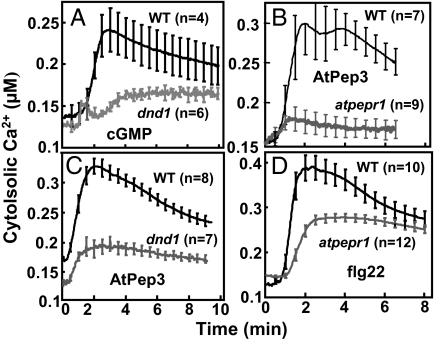
Fig. 1.
Fig. 1.
Ligand-induced cytosolic Ca2+ elevation in leaves of aequorin-expressing Arabidopsis plants. Ligand was added at time 0 to wild-type (WT; darker lines) or mutant (lighter lines) plants as noted in A–D. (A) A lipophilic analog of cGMP. (B) AtPep3. (C) AtPep3. (D) flg22. The signals shown are averages generated from biological replicates (replicate numbers are in parentheses); leaves for each replicate were taken from different plants. At 0.5-min time intervals, SE was calculated for each mean; SE values are portrayed as error bars. Results similar to those shown here are presented in Fig. 4A and Figs. S6 and S7 for whole leaves or roots of various genotypes of aequorin-expressing Arabidopsis plants. The experimental design, analysis, and presentation of the work shown in these other figures are similar to that shown here.
Fig. 2.
Fig. 2.
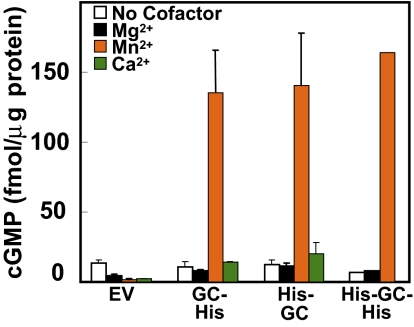
Affinity-purified AtPepR1-GC has GC activity. Details of AtPepR1-GC cloning, expression in E. coli, purification, and use with cGMP ELISAs can be found in SI Materials and Methods. GC assays were performed on empty vector protein (EV) or with protein affinity-purified from E. coli transfected with the cloned AtPepR1-GC region coding sequence expressed with a six-His tag fused to either the carboxyl terminus (GC-His), the amino terminus (His-GC), or both ends of the protein (His-GC-His). GC assays were performed in the absence of any added cofactor (no cofactor) or with 5 mM Mg2+, Mn2+, or Ca2+ added to the assay. Results from several different experiments are shown in this figure. An individual experiment represented assays from different E. coli genotypes (with different assay cofactor additions as noted in the figure) performed in parallel. For an individual experiment, 3–4 replicate measurements of cGMP production were made (i.e., three to four wells of an ELISA plate). These replicates were averaged to yield one value of cGMP production for a given genotype and assay condition for an experiment. Results are shown in the figure for three different experiments (i.e., individual evaluations of cGMP generation using three different ELISA plates) for cultures expressing GC-His and His-GC; means of cGMP values obtained in the three experiments are shown ±SE. In the case of His-GC-His protein, only one experiment (using one ELISA plate) was performed, and the four measurements were averaged to generate one replicate; no SE bars are shown for this genotype.
Fig. 3.
Fig. 3.
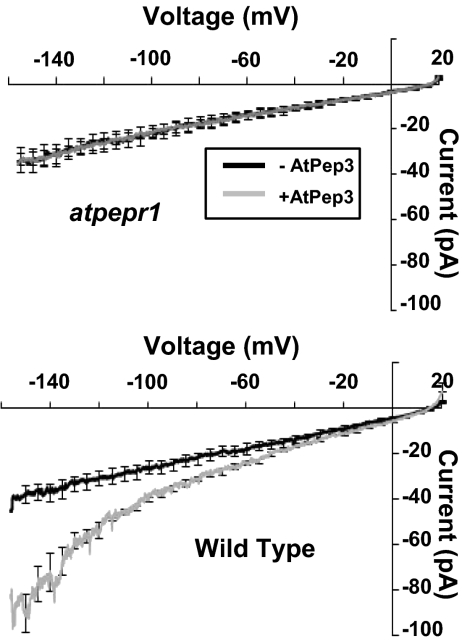
Patch clamp recordings from mesophyll protoplasts isolated from leaves of WT and atpepr1 mutant plants show an AtPepR1-dependent activation of an inwardly rectified Ca2+-conducting plasma membrane channel by AtPep3. Ramp recordings (whole-cell configuration) made in the presence (gray lines) and absence (black lines) of 200 nM AtPep3 are shown for mesophyll protoplasts isolated from leaves of WT and atpepr1 mutant plants. Results shown are mean current values calculated from multiple recordings made from WT (n = 6) and atpepr1 mutant (n = 5) protoplasts. The multiple recordings used to generate the mean values shown here are biological replications; individual recordings were made from different protoplast preparations. Results are presented as means with SE calculated at 5-mV intervals. As is convention (20), Ba2+ was used as a charge carrier to monitor Ca2+-conducting channels. In the pipette and bath solutions used, the Ba2+, Cl, and K+ Nernst equilibrium potentials (EBa, ECl, and EK; after correcting for ion activities) (24) are calculated to be +26, −31, and −75 mV, respectively. The reversal potential for the WT protoplasts in the presence of AtPep3 ligand was +20 mV; this value is close to EBa and distant from ECl and EK, indicating that the charge was primarily carried by Ba2+. The addition of AtPep3 increased inward current at hyperpolarizing membrane potentials with WT protoplasts; no effect of the ligand was observed on currents recorded from atpepr1 protoplasts.
Fig. 4.
Fig. 4.
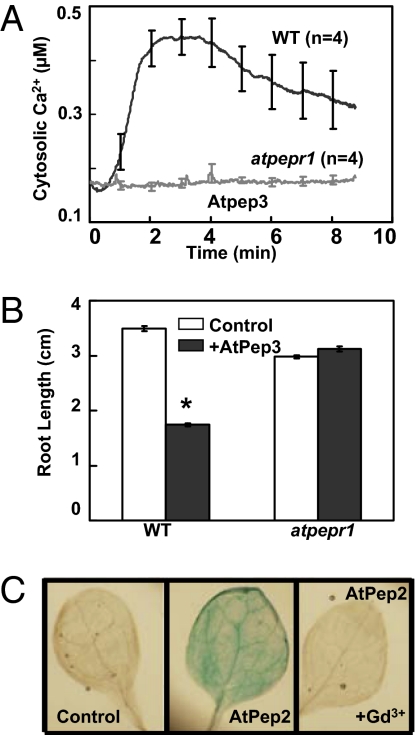
AtPep ligand and AtPepR1 receptor effects on root growth and pathogen-defense gene activation are associated with Ca2+ signaling. (A) AtPep3 (20 nM) application to Arabidopsis roots results in AtPepR1-dependent cytosolic Ca2+ elevation in a manner similar to that occurring in leaves (Fig. 1B). (B) Root length of WT and atpepr1 mutant (7-d-old) seedlings grown (on solid agar medium) in the absence (open bars) and presence (filled bars) of 20 nM AtPep3. An asterisk above a filled bar indicates that the mean (n = 10) root length of seedlings of the specific genotype (WT or atpepr1) was significantly different (P ≤ 0.01) when seedlings were grown in the presence and absence of AtPep3. (C) AtPep2 effects on PDF1.2::GUS expression in the absence and presence of the Ca2+ channel blocker Gd3+ (2 mM).

Comment in

  • Guanylyl cyclase activity in plants?
    Ashton AR. Ashton AR. Proc Natl Acad Sci U S A. 2011 May 10;108(19):E96; author reply E97-8. doi: 10.1073/pnas.1101007108. Epub 2011 Apr 28. Proc Natl Acad Sci U S A. 2011. PMID: 21527716 Free PMC article. No abstract available.

References

    1. Baryshnikov SG, Pulina MV, Zulian A, Linde CI, Golovina VA. Orai1, a critical component of store-operated Ca2+ entry, is functionally associated with Na+/Ca2+ exchanger and plasma membrane Ca2+ pump in proliferating human arterial myocytes. Am J Physiol Cell Physiol. 2009;297:C1103–C1112. - PMC - PubMed
    1. Feske S, et al. A mutation in Orai1 causes immune deficiency by abrogating CRAC channel function. Nature. 2006;441:179–185. - PubMed
    1. Interlandi J. An immune portal. Sci Am. 2006;295:20–23. - PubMed
    1. Ali R, et al. Death don't have no mercy and neither does calcium: Arabidopsis cyclic nucleotide gated channel 2 and innate immunity. Plant Cell. 2007;19:1081–1095. - PMC - PubMed
    1. Kaplan B, Sherman T, Fromm H. Cyclic nucleotide-gated channels in plants. FEBS Lett. 2007;581:2237–2246. - PubMed

Publication types

MeSH terms