Microvolt T-wave alternans in end-stage renal disease patients--associations with uremic cardiomyopathy
- PMID: 21088291
- PMCID: PMC3082409
- DOI: 10.2215/CJN.06370710
Microvolt T-wave alternans in end-stage renal disease patients--associations with uremic cardiomyopathy
Abstract
Background and objectives: Premature cardiovascular (CV) events, especially sudden cardiac death, are common in ESRD patients and associated with uremic cardiomyopathy. Identification of high-risk patients is difficult. Microvolt T-wave alternans (MTWA) is a noninvasive method of detecting variability in electrocardiogram (ECG) T-wave morphology and is a promising technique for identifying patients at high risk of ventricular tachyarrhythmias. MTWA results of ESRD and hypertensive left ventricular hypertrophy (LVH) patients were assessed to determine the prevalence of abnormal results and associations with uremic cardiomyopathy.
Design, setting, participants, & measurements: In this single-center observational study, 200 ESRD and 30 LVH patients underwent assessment including CV history, ECG, cardiac magnetic resonance imaging, and an MTWA exercise test. MTWA results were classified as "negative" or "abnormal" on the basis of previously published reports.
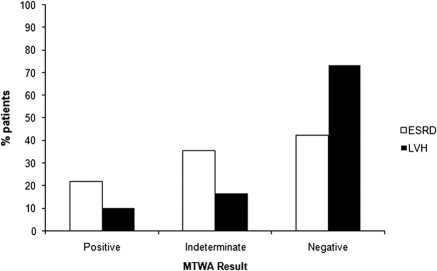
Results: An abnormal MTWA result was more common in ESRD compared with LVH patients (57.5% versus 26.7%, respectively; P = 0.002). In ESRD patients, MTWA was significantly associated with uremic cardiomyopathy, clinical history of atherosclerosis (coronary, cerebral, peripheral) and diabetes mellitus, older age, and hemodialysis therapy. Independent associations with an abnormal MTWA result were older age, macrovascular disease, increased left ventricle (LV) mass, and LV dilation.
Conclusions: Features of uremic cardiomyopathy are associated with an abnormal MTWA result.
Figures
References
-
- U.S. Renal Data System: USRDS 2009 Annual Data Report: Atlas of Chronic Kidney Disease and End-Stage Renal Disease in the United States, Bethesda, MD, National Institute of Health, National Institute of Diabetes and Digestive and Kidney Disease, 2009
-
- Parfrey PS, Foley RN, Harnett JD, Kent GM, Murray DC, Barre PE: Outcome and risk factors for left ventricular disorders in chronic uraemia. Nephrol Dial Transplant 11: 1277–1285, 1996 - PubMed
-
- Bleyer AJ, Russell GB, Satko SG: Sudden and cardiac death rates in hemodialysis patients. Kidney Int 55: 1553–1559, 1999 - PubMed
-
- Zoccali C, Mallamaci F, Tripepi G, Parlongo S, Cutrupi S, Benedetto FA, Cataliotti A, Malatino LS: Norepinephrine and concentric hypertrophy in patients with end-stage renal disease. Hypertension 40: 41–46, 2002 - PubMed
Publication types
MeSH terms
Grants and funding
LinkOut - more resources
Full Text Sources
Medical