


REST and CoREST are transcriptional and epigenetic regulators of seminal neural fate decisions
- PMID: 21088488
- PMCID: PMC3048046
- DOI: 10.4161/cc.9.22.13973
REST and CoREST are transcriptional and epigenetic regulators of seminal neural fate decisions
Abstract
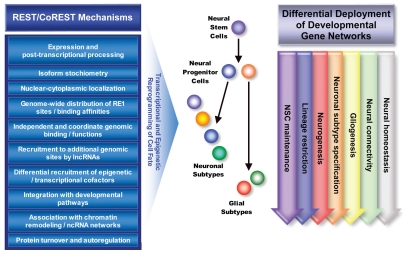
Complementary transcriptional and epigenetic regulatory factors (e.g., histone and chromatin modifying enzymes and non-coding RNAs) regulate genes responsible for mediating neural stem cell maintenance and lineage restriction, neuronal and glial lineage specification, and progressive stages of lineage maturation. However, an overall understanding of the mechanisms that sense and integrate developmental signals at the genomic level and control cell type-specific gene network deployment has not emerged. REST and CoREST are central players in the transcriptional and epigenetic regulatory circuitry that is responsible for modulating neural genes, and they have been implicated in establishing cell identity and function, both within the nervous system and beyond it. Herein, we discuss the emerging context-specific roles of REST and CoREST and highlight our recent studies aimed at elucidating their neural developmental cell type- and stage-specific actions. These observations support the conclusion that REST and CoREST act as master regulators of key neural cell fate decisions.
Figures
References
-
- Chong JA, Tapia-Ramirez J, Kim S, Toledo-Aral JJ, Zheng Y, Boutros MC, et al. REST: A mammalian silencer protein that restricts sodium channel gene expression to neurons. Cell. 1995;80:949–957. - PubMed
-
- Schoenherr CJ, Anderson DJ. The neuron-restrictive silencer factor (NRSF): A coordinate repressor of multiple neuron-specific gene. Science. 1995;267:1360–1363. - PubMed
-
- Shimojo M. Characterization of the nuclear targeting signal of REST/NRSF. Neurosci Lett. 2006;398:161–166. - PubMed
Publication types
MeSH terms
Substances
Grants and funding
LinkOut - more resources
Full Text Sources
Other Literature Sources
