


Hip circumference and incident metabolic risk factors in Chinese men and women: the People's Republic of China study
- PMID: 21091063
- PMCID: PMC3125562
- DOI: 10.1089/met.2010.0045
Hip circumference and incident metabolic risk factors in Chinese men and women: the People's Republic of China study
Abstract
Background: The associations between adiposity and metabolic risk factors have been suggested to vary across ethnicities. Studies in Caucasians have shown that after adjusting for waist circumference and body mass index (BMI), a larger hip circumference may be protective for metabolic risk factors. To our knowledge, these associations have never been examined in a Chinese population.
Methods: Baseline (1987-1988) and follow-up (1993-1994) data were from the People's Republic of China Study (n = 1,144 men, n = 1,776 women). Logistic models were stratified by sex and adjusted for age, smoking, center, and education. Incidence differences (ID) comparing the sex specific 85(th) percentile to the 15(th) percentile of hip circumference were computed for elevated blood pressure, blood glucose and triglycerides, low high-density lipoprotein cholesterol (HDL-C), and multiple metabolic abnormalities (three or more of the aforementioned).
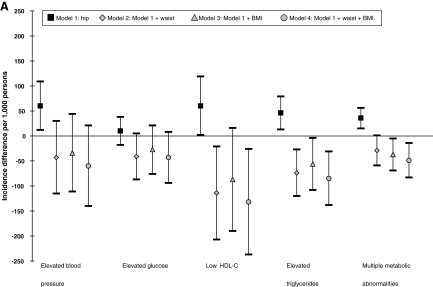
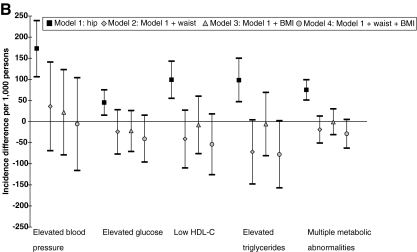
Results: In models adjusted for waist circumference and BMI, the ID [95% confidence interval (CI)] per 1,000 persons associated with a 12-cm larger hip were -132 (-237, -26) for low HDL-C; -85 (-138, -31) for elevated triglycerides; and -49 (-83, -4) for multiple metabolic abnormalities. In males, a larger hip circumference was not associated with a reduction of incident risk factors, although the ID tended to be negative.
Conclusions: In Chinese women, greater mass in the lower trunk region was inversely associated with incident high triglycerides, low HDL-C, and multiple metabolic abnormalities when adjusted for general and central adiposity. This association was not detected in men. Additional research is needed to better understand the mechanisms by which fat at different depots results in differential risk.
Figures
References
-
- Westphal SA. Obesity, abdominal obesity, and insulin resistance. Clin Cornerstone. 2008;9:23–29. discussion 30–21. - PubMed
-
- Seidell JC. Kahn HS. Williamson DF. Lissner L. Valdez R. Report from a Centers for Disease Control and Prevention Workshop on use of adult anthropometry for public health and primary health care. Am J Clin Nutr. 2001;73:123–126. - PubMed
-
- Allison DB. Paultre F. Goran MI. Poehlman ET. Heymsfield SB. Statistical considerations regarding the use of ratios to adjust data. Int J Obes Relat Metab Disord. 1995;19:644–652. - PubMed
-
- Jiang C. Lei SF. Liu MY. Xiao SM. Chen XD. Deng FY. Xu H. Tan LJ. Yang YJ. Wang YB. Sun X. Guo YF. Guo JJ. Zhu XZ. Deng HW. Evaluating the correlation and prediction of trunk fat mass with five anthropometric indices in Chinese females aged 20–40 years. Nutr Metab Cardiovasc Dis. 2007;17:676–683. - PubMed
-
- Xiao SM. Lei SF. Chen XD. Liu MY. Jian WX. Xu H. Tan LJ. Deng FY. Yang YJ. Wang YB. Sun X. Jiang C. Guo YF. Guo JJ. Li YN. Jiang H. Zhu XZ. Deng HW. Correlation and prediction of trunk fat mass with four anthropometric indices in Chinese males. Br J Nutr. 2006;96:949–955. - PubMed
Publication types
MeSH terms
Grants and funding
LinkOut - more resources
Full Text Sources
Medical