. 2011 Oct 1;15(7):1779-88.
doi: 10.1089/ars.2010.3722. Epub 2011 Apr 11.

Reduced cardioprotective action of adiponectin in high-fat diet-induced type II diabetic mice and its underlying mechanisms

Affiliations

Reduced cardioprotective action of adiponectin in high-fat diet-induced type II diabetic mice and its underlying mechanisms

Wei Yi et al. Antioxid Redox Signal. .

Abstract

Diabetes exacerbates ischemic heart disease morbidity and mortality via incompletely understood mechanisms. Although adiponectin (APN) reduces myocardial ischemia/reperfusion (MI/R) injury in nondiabetic animals, whether APN's cardioprotective actions are altered in diabetes, a pathologic condition with endogenously reduced APN, has never been investigated. High-fat diet (HD)-induced diabetic mice and normal diet (ND) controls were subjected to MI via coronary artery ligation, and given vehicle or APN globular domain (gAPN, 2 μg/g) 10 min before reperfusion. Compared to ND mice (where gAPN exerted pronounced cardioprotection), HD mice manifested greater MI/R injury, and a tripled gAPN dose was requisite to achieve cardioprotective extent seen in ND mice (i.e., infarct size, apoptosis, and cardiac function). APN reduces MI/R injury via AMP-activated protein kinase (AMPK)-dependent metabolic regulation and AMPK-independent antioxidative/antinitrative pathways. Compared to ND, HD mice manifested significantly blunted gAPN-induced AMPK activation, basally and after MI/R (p<0.05). Although both low- and high-dose gAPN equally attenuated MI/R-induced oxidative stress (i.e., NADPH oxidase expression and superoxide production) and nitrative stress (i.e., inducible nitric oxide synthase expression, nitric oxide production, and peroxynitrite formation) in ND mice, only high-dose gAPN efficaciously did so in HD mice. We demonstrate for the first time that HD-induced diabetes diminished both AMPK-dependent and AMPK-independent APN cardioprotection, suggesting an unreported diabetic heart APN resistance.


Figures
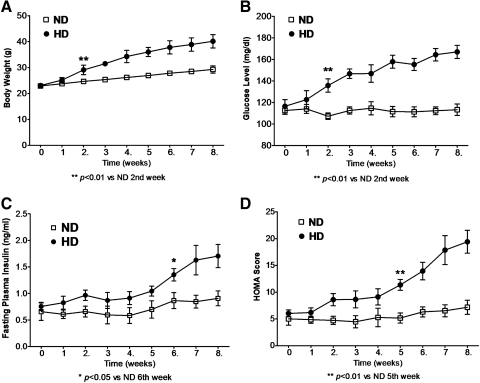
FIG. 1.
FIG. 1.
High-fat diet (HD) for 8 weeks induced type-2 diabetes model in mice. (A) Body weight. (B) Fasting plasma glucose. (C) Fasting plasma insulin determined by enzyme-linked immunosorbent assay. (D) Fasting Homeostatic Model Assessment (HOMA) score calculated by fasting plasma glucose and insulin. n = 10–13 mice per group. *p < 0.05, **p < 0.01 versus normal diet (ND) mice at the same time point.
FIG. 2.
FIG. 2.
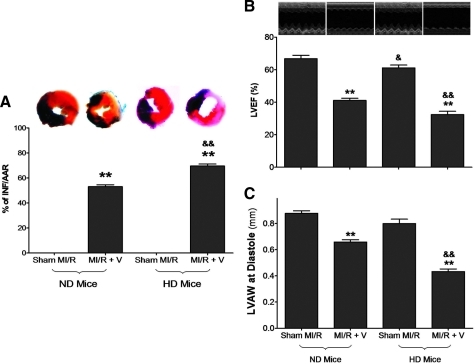
HD increased susceptibility of myocardial ischemia/reperfusion (MI/R) injury. (A) Myocardial infarction determined by Evans blue/2,3,5-triphenyl tetrazolium chloride double staining. (B) Left ventricular ejection fraction (LVEF) determined by echocardiography. (C) Left ventricular wall thickness (LVAW) determined by echocardiography. n = 10–13 mice per group. **p < 0.01 versus sham control in the same diet group; &p < 0.05, &&p < 0.01 between the different diet groups with the same treatment (i.e., sham MI/R or MI/R + V). (To see this illustration in color the reader is referred to the web version of this article at www.liebertonline.com/ars).
FIG. 3.
FIG. 3.
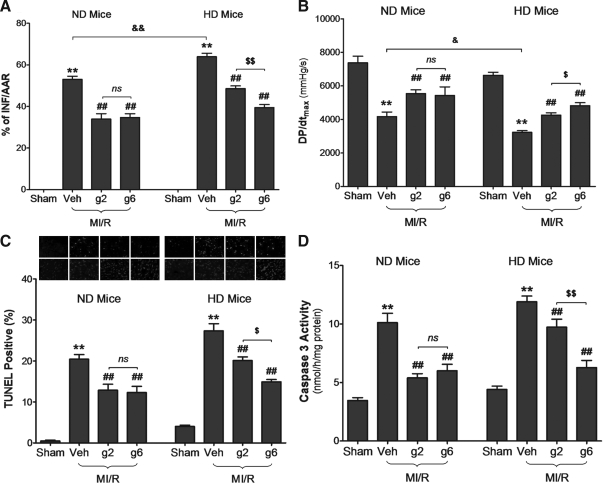
Cardioprotective effect of globular domain of adiponectin (gAPN) was attenuated in HD mice. (A) Myocardial infarction determined by Evans blue/2,3,5-triphenyl tetrazolium chloride double staining. (B) Left ventricular pressure (dP/dt) determined by hemodynamic measurements. (C) Cardiomyocyte apoptosis determined by terminal deoxynucleotidyl transferase-mediated dUTP nick-end labeling (TUNEL). (D) Caspase-3 activity. n = 10–13 mice per group. **p < 0.01 versus sham control in the same diet group; ##p < 0.01 versus vehicle-treated group in the same diet group; $p < 0.05, $$p < 0.01 versus low dose gAPN-treated animals in the same diet group; &p < 0.05, &&p < 0.01 between different diet groups with the same treatment; ns, no significant difference between compared groups.
FIG. 4.
FIG. 4.
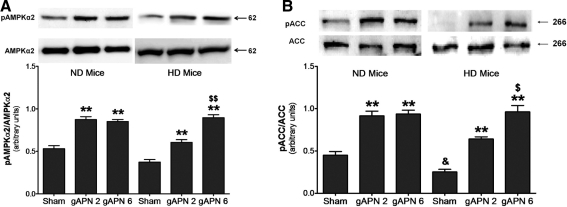
Reduced APN stimulated AMP-activated protein kinase (AMPK)/acetyl-CoA carboxylase (ACC) activation occurred in HD mice. (A) Effect of adiponectin treatment on AMPKα2 phosphorylation determined by representative Western blots. (B) Effect of adiponectin treatment on ACC phosphorylation determined by representative Western blots. n = 5–8 hearts per group. **p < 0.01 versus sham control in the same diet group; $p < 0.05, $$p < 0.01 versus low dose gAPN-treated animals in the same diet group; &p < 0.05 between different diet groups with the same treatment.
FIG. 5.
FIG. 5.
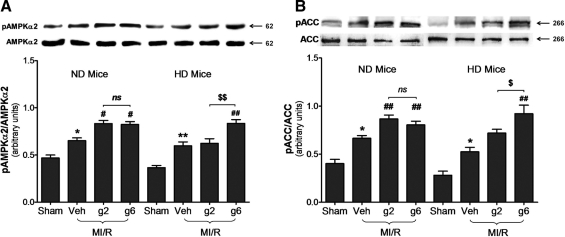
Cardiac adiponectin resistance to stimulate AMPK/ACC activation occurred upon MI/R injury in HD mice. (A) Effect of adiponectin treatment on AMPKα2 phosphorylation determined by representative Western blots. (B) Effect of adiponectin treatment on ACC phosphorylation determined by representative Western blots. n = 5–8 hearts per group. *p < 0.05, **p < 0.01 versus sham control in the same diet group; #p < 0.05, ##p < 0.01 versus vehicle-treated group in the same diet group; $p < 0.05, $$p < 0.01 versus low dose gAPN-treated animals in the same diet group.
FIG. 6.
FIG. 6.
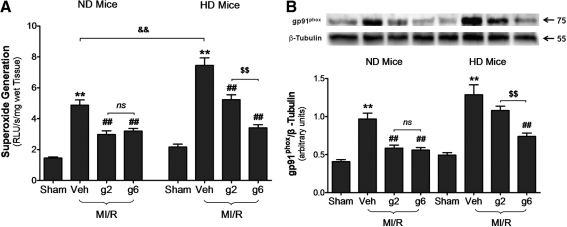
Cardiac adiponectin resistance in HD mice impaired its antioxidative protection. (A) Production of superoxide (n = 8–10 hearts per group). (B) gp91phox determined by representative Western blots (n = 5–8 hearts per group). **p < 0.01 versus sham control in the same diet group; ##p < 0.01 versus vehicle-treated group in the same diet group; $$p < 0.01 versus low dose gAPN-treated animals in the same diet group; &&p < 0.01 between different diet groups with the same treatment.
FIG. 7.
FIG. 7.
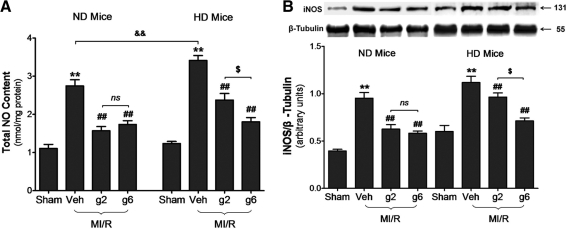
Cardiac adiponectin resistance impaired antinitrative protection. (A) Production of NOx content (n = 10–13 hearts per group). (B) Inducible nitric oxide synthase (iNOS) expression (n = 5–7/group) by representative Western blots. **p < 0.01 versus sham control in the same diet group; ##p < 0.01 versus vehicle-treated group in the same diet group; $p < 0.05 versus low dose gAPN-treated animals in the same diet group; &&p < 0.01 between different diet groups with the same treatment.
FIG. 8.
FIG. 8.
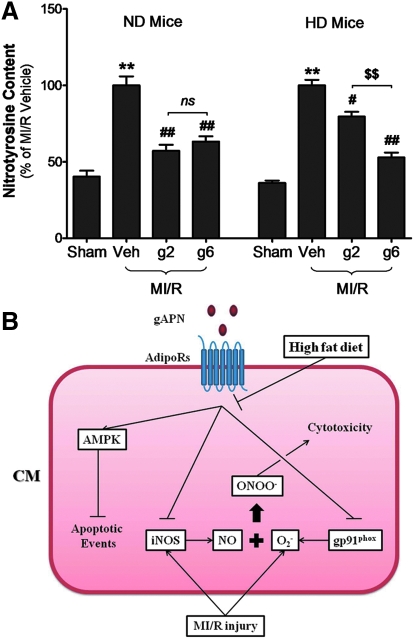
Peroxynitrite was significantly blunted in HD-induced diabetic heart. (A) Nitrotyrosine content determined by ELISA (n = 10–13/group). **p < 0.01 versus sham control in the same diet group; #p < 0.05, ##p < 0.01 versus vehicle-treated group in the same group; $$p < 0.01 versus low dose gAPN-treated animals in the same diet group. (B) A schematic illustration of the hypothesis tested in the current study. (To see this illustration in color the reader is referred to the web version of this article at www.liebertonline.com/ars).

References

    1. Basu R. Pajvani UB. Rizza RA. Scherer PE. Selective downregulation of the high molecular weight form of adiponectin in hyperinsulinemia and in type 2 diabetes: differential regulation from nondiabetic subjects. Diabetes. 2007;56:2174–2177. - PubMed
    1. Beckman JS. Koppenol WH. Nitric oxide, superoxide, and peroxynitrite: the good, the bad, and ugly. Am J Physiol. 1996;271:C1424–C1437. - PubMed
    1. Behrends M. Schulz R. Post H. Alexandrov A. Belosjorow S. Michel MC. Heusch G. Inconsistent relation of MAPK activation to infarct size reduction by ischemic preconditioning in pigs. Am J Physiol Heart Circ Physiol. 2000;279:H1111–H1119. - PubMed
    1. Berg AH. Combs TP. Du X. Brownlee M. Scherer PE. The adipocyte-secreted protein Acrp30 enhances hepatic insulin action. Nat Med. 2001;7:947–953. - PubMed
    1. Bruce CR. Mertz VA. Heigenhauser GJ. Dyck DJ. The stimulatory effect of globular adiponectin on insulin-stimulated glucose uptake and fatty acid oxidation is impaired in skeletal muscle from obese subjects. Diabetes. 2005;54:3154–3160. - PubMed

Publication types

MeSH terms