. 2010;11(11):R111.
doi: 10.1186/gb-2010-11-11-r111. Epub 2010 Nov 19.

Reduced levels of two modifiers of epigenetic gene silencing, Dnmt3a and Trim28, cause increased phenotypic noise

Affiliations

Reduced levels of two modifiers of epigenetic gene silencing, Dnmt3a and Trim28, cause increased phenotypic noise

Nadia C Whitelaw et al. Genome Biol. 2010.

Abstract

Background: Inbred individuals reared in controlled environments display considerable variance in many complex traits but the underlying cause of this intangible variation has been an enigma. Here we show that two modifiers of epigenetic gene silencing play a critical role in the process.

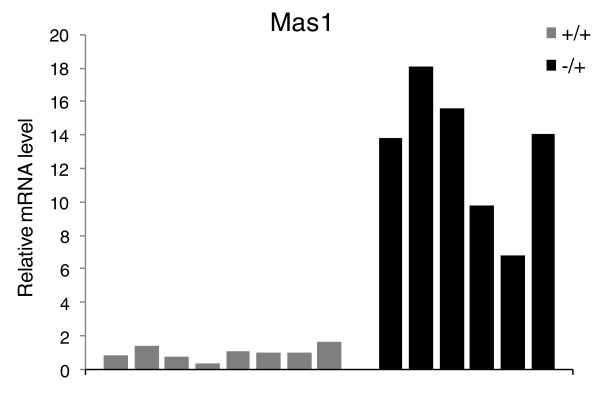
Results: Inbred mice heterozygous for a null mutation in DNA methyltransferase 3a (Dnmt3a) or tripartite motif protein 28 (Trim28) show greater coefficients of variance in body weight than their wild-type littermates. Trim28 mutants additionally develop metabolic syndrome and abnormal behavior with incomplete penetrance. Genome-wide gene expression analyses identified 284 significantly dysregulated genes in Trim28 heterozygote mutants compared to wild-type mice, with Mas1, which encodes a G-protein coupled receptor implicated in lipid metabolism, showing the greatest average change in expression (7.8-fold higher in mutants). This gene also showed highly variable expression between mutant individuals.

Conclusions: These studies provide a molecular explanation of developmental noise in whole organisms and suggest that faithful epigenetic control of transcription is central to suppressing deleterious levels of phenotypic variation. These findings have broad implications for understanding the mechanisms underlying sporadic and complex disease in humans.


Figures

Figure 1
Figure 1
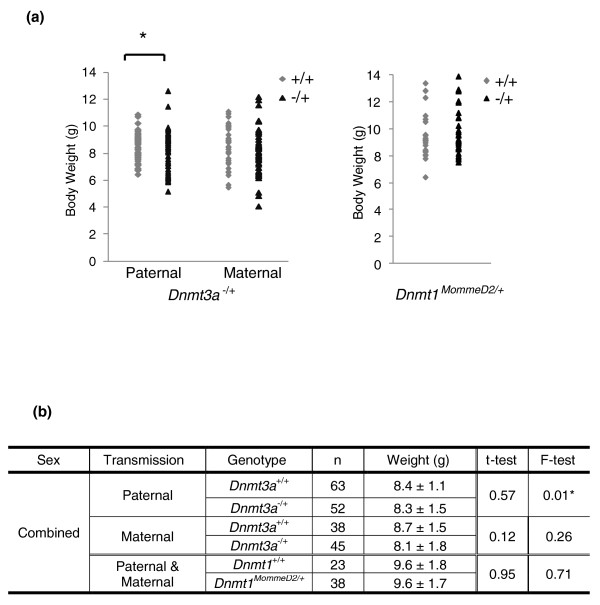
Variance in weights of mice haploinsufficient for Dnmt3a. (a) Mice from paternal and maternal transmission of the Dnmt3a- null allele and the Dmnt1MommeD2 allele were weighed and genotyped at 3 weeks of age (weaning). The data presented in these graphs are tabulated below. (b) There is significantly more variation in the weights of Dnmt3a-/+ mice following paternal transmission of the mutant allele (F test, P = 0.01). Dnmt3a- data were collected from wild-type and heterozygous mutant littermates from a wild-type x heterozygous cross. Dmnt1MommeD2 data were collected from wild-type x heterozygous crosses (equal contributions from reciprocal crosses) and heterozygous intercrosses.
Figure 2
Figure 2
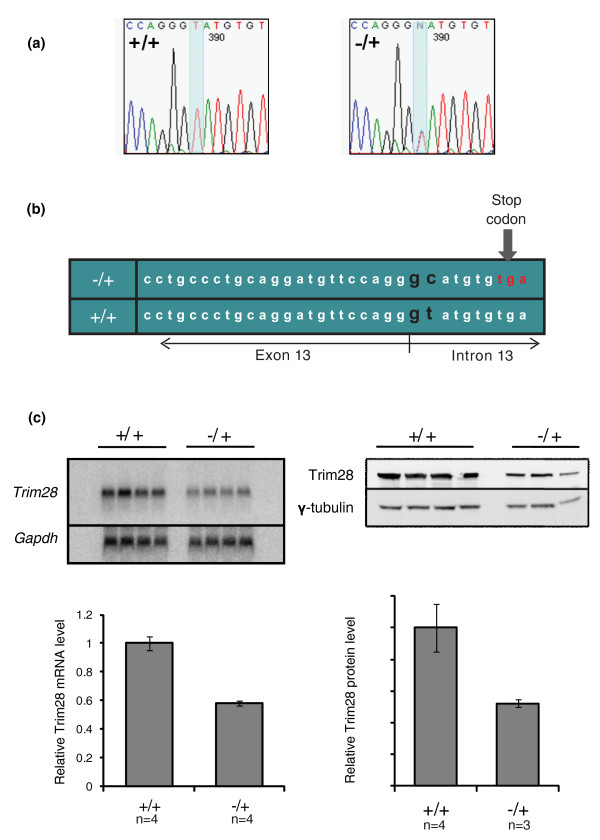
Haploinsufficiency for Trim28 caused by a splice site mutation. (a) Sequence chromatograms show that MommeD9-/+ mice have a T to C mutation 2 bp into intron 13 of Trim28. (b) The mutation is expected to prevent splicing of intron 13 causing an in-frame premature stop codon. The splice acceptor site is shown in black. (c) Northern and western analysis of Trim28 mRNA and protein show that MommeD9-/+ mice have a reduced dosage of Trim28. Error bars indicate + SEM.
Figure 3
Figure 3
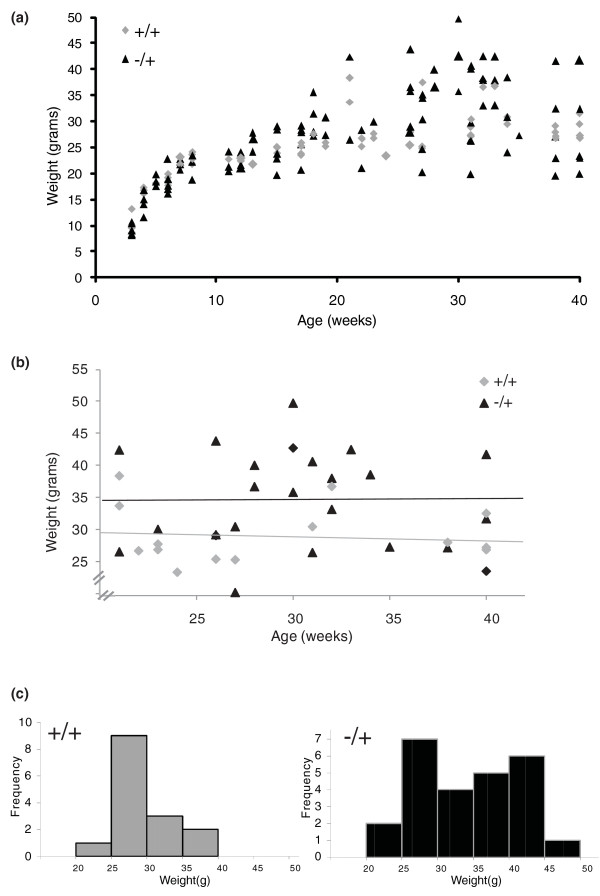
Increased variation in body weight in Trim28MommeD9/+ mice. (a) Twenty Trim28+/+ mice and 33 Trim28MommeD9/+ mice (all female) were weighed between 3 and 40 weeks of age. The data are the sum of 170 data points representing 103 Trim28MommeD9/+ and 67 Trim28+/+ body weight measurements. Trim28MommeD9/+ mice appear to have a greater variation in weight as they age. (b) There is no correlation between age and weight between 20 and 40 weeks of age in 15 Trim28+/+ mice and 25 Trim28MommeD9/+ mice; however, Trim28MommeD9/+ mice are heavier on average (P = 0.008). (c) Trim28MommeD9/+ mice have a significant increase in weight variation between the ages of 20 and 40 weeks (P = 0.005).
Figure 4
Figure 4
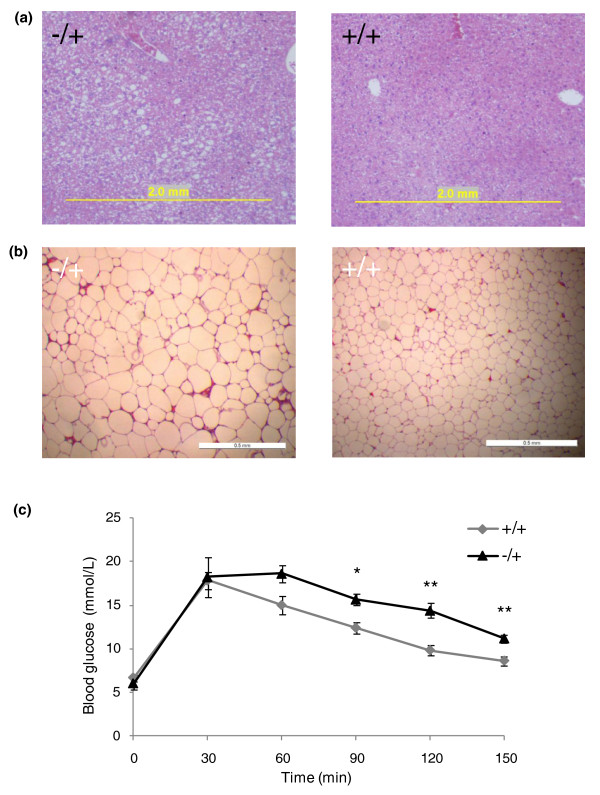
Symptoms of metabolic syndrome in obese Trim28MommeD9/+ mice. (a) Liver tissue was dissected from an obese Trim28MommeD9/+ mouse and a wild-type littermate. Tissues were sectioned and stained with H&E. (b) Inguinal fat pads were dissected from an obese Trim28MommeD9/+ mouse and a wild-type littermate. Tissues were sectioned and stained with H&E. In both cases the data shown are representative of sections taken from at least five different Trim28MommeD9/+ mutants and five different Trim28+/+ individuals. (c) Four obese Trim28MommeD9/+ mice and six Trim28+/+ littermates were fasted for 15 hours and a blood glucose measurement was taken at t = 0. Mice were injected with 2 g/kg of a 20% glucose solution and blood glucose measurements were taken every 30 minutes for 150 minutes with a blood glucose monitor (Accu-Chek). *P < 0.05, **P < 0.005 (Students t-test).
Figure 5
Figure 5
Variable expression of Mas1 in Trim28MommeD9/+ mice. Expression levels of the Mas1 gene were validated by quantitative PCR on cDNA from additional Trim28MommeD9/+ (n = 6) and wild-type individuals (n = 8). Levels were normalized to Gapdh.
Figure 6
Figure 6
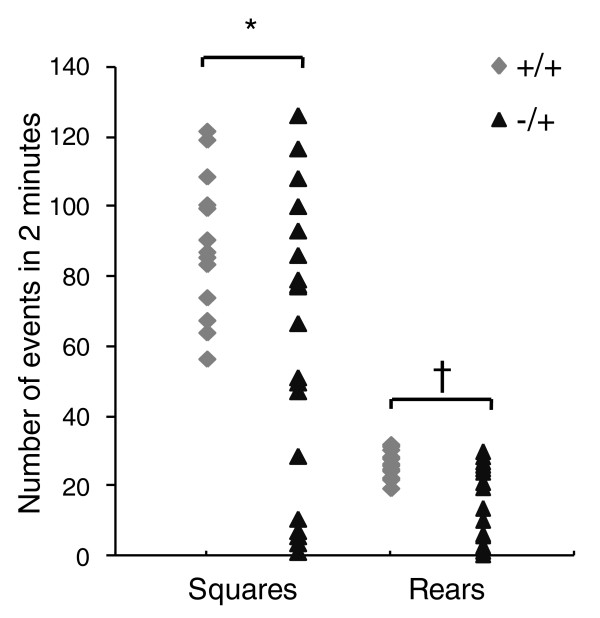
Abnormal exploratory behavior in Trim28MommeD9/+ mice. The behavior of 19 Trim28MommeD9/+ mice and 14 Trim28+/+ mice was tested in an open field (40 cm × 40 cm). Mice were scored for the number of 10-cm2 squares entered (Squares) and the number of times they reared on their hind legs (Rears) in a 2-minute period. *P < 0.05 (t-test and F test), P < 0.0005 (t-test and F test).

References

    1. Falconer DS. The genetics of litter size in mice. J Cell Comp Physiol. 1960;56(Suppl 1):153–167. doi: 10.1002/jcp.1030560414. - DOI - PubMed
    1. Gartner K. A third component causing random variability beside environment and genotype. A reason for the limited success of a 30 year long effort to standardize laboratory animals? Lab Anim. 1990;24:71–77. doi: 10.1258/002367790780890347. - DOI - PubMed
    1. Griffiths AJF, Miller JH, Suzuki DT, Lewontin RC, Gelbart WM. Introduction to Genetic Analysis. 6. Freeman: New York; 1996.
    1. Biggers JD, Mc LA, Michie D. Variance control in the animal house. Nature. 1958;182:77–80. doi: 10.1038/182077a0. - DOI - PubMed
    1. Durrant A, Mather K. Heritable variation in a long inbred line of Drosophila. Genetica. 1954;27:97–119. doi: 10.1007/BF01664156. - DOI - PubMed

Publication types

MeSH terms

Associated data