


Effect of adding the novel fiber, PGX®, to commonly consumed foods on glycemic response, glycemic index and GRIP: a simple and effective strategy for reducing post prandial blood glucose levels--a randomized, controlled trial
- PMID: 21092221
- PMCID: PMC2996336
- DOI: 10.1186/1475-2891-9-58
Effect of adding the novel fiber, PGX®, to commonly consumed foods on glycemic response, glycemic index and GRIP: a simple and effective strategy for reducing post prandial blood glucose levels--a randomized, controlled trial
Abstract
Background: Reductions in postprandial glycemia have been demonstrated previously with the addition of the novel viscous polysaccharide (NVP), PolyGlycopleX® (PGX®), to an OGTT or white bread. This study explores whether these reductions are sustained when NVP is added to a range of commonly consumed foods or incorporated into a breakfast cereal.
Methods: Ten healthy subjects (4M, 6F; age 37.3 ± 3.6 y; BMI 23.8 ± 1.3 kg/m2), participated in an acute, randomized controlled trial. The glycemic response to cornflakes, rice, yogurt, and a frozen dinner with and without 5 g of NVP sprinkled onto the food was determined. In addition, 3 granolas with different levels of NVP and 3 control white breads and one white bread and milk were also consumed. All meals contained 50 g of available carbohydrate. Capillary blood samples were taken fasting and at 15, 30, 45, 60, 90 and 120 min after the start of the meal. The glycemic index (GI) and the glycemic reduction index potential (GRIP) were calculated. The blood glucose concentrations at each time and the iAUC values were subjected to repeated-measures analysis of variance (ANOVA) examining for the effect of test meal. After demonstration of significant heterogeneity, differences between individual means was assessed using GLM ANOVA with Tukey test to adjust for multiple comparisons.
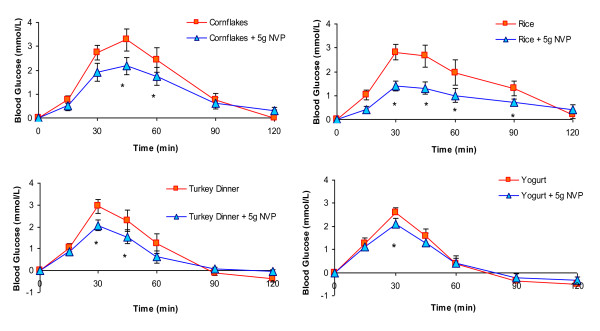
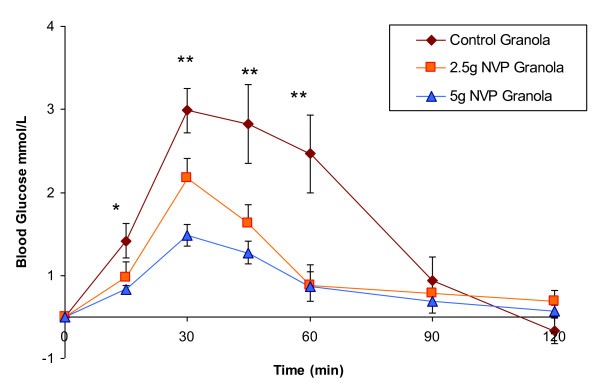
Results: Addition of NVP reduced blood glucose response irrespective of food or dose (p < 0.01). The GI of cornflakes, cornflakes+NVP, rice, rice+NVP, yogurt, yogurt+NVP, turkey dinner, and turkey dinner+NVP were 83 ± 8, 58 ± 7, 82 ± 8, 45 ± 4, 44 ± 4, 38 ± 3, 55 ± 5 and 41 ± 4, respectively. The GI of the control granola, and granolas with 2.5 and 5 g of NVP were 64 ± 6, 33 ± 5, and 22 ± 3 respectively. GRIP was 6.8 ± 0.9 units per/g of NVP.
Conclusion: Sprinkling or incorporation of NVP into a variety of different foods is highly effective in reducing postprandial glycemia and lowering the GI of a food.
Clinical trial registration: NCT00935350.
Figures
References
-
- Glucose tolerance and mortality: comparison of WHO and American Diabetes Association diagnostic criteria. The DECODE study group. European Diabetes Epidemiology Group. Diabetes Epidemiology: Collaborative analysis Of Diagnostic criteria in Europe. Lancet. 1999;354:617–621. doi: 10.1016/S0140-6736(98)12131-1. - DOI - PubMed
-
- Jenkins DJ, Wolever TM, Collier GR, Ocana A, Rao AV, Buckley G. et al.Metabolic effects of a low-glycemic-index diet. Am J Clin Nutr. 1987;46:968–975. - PubMed
-
- Livesey G, Taylor R, Hulshof T, Howlett J. Glycemic response and health--a systematic review and meta-analysis: relations between dietary glycemic properties and health outcomes. Am J Clin Nutr. 2008;87:258S–268S. - PubMed
Publication types
MeSH terms
Substances
Associated data
LinkOut - more resources
Full Text Sources
Medical
