


Decrease of vitamin D concentration in patients with HIV infection on a non nucleoside reverse transcriptase inhibitor-containing regimen
- PMID: 21092280
- PMCID: PMC3001414
- DOI: 10.1186/1742-6405-7-40
Decrease of vitamin D concentration in patients with HIV infection on a non nucleoside reverse transcriptase inhibitor-containing regimen
Abstract
Background: Vitamin D is an important determinant of bone health and also plays a major role in the regulation of the immune system. Interestingly, vitamin D status before the start of highly active antiretroviral therapy (HAART) has been recently associated with HIV disease progression and overall mortality in HIV-positive pregnant women. We prospectively studied vitamin D status in HIV individuals on HAART in Belgium.We selected samples from HIV-positive adults starting HAART with a pre-HAART CD4 T-cell count >100 cells/mm3 followed up for at least 12 months without a treatment change. We compared 25-hydroxyvitamin D plasma [25-(OH)D] concentration in paired samples before and after 12 months of HAART. 25-(OH)D levels are presented using two different cut-offs: <20 ng/ml and <30 ng/ml.
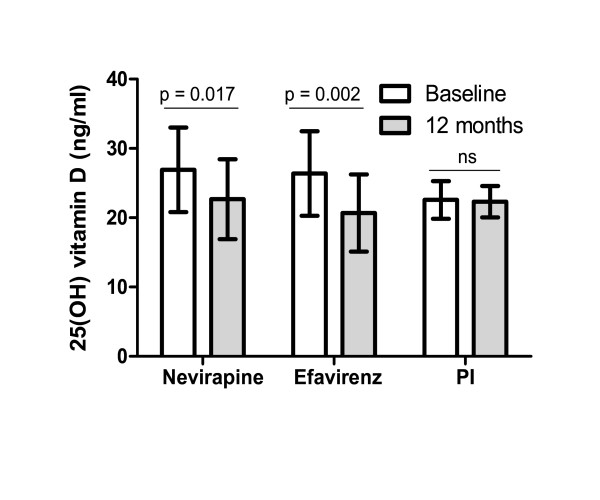
Results: Vitamin D deficiency was common before HAART, the frequency of plasma 25-(OH)D concentrations below 20 ng/ml and 30 below ng/ml was 43.7% and 70.1% respectively. After 12 months on HAART, the frequency increased to 47.1% and 81.6%.HAART for 12 months was associated with a significant decrease of plasma 25-(OH)D concentration (p = 0.001). Decreasing plasma 25-(OH)D concentration on HAART was associated in the multivariate model with NNRTI-based regimen (p = 0.001) and lower body weight (p = 0.008). Plasma 25-(OH)D concentrations decreased significantly in both nevirapine and efavirenz-containing regimens but not in PI-treated patients.
Conclusions: Vitamin D deficiency is frequent in HIV-positive individuals and NNRTI therapy further decreases 25-(OH)D concentrations. Consequently, vitamin D status need to be checked regularly in all HIV-infected patients and vitamin D supplementation should be given when needed.
Figures
References
-
- Chiu KC, Chu A, Go VL, Saad MF. Hypovitaminosis D is associated with insulin resistance and beta cell dysfunction. Am J Clin Nutr. 2004;79:820–825. - PubMed
-
- Liu PT, Stenger S, Li H, Wenzel L, Tan BH, Krutzik SR, Ochoa MT, Schauber J, Wu K, Meinken C, Kamen DL, Wagner M, Bals R, Steinmeyer A, Zugel U, Gallo RL, Eisenberg D, Hewison M, Hollis BW, Adams JS, Bloom BR, Modlin RL. Toll-like receptor triggering of a vitamin D-mediated human antimicrobial response. Science. 2006;311:1770–1773. doi: 10.1126/science.1123933. - DOI - PubMed
-
- Martins D, Wolf M, Pan D, Zadshir A, Tareen N, Thadhani R, Felsenfeld A, Levine B, Mehrotra R, Norris K. Prevalence of cardiovascular risk factors and the serum levels of 25-hydroxyvitamin D in the United States: data from the Third National Health and Nutrition Examination Survey. Arch Intern Med. 2007;167:1159–1165. doi: 10.1001/archinte.167.11.1159. - DOI - PubMed
LinkOut - more resources
Full Text Sources
Medical
Research Materials
Miscellaneous
