Review
. 2011 Jan;17(1):7-13.
doi: 10.1017/S1355617710001396. Epub 2010 Nov 19.

Neuropsychology 3.0: evidence-based science and practice

Affiliations
Review

Neuropsychology 3.0: evidence-based science and practice

Robert M Bilder. J Int Neuropsychol Soc. 2011 Jan.

Erratum in

  • J Int Neuropsychol Soc. 2011 Mar;17(2):383

Abstract

Neuropsychology is poised for transformations of its concepts and methods, leveraging advances in neuroimaging, the human genome project, psychometric theory, and information technologies. It is argued that a paradigm shift toward evidence-based science and practice can be enabled by innovations, including (1) formal definition of neuropsychological concepts and tasks in cognitive ontologies; (2) creation of collaborative neuropsychological knowledgebases; and (3) design of Web-based assessment methods that permit free development, large-sample implementation, and dynamic refinement of neuropsychological tests and the constructs these aim to assess. This article considers these opportunities, highlights selected obstacles, and offers suggestions for stepwise progress toward these goals.


Figures
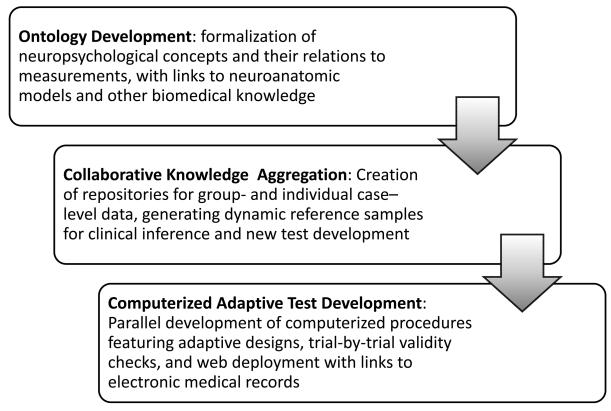
Figure 1
Figure 1. Agenda for Neuropsychology 3.0
Partially overlapping stages are suggested to advance evidence-based science and practice in neuropsychology, from ontology development, through collaborative knowledge aggregation, to web-based adaptive test development.
Figure 2
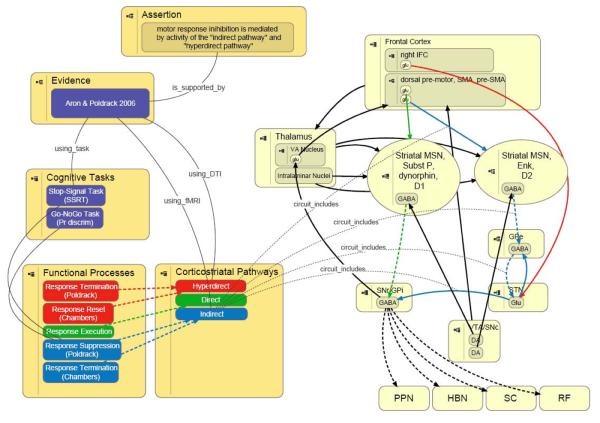
Figure 2. Schematic Representation of a Neuropsychological Hypothesis
The hypothesis includes an assertion (about “motor response inhibition”) and associated evidence. The evidence is derived from a particular publication, which used a specific cognitive task (the Stop Signal Reaction Time test) to measure a specific functional process (which in this example is the cognitive concept “response suppression” according to one author [Poldrack]). The hypothesis suggests that this process is dependent on functioning of a specific corticostriatal pathway, and this circuit (the “indirect pathway”) is linked to a graphical representation of the relevant connectional anatomy. The evidence also includes neuroimaging data, including functional MRI (fMRI) and diffusion tensor imaging (DTI) as supporting links to implicate the neuroanatomic circuit components that are putatively involved in the behavioral process.

References

    1. American Psychiatric Association . Diagnostic and Statistical Manual of Mental Disorders (DSM-IV) American Psychiatric Association; Washington, DC: 1994.
    1. Bilder RM. Phenomics: building scaffolds for biological hypotheses in the post-genomic era. Biol Psychiatry. 2008;63(5):439–440. doi: S0006-3223(07)01140-7 [pii] 0.1016/j.biopsych.2007.11.013. - PMC - PubMed
    1. Bilder RM, Sabb FW, Cannon TD, London ED, Jentsch JD, Parker DS. Phenomics: the systematic study of phenotypes on a genome-wide scale. Neuroscience. 2009;164(1):30–42. doi: S0306-4522(09)00048-7 [pii] 10.1016/j.neuroscience.2009.01.027. - PMC - PubMed
    1. Bilder RM, Sabb FW, Parker DS, Kalar D, Chu WW, Fox J. Cognitive ontologies for neuropsychiatric phenomics research. Cogn Neuropsychiatry. 2009;14(4-5):419–450. doi: 913383678 [pii] 10.1080/13546800902787180. - PMC - PubMed
    1. Biswal BB, Mennes M, Zuo XN, Gohel S, Kelly C, Smith SM. Toward discovery science of human brain function. Proc Natl Acad Sci U S A. 2010;107(10):4734–4739. doi: 0911855107 [pii] 10.1073/pnas.0911855107. - PMC - PubMed

Publication types