


Neuroimaging evidence of cerebellar involvement in premenstrual dysphoric disorder
- PMID: 21092938
- PMCID: PMC3053132
- DOI: 10.1016/j.biopsych.2010.09.029
Neuroimaging evidence of cerebellar involvement in premenstrual dysphoric disorder
Abstract
Background: Premenstrual dysphoric disorder (PMDD) is a debilitating cyclic disorder that is characterized by affective symptoms, including irritability, depression, and anxiety, which arise in the luteal phase of the menstrual cycle and resolve soon after the onset of menses. Despite a prevalence of up to 8% in women of reproductive age, few studies have investigated the brain mechanisms that underlie this disorder.
Methods: We used positron emission tomography with [(18)F] fluorodeoxyglucose and self-report questionnaires to assess cerebral glucose metabolism and mood in 12 women with PMDD and 12 healthy comparison subjects in the follicular and late luteal phases of the menstrual cycle. The primary biological end point was incorporated regional cerebral radioactivity (scaled to the global mean) as an index of glucose metabolism. Relationships between regional brain activity and mood ratings were assessed. Blood samples were taken before each session for assay of plasma estradiol and progesterone concentrations.
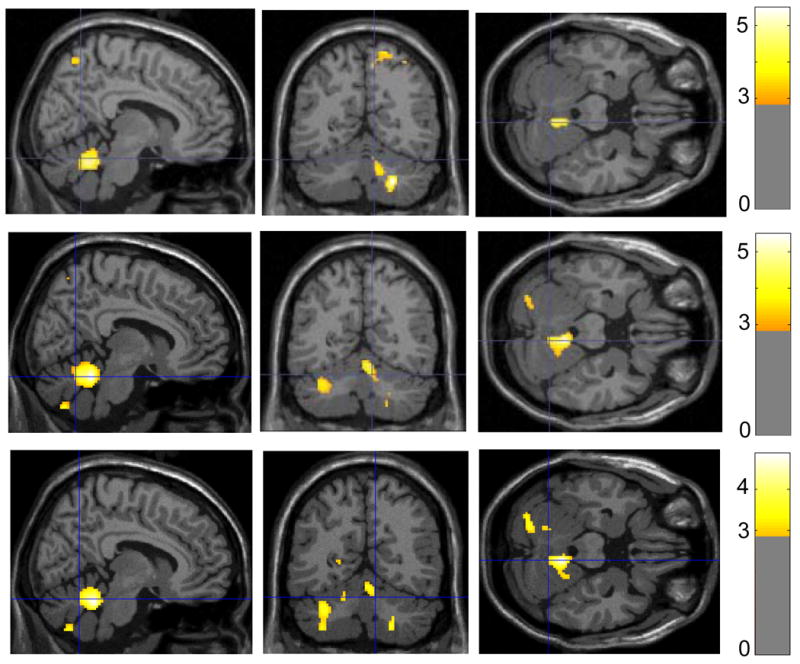
Results: There were no group differences in hormone levels in either the follicular or late luteal phase, but the groups differed in the effect of menstrual phase on cerebellar activity. Women with PMDD but not comparison subjects showed an increase in cerebellar activity (particularly in the right cerebellar vermis) from the follicular phase to the late luteal phase (p = .003). In the PMDD group, this increase in cerebellar activity was correlated with worsening of mood (p = .018).
Conclusions: These findings suggest that the midline cerebellar nuclei, which have been implicated in other mood disorders, also contribute to negative mood in PMDD.
Copyright © 2011 Society of Biological Psychiatry. Published by Elsevier Inc. All rights reserved.
Figures
References
-
- Backstrom T, Andersson A, Andree L, Birzniece V, Bixo M, et al. Pathogenesis in menstrual cycle-linked CNS disorders. Ann N Y Acad Sci. 2003;1007:42–53. - PubMed
-
- Wittchen HU, Becker E, Lieb R, Krause P. Prevalence, incidence and stability of premenstrual dysphoric disorder in the community. Psychol Med. 2002;32:119–132. - PubMed
-
- Halbreich U, Borenstein J, Kahn LS. The prevalence, impairment, impact, and burden of premenstrual dysphoric disorder (PMS/PMDD) Psychoneuroendocrinology. 2003 3:1–23. - PubMed
-
- American Psychiatric Association. Diagnostic and Statistical Manual of Mental Disorders. 4th. Washington DC: American Psychiatric Press; 1994.
-
- Rubinow DR, Hoban MC, Grover GN, Galloway DS, Roy-Byrne PP, Anderson R, Merriam GR. Changes in plasma hormones across the menstrual cycle in patients with menstrually related mood disorder and in control subjects. Am J Obstet Gynecol. 1988;158:5–11. - PubMed
Publication types
MeSH terms
Substances
Grants and funding
LinkOut - more resources
Full Text Sources
Medical
