


Surveillance of adenoviruses and noroviruses in European recreational waters
- PMID: 21093010
- PMCID: PMC7112131
- DOI: 10.1016/j.watres.2010.10.015
Surveillance of adenoviruses and noroviruses in European recreational waters
Abstract
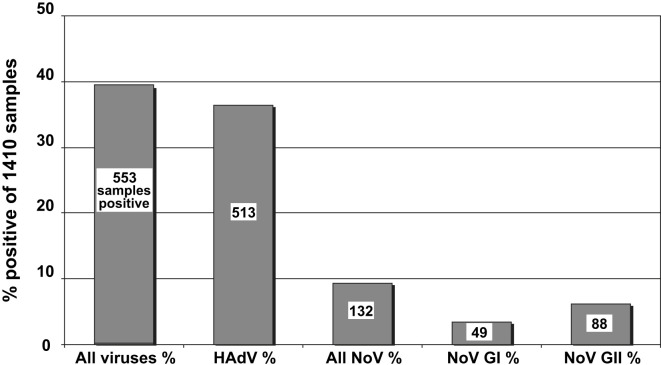
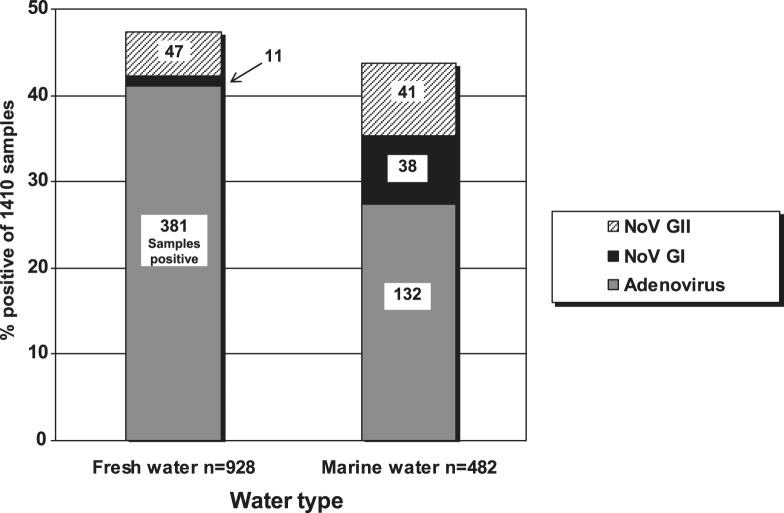
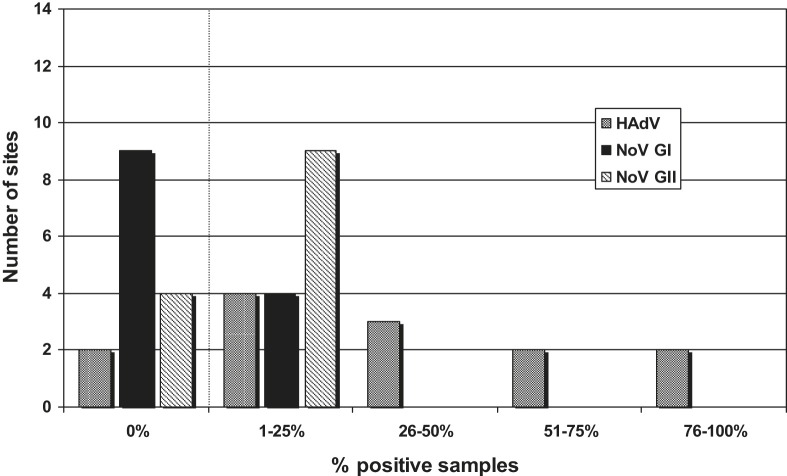
Exposure to human pathogenic viruses in recreational waters has been shown to cause disease outbreaks. In the context of Article 14 of the revised European Bathing Waters Directive 2006/7/EC (rBWD, CEU, 2006) a Europe-wide surveillance study was carried out to determine the frequency of occurrence of two human enteric viruses in recreational waters. Adenoviruses were selected based on their near-universal shedding and environmental survival, and noroviruses (NoV) selected as being the most prevalent gastroenteritis agent worldwide. Concentration of marine and freshwater samples was done by adsorption/elution followed by molecular detection by (RT)-PCR. Out of 1410 samples, 553 (39.2%) were positive for one or more of the target viruses. Adenoviruses, detected in 36.4% of samples, were more prevalent than noroviruses (9.4%), with 3.5% GI and 6.2% GII, some samples being positive for both GI and GII. Of 513 human adenovirus-positive samples, 63 (12.3%) were also norovirus-positive, whereas 69 (7.7%) norovirus-positive samples were adenovirus-negative. More freshwater samples than marine water samples were virus-positive. Out of a small selection of samples tested for adenovirus infectivity, approximately one-quarter were positive. Sixty percent of 132 nested-PCR adenovirus-positive samples analysed by quantitative PCR gave a mean value of over 3000 genome copies per L of water. The simultaneous detection of infectious adenovirus and of adenovirus and NoV by (RT)PCR suggests that the presence of infectious viruses in recreational waters may constitute a public health risk upon exposure. These studies support the case for considering adenoviruses as an indicator of bathing water quality.
Copyright © 2010 Elsevier Ltd. All rights reserved.
Figures
References
-
- Abdulmawjood A., Bülte M., Roth S., Schönenbrücher H., Cook N., Heuvelink A.E., Hoorfar J. Development, validation, and standardization of polymerase chain reaction-based detection of E. coli O157. Journal of AOAC International. 2004;87(3):596–603. - PubMed
-
- Calgua B., Mengewein A., Grunert A., Bofill-Mas S., Clemente-Casares P., Hundesa A., Wyn-Jones A.P., López-Pila J.M., Girones R. Development and application of a one-step low cost procedure to concentrate viruses from seawater samples. Journal of Virological Methods. 2008;153:79–83. - PubMed
Publication types
MeSH terms
LinkOut - more resources
Full Text Sources
Other Literature Sources
Medical
