


Neurobiology of the adolescent brain and behavior: implications for substance use disorders
- PMID: 21093769
- PMCID: PMC3099425
- DOI: 10.1016/j.jaac.2010.08.017
Neurobiology of the adolescent brain and behavior: implications for substance use disorders
Abstract
Objective: Adolescence is a developmental period that entails substantial changes in risk-taking behavior and experimentation with alcohol and drugs. Understanding how the brain is changing during this period relative to childhood and adulthood and how these changes vary across individuals are key in predicting risk for later substance abuse and dependence.
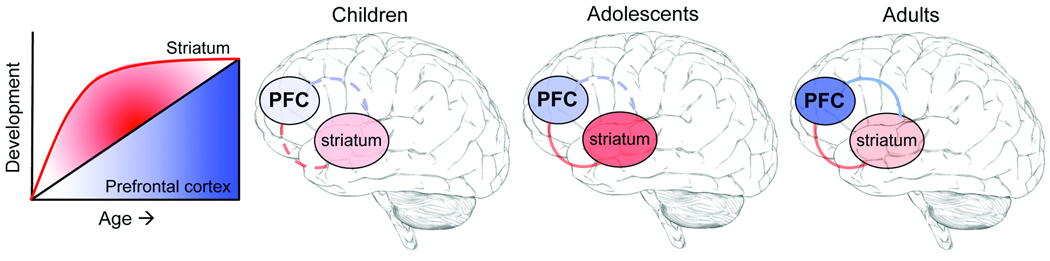
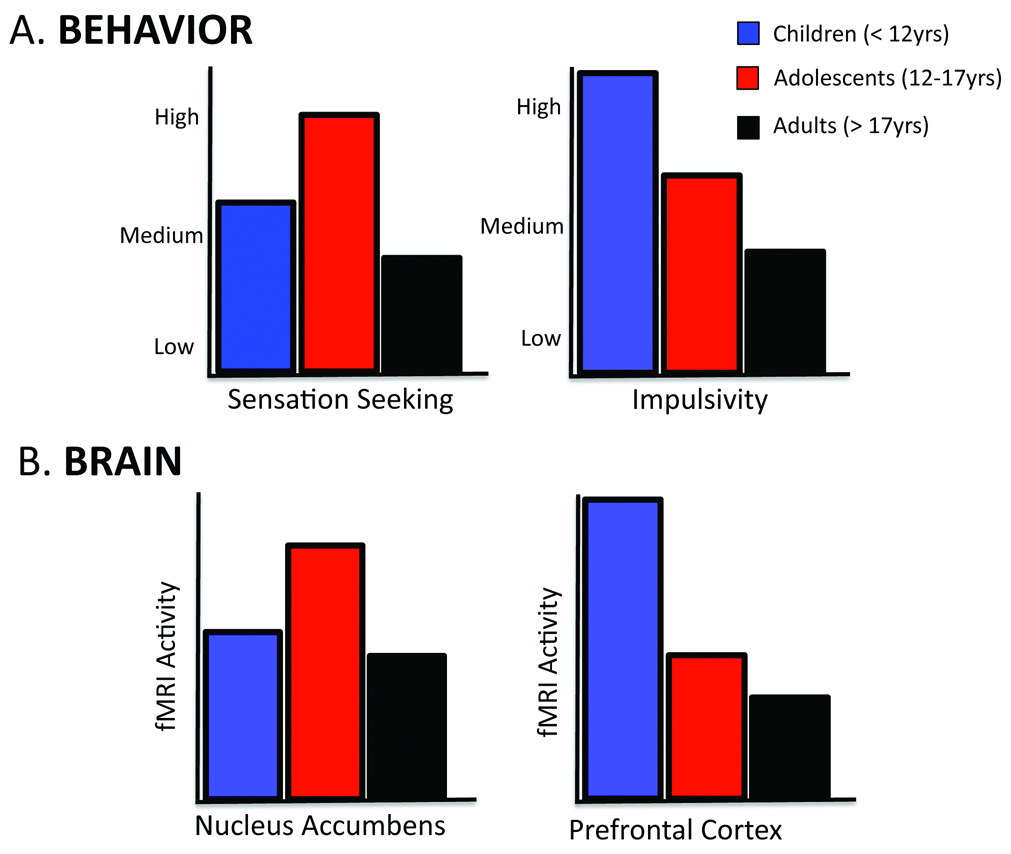
Method: This review discusses recent human imaging and animal work in the context of an emerging view of adolescence as characterized by a tension between early emerging "bottom-up" systems that express exaggerated reactivity to motivational stimuli and later maturing "top-down" cognitive control regions. Behavioral, clinical, and neurobiological evidences are reported for dissociating these two systems developmentally. The literature on the effects of alcohol and its rewarding properties in the brain is discussed in the context of these two systems.
Results: Collectively, these studies show curvilinear development of motivational behavior and the underlying subcortical brain regions, with a peak inflection from 13 to 17 years. In contrast, prefrontal regions, important in top-down regulation of behavior, show a linear pattern of development well into young adulthood that parallels that seen in behavioral studies of impulsivity.
Conclusions: The tension or imbalance between these developing systems during adolescence may lead to cognitive control processes being more vulnerable to incentive-based modulation and increased susceptibility to the motivational properties of alcohol and drugs. As such, behavior challenges that require cognitive control in the face of appetitive cues may serve as useful biobehavioral markers for predicting which teens may be at greater risk for alcohol and substance dependence.
Copyright © 2010 American Academy of Child and Adolescent Psychiatry. Published by Elsevier Inc. All rights reserved.
Figures

References
Publication types
MeSH terms
Grants and funding
LinkOut - more resources
Full Text Sources
Medical
Research Materials
