


Artificial atoms on semiconductor surfaces
- PMID: 21097704
- PMCID: PMC3024701
- DOI: 10.1073/pnas.1006665107
Artificial atoms on semiconductor surfaces
Abstract
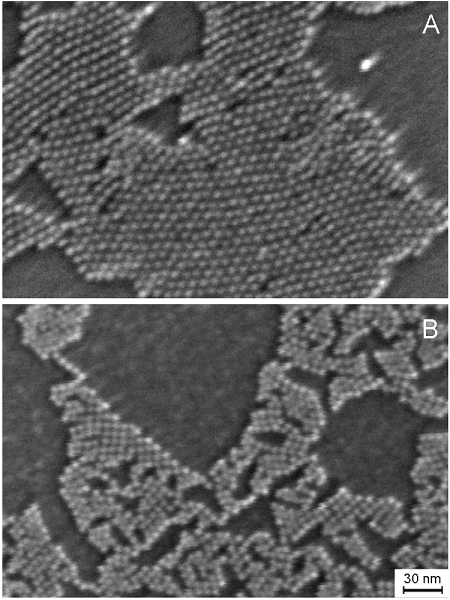
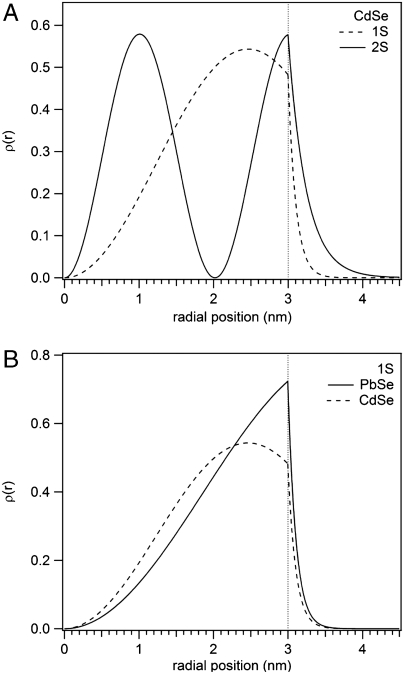
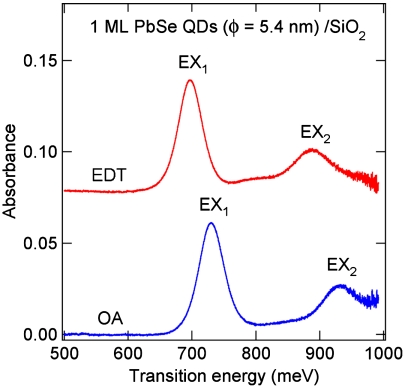
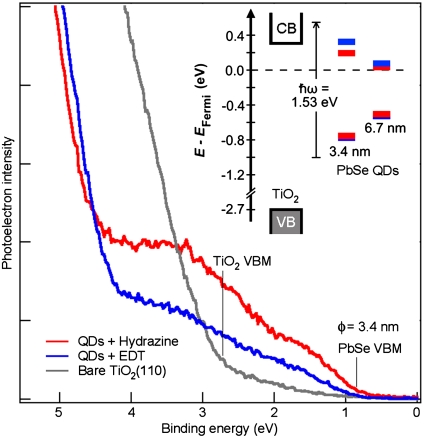
Semiconductor nanocrystals are called artificial atoms because of their atom-like discrete electronic structure resulting from quantum confinement. Artificial atoms can also be assembled into artificial molecules or solids, thus, extending the toolbox for material design. We address the interaction of artificial atoms with bulk semiconductor surfaces. These interfaces are model systems for understanding the coupling between localized and delocalized electronic structures. In many perceived applications, such as nanoelectronics, optoelectronics, and solar energy conversion, interfacing semiconductor nanocrystals to bulk materials is a key ingredient. Here, we apply the well established theories of chemisorption and interfacial electron transfer as conceptual frameworks for understanding the adsorption of semiconductor nanocrystals on surfaces, paying particular attention to instances when the nonadiabatic Marcus picture breaks down. We illustrate these issues using recent examples from our laboratory.
Conflict of interest statement
The authors declare no conflict of interest.
Figures
References
-
- Steigerwald ML, Brus LE. Semiconductor crystallites—a class of large molecules. Acc Chem Res. 1990;23:183–188.
-
- Klimov VI, editor. Semiconductor quantum dots. 2nd Ed. Boca Raton: CRC Press; 2010.
-
- Murray CB, Kagan CR, Bawendi MG. Synthesis and characterization of monodisperse nanocrystals and close-packed nanocrystal assemblies. Ann Rev Mater Sci. 2000;30:545–610.
-
- Kim J, Wong CY, Scholes GD. Exciton fine structure and spin relaxation in semiconductor colloidal quantum dots. Acc Chem Res. 2009;42:1037–1046. - PubMed
-
- Banin U. Light-emitting diodes—bright and stable. Nat Photonics. 2008;2:209–210.
Publication types
MeSH terms
Substances
LinkOut - more resources
Full Text Sources
