


Racial and ethnic disparities in risk and survival in children with neuroblastoma: a Children's Oncology Group study
- PMID: 21098321
- PMCID: PMC3055862
- DOI: 10.1200/JCO.2010.29.6103
Racial and ethnic disparities in risk and survival in children with neuroblastoma: a Children's Oncology Group study
Abstract
Purpose: Although health disparities are well-described for many cancers, little is known about racial and ethnic disparities in neuroblastoma. To evaluate differences in disease presentation and survival by race and ethnicity, data from the Children's Oncology Group (COG) were analyzed.
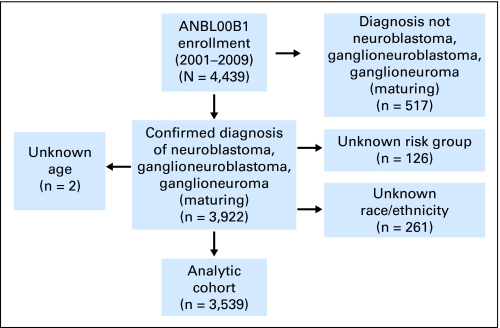
Patients and methods: The racial/ethnic differences in clinical and biologic risk factors, and outcome of patients with neuroblastoma enrolled on COG ANBL00B1 between 2001 and 2009 were investigated.
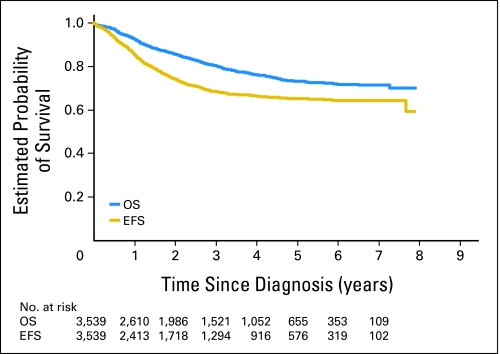
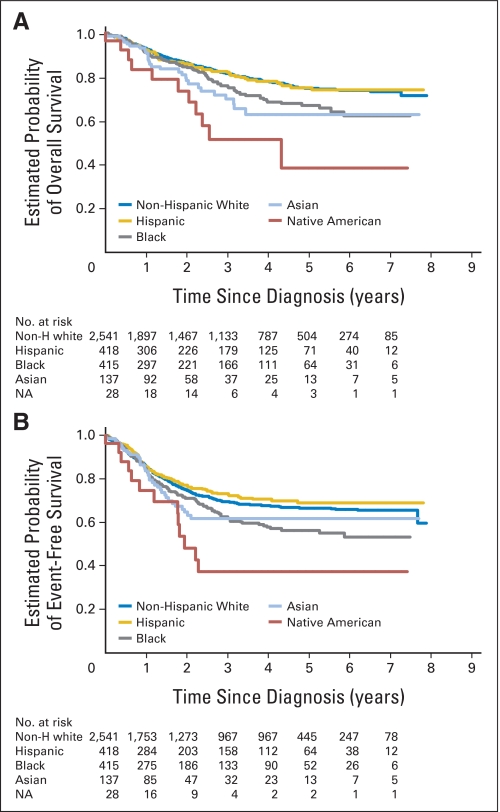
Results: A total of 3,539 patients (white, 72%; black, 12%; Hispanic, 12%; Asian, 4%; and Native American, < 1%) with neuroblastoma were included. The 5-year event-free survival (EFS) rates were 67% for whites (95% CI, 65% to 69%), 69% for Hispanics (95% CI, 63% to 74%), 62% for Asians (95% CI, 51% to 71%), 56% for blacks (95% CI, 50% to 62%), and 37% for Native American (95% CI, 17% to 58%). Blacks (P < .001) and Native Americans (P = .04) had a higher prevalence of high-risk disease than whites, and significantly worse EFS (P = .01 and P = .002, respectively). Adjustment for risk group abrogated these differences. However, closer examination of the EFS among high-risk patients who remained event free for 2 years or longer, revealed a higher prevalence of late-occurring events among blacks compared with whites (hazard ratio, 1.5; 95% CI, 1.0 to 2.3; P = .04).
Conclusion: Black and Native American patients with neuroblastoma have a higher prevalence of high-risk disease, accounting for their worse EFS when compared with whites. The higher prevalence of late-occurring events among blacks with high-risk disease suggests that this population may be more resistant to chemotherapy. Studies focused on delineating the genetic basis for the racial disparities observed in this study are planned.
Conflict of interest statement
Authors' disclosures of potential conflicts of interest and author contributions are found at the end of this article.
Figures
References
-
- Maris JM, Hogarty MD, Bagatell R, et al. Neuroblastoma. Lancet. 2007;369:2106–2120. - PubMed
-
- Schmidt ML, Lukens JN, Seeger RC, et al. Biologic factors determine prognosis in infants with stage IV neuroblastoma: A prospective Children's Cancer Group Study. J Clin Oncol. 2000;18:1260–1268. - PubMed
-
- Bagatell R, Rumcheva P, London WB, et al. Outcomes of children with intermediate-risk neuroblastoma after treatment stratified by MYCN status and tumor cell ploidy. J Clin Oncol. 2005;23:8819–8827. - PubMed
-
- De Bernardi B, Gerrard M, Boni L, et al. Excellent outcome with reduced treatment for infants with disseminated neuroblastoma without MYCN gene amplification. J Clin Oncol. 2009;27:1034–1040. - PubMed
Publication types
MeSH terms
Grants and funding
LinkOut - more resources
Full Text Sources
Medical
