Comparative Study
. 2010 Nov 23;75(21):1904-11.
doi: 10.1212/WNL.0b013e3181feb283.

Afferent baroreflex failure in familial dysautonomia

Affiliations
Comparative Study

Afferent baroreflex failure in familial dysautonomia

Lucy Norcliffe-Kaufmann et al. Neurology. .

Abstract

Background: Familial dysautonomia (FD) is due to a genetic deficiency of the protein IKAP, which affects development of peripheral neurons. Patients with FD display complex abnormalities of the baroreflex of unknown cause.

Methods: To test the hypothesis that the autonomic phenotype of FD is due to selective impairment of afferent baroreceptor input, we examined the autonomic and neuroendocrine responses triggered by stimuli that either engage (postural changes) or bypass (cognitive/emotional) afferent baroreflex pathways in 50 patients with FD and compared them to those of normal subjects and to those of patients with pure autonomic failure (PAF), a disorder with selective impairment of efferent autonomic neurons.

Results: During upright tilt, in patients with FD and in patients with PAF blood pressure fell markedly but the heart rate increased in PAF and decreased in FD. Plasma norepinephrine levels failed to increase in both groups. Vasopressin levels increased appropriately in patients with PAF but failed to increase in patients with FD. Head-down tilt increased blood pressure in both groups but increased heart rate only in patients with FD. Mental stress evoked a marked increase in blood pressure and heart rate in patients with FD but little change in those with PAF.

Conclusion: The failure to modulate sympathetic activity and to release vasopressin by baroreflex-mediated stimuli together with marked sympathetic activation during cognitive tasks indicate selective failure of baroreceptor afference. These findings indicate that IKAP is critical for the development of afferent baroreflex pathways and has therapeutic implications in the management of these patients.


Figures
None
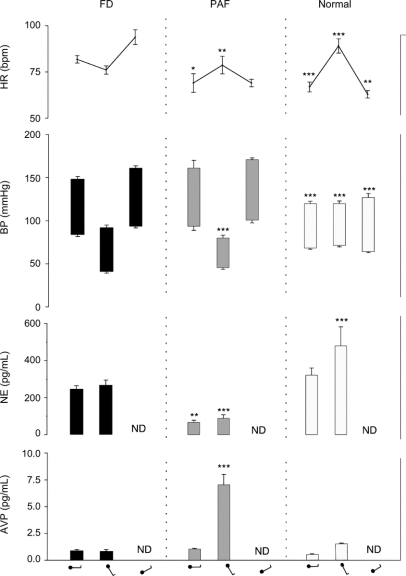
Figure 1 Heart rate (HR), blood pressure (BP), plasma norepinephrine (NE), and plasma vasopressin concentration while in the supine position and during head-up and head-down tilt in patients with familial dysautonomia (FD), patients with pure autonomic failure (PAF), and normal controls AVP = arginine vasopressin; ND = not done. Figurine denotes position on the tilt table (supine, head-up and head-down tilt). ***p < 0.001, **p < 0.02, *p < 0.05.
None
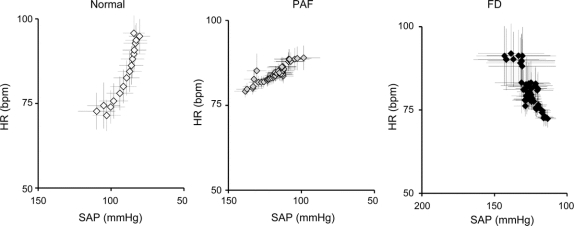
Figure 2 Baroreflex function in patients with familial dysautonomia, patients with pure autonomic failure, and healthy controls Baroreflex function was determined by the relationship between blood pressure and heart rate during the first 40 beats of upright tilt. Each value represents the average of 50 subjects. Quantification of these data showed that cardiac baroreflex sensitivity was −0.87 bpm/mm Hg in controls (y = −0.87x + 163, R2 = 0.88, p < 0.001), −0.24 bpm/mm Hg in PAF (y = −0.24x + 113, R2 0.81, p < 0.001), and +0.71 bpm/mm Hg in FD (y = +0.71x – 8, R2 = 0.74, p < 0.01). FD = familial dysautonomia; HR = heart rate; PAF = pure autonomic failure; SAP = systolic arterial pressure.
None
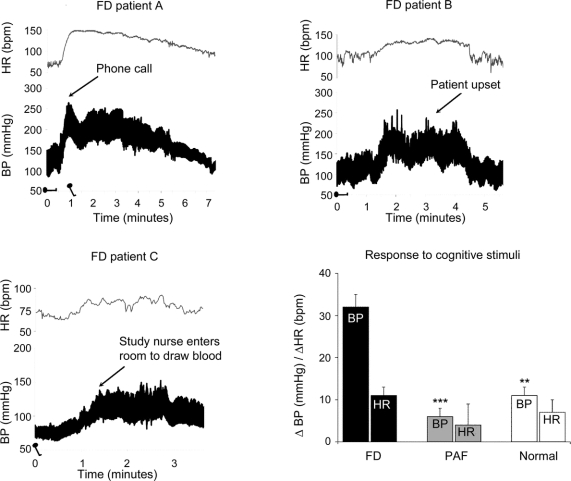
Figure 3 Blood pressure (BP) and heart rate (HR) during emotional arousal and cognitive stimuli (A) Beat-to-beat BP and HR in a patient with familial dysautonomia (FD) who received an unexpected phone call from a friend. Her BP and HR rose in parallel. She was then tilted to the upright position (min 1). BP initially fell, but quickly rose again. (B) BP and HR in a boy with FD during an argument with his mother. (C) BP and HR in a patient with FD when the study nurse enters the room to draw blood. (D) Changes in BP and HR in patients with FD, pure autonomic failure (PAF), and normal controls induced by a cognitive stimulus (mental arithmetic).
None
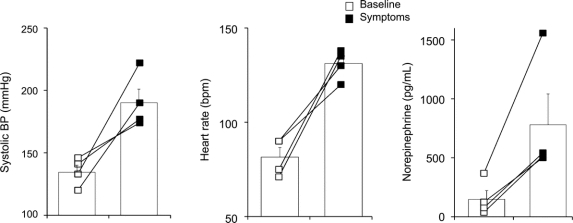
Figure 4 Blood pressure (BP), heart rate, and plasma catecholamine levels during typical crisis triggered by emotionally charged situations Left bar charts show systolic BP, middle bar chart shows heart rate, and right bar chart shows plasma norepinephrine concentration at baseline (open squares) and during a typical crisis provoked by an emotionally charged situation (black squares).
None
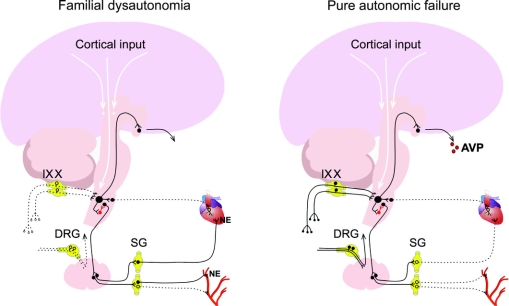
Figure 5 Afferent and efferent pathways involved in cardiovascular control in patients with familial dysautonomia and patients with pure autonomic failure Dotted line indicates site of abnormality. IX = glossopharyngeal neurons with cell bodies in the petrosal ganglia relaying information from the carotid baroreceptors; X = vagal neurons with cell bodies in the nodose ganglia relaying information from baroreceptors in the aortic arch; AVP = arginine vasopressin; DRG = dorsal root ganglia with cell bodies of primary sensory neurons; NE = norepinephrine; SG = sympathetic ganglia.

References

    1. Slaugenhaupt SA, Blumenfeld A, Gill SP, et al. Tissue-specific expression of a splicing mutation in the IKBKAP gene causes familial dysautonomia. Am J Hum Genet 2001;68:598–605. - PMC - PubMed
    1. Anderson SL, Coli R, Daly IW, et al. Familial dysautonomia is caused by mutations of the IKAP gene. Am J Hum Genet 2001;68:753–758. - PMC - PubMed
    1. Riley CM, Day RA, Greeley DM, Landford WS. Central autonomic dysfunction with defective lacrimation: I: report of five cases. Pediatrics 1949;3:468–478. - PubMed
    1. Pearson J, Pytel BA, Grover-Johnson N, Axelrod F, Dancis J. Quantitative studies of dorsal root ganglia and neuropathologic observations on spinal cords in familial dysautonomia. J Neurol Sci 1978;35:77–92. - PubMed
    1. Brown WJ, Beauchemin JA, Linde LM. A neuropathological study of familial dysautonomia (Riley-Day syndrome) in siblings. J Neurol Neurosurg Psychiatry 1964;27:131–139. - PMC - PubMed

Publication types

MeSH terms