. 2010 Dec 21;122(25):2669-79.
doi: 10.1161/CIRCULATIONAHA.110.982298. Epub 2010 Nov 15.

Ryanodine receptor phosphorylation by calcium/calmodulin-dependent protein kinase II promotes life-threatening ventricular arrhythmias in mice with heart failure

Affiliations

Ryanodine receptor phosphorylation by calcium/calmodulin-dependent protein kinase II promotes life-threatening ventricular arrhythmias in mice with heart failure

Ralph J van Oort et al. Circulation. .

Abstract

Background: approximately half of patients with heart failure die suddenly as a result of ventricular arrhythmias. Although abnormal Ca(2+) release from the sarcoplasmic reticulum through ryanodine receptors (RyR2) has been linked to arrhythmogenesis, the molecular mechanisms triggering release of arrhythmogenic Ca(2+) remain unknown. We tested the hypothesis that increased RyR2 phosphorylation by Ca(2+)/calmodulin-dependent protein kinase II is both necessary and sufficient to promote lethal ventricular arrhythmias.

Methods and results: mice in which the S2814 Ca(2+)/calmodulin-dependent protein kinase II site on RyR2 is constitutively activated (S2814D) develop pathological sarcoplasmic reticulum Ca(2+) release events, resulting in reduced sarcoplasmic reticulum Ca(2+) load on confocal microscopy. These Ca(2+) release events are associated with increased RyR2 open probability in lipid bilayer preparations. At baseline, young S2814D mice have structurally and functionally normal hearts without arrhythmias; however, they develop sustained ventricular tachycardia and sudden cardiac death on catecholaminergic provocation by caffeine/epinephrine or programmed electric stimulation. Young S2814D mice have a significant predisposition to sudden arrhythmogenic death after transverse aortic constriction surgery. Finally, genetic ablation of the Ca(2+)/calmodulin-dependent protein kinase II site on RyR2 (S2814A) protects mutant mice from pacing-induced arrhythmias versus wild-type mice after transverse aortic constriction surgery.

Conclusions: our results suggest that Ca(2+)/calmodulin-dependent protein kinase II phosphorylation of RyR2 Ca(2+) release channels at S2814 plays an important role in arrhythmogenesis and sudden cardiac death in mice with heart failure.


Conflict of interest statement

CONFLICT OF INTEREST DISCLOSURES: M.E.A. is a named inventor on several patents that claim to treat arrhythmias by CaMKII inhibition.

Figures

Figure 1
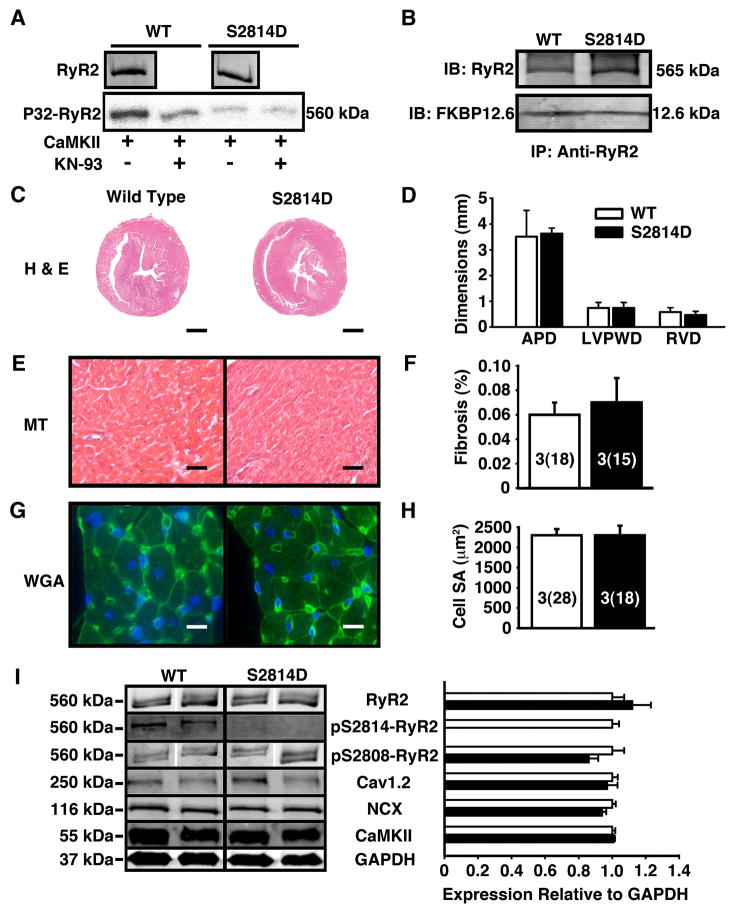
Figure 1. Baseline molecular and structural characteristics of S2814D mice
(A) The S2814D mutation prevents CaMKII mediated phosphorylation of RyR2. Equal amounts of RyR2 protein were immunoprecipitated from WT and S2814D hearts and phosphorylated with CaMKII in the presence or absence of KN93. Shown is a representative example of an experiment repeated twice. (B) Co-immunoprecipitation showing that the binding of FKBP12.6 to RyR2 was not altered in S2814D mice. (C) Representative histological sections of 3 month-old mouse hearts stained with hematoxylin and eosin (H&E). Scale bar lines represent 1 mm (D) Cardiac wall dimensions assessed from H&E histological sections. Left-ventricular (LV) anterior-posterior diameter (APD), LV posterior wall diameter (LVPWD) and right ventricular (RV) wall diameter (RVD) were similar among WT and S2814D hearts. (E) Masson’s Trichrome for fibrosis of histological sections of 3 month-old mouse hearts. Scale bar lines represent 30 μm. (F) Percent fibrosis quantified from Masson’s Trichrome stain. (G) Representative wheat germ agglutinin fluorescence stains (WGA) of mouse cardiomyocytes. Scale bars represent 10 μm. (H) Cardiomyocyte surface area calculated from WGA stains. (I) Western blot and phosphorylation assays showing baseline protein expression and phosphorylation of RyR2 at baseline. On Western blot, expression of the cardiac ryanodine receptor (RyR2), the L-type Ca2+ channel (Cav1.2), Na+/Ca2+-exchanger (NCX), and Ca2+/calmodulin kinase II (CaMKII) were not statistically different between WT and S2814D mouse hearts at rest. GAPDH was used as a loading control for Western Blots. Number of animals (number of cells) is indicated in bar graphs.
Figure 2
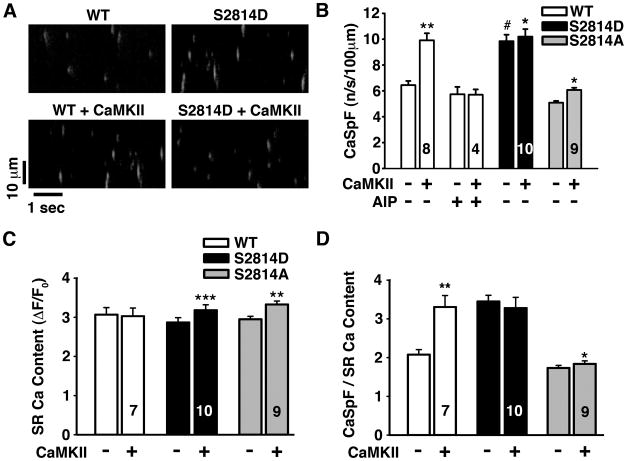
Figure 2. CaMKII phosphorylation induces RyR2 mediated SR calcium leak in permeabilized myocytes
(A) Respresentative confocal line-scan images obtained in permeabilized cardiomyocytes from WT and S2814D mice before and after activation of endogenous CaMKII. (B) Quantification of Ca2+ spark frequency (CaSpF) in cardiomyocytes isolated from WT, S2814D and S2814A mice in the absence (−) or presence (+) of CaMKII and CaMKII inhibitor AIP. (C) SR calcium content (ΔF/F0) in permeabilized myocytes in the absence (−) or presence (+) of CaMKII. (D) Ratio of calcium spark frequency (CaSpF) to SR calcium content. WT myocytes had a significantly increased CaSpF/SR content ratio in the presence of CaMKII. N is indicated in bar graphs. 2-way repeated measures ANOVA was used to compare groups. *P<0.05, **P<0.01, *** P<0.001 vs. same genotype without CaMKII; # P<0.05 vs. WT.
Figure 3
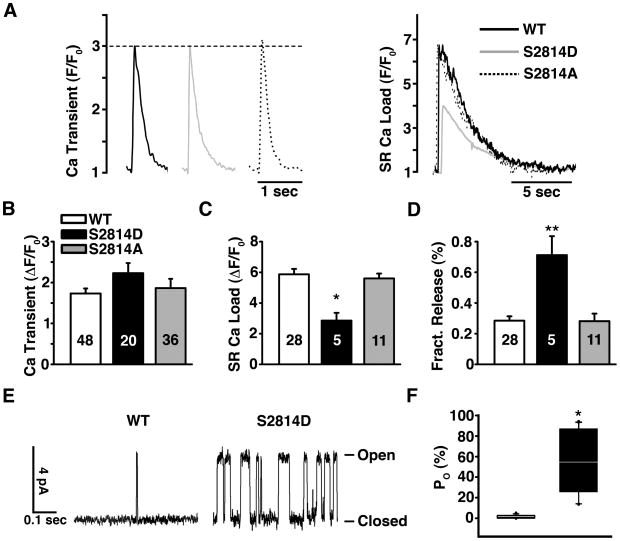
Figure 3. CaMKII phosphorylation induces RyR2 mediated SR calcium leak and reduced SR calcium load in intact myocytes
(A) Representative Ca2+ transients (left) and superimposed SR load traces (right) expressed as F/F0. (B) Average twitch Ca2+ transient amplitude (DF/F0) in WT, S2814D, and S2814A cardiomyocytes. (C) Averaged peak fluorescence ratio (DF/F0) obtained by 10 mM caffeine application in WT, S2814D, and S2814A cardiomyocytes. (D) Fractional Ca2+ release expressed as ratio for twitch Ca2+ transient/caffeine transient in WT, S2814D, and S2814A cardiomyocytes. (E and F) CaMKII phosphorylation activates RyR2. RyR2 open probablity (Po) is increased in S2814D mice (see box plot in F) as calculated from RyR2 single channel recordings (n=14 channels for each group) (E). N is indicated in bar graphs. 2-way repeated measures ANOVA was used to compare Ca2+ imaging data. The Mann-Whitney U-test was used to compare Po. *P<0.05, **P<0.01, ***P<0.001 versus WT.
Figure 4
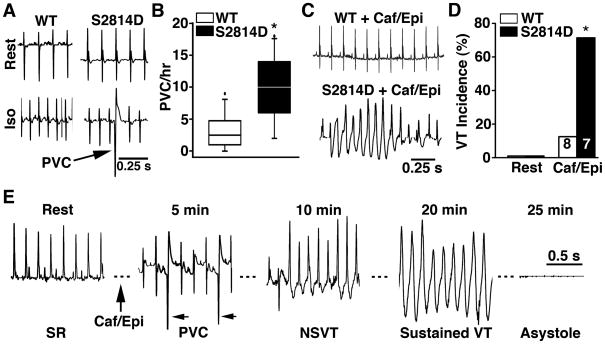
Figure 4. Constitutive CaMKII phosphorylation of RyR2 leads to ventricular arrhythmias and sudden cardiac death
(A) Representative ECG telemetry tracings in wild type (WT) and S2814D knock-in mice at rest and following injection of isoproterenol (Iso; 0.5 mg/kg i.p.). Arrow indicates pro-arrhythmic premature ventricular complex (PVC). (B) Box plot showing incidence of PVCs in WT and S2814D mice before and after Iso challenge. (C) Representative telemetric ECG tracings from WT and S2814D mice following injection of caffeine and epinephrine (Caf/Epi; 120 mg/kg and 2 mg/kg i.p., respectively). (D) Ventricular tachycardia (VT) was observed in the majority of S2814D mice following Caf/Epi. (E) ECG waveform showing baseline ECG tracing of a S2814D mouse in sinus rhythm (heart rate 431 beats per minute, bpm). Upon the injection of caffeine and epinephrine (caf/epi), heart rate increased to 480 bpm, and premature ventricular contractions (PVC) occurred starting at 5 minutes post caf/epi. At 10 minutes, episodes of non-sustained ventricular tachycardia (NSVT) started occurring (570 bpm), eventually deteriorating into an episode of sustained VT starting at 20 minutes (ventricular rate varying between 588–667 bpm). Immediately following this VT episode, the mouse developed progressive heart block followed by asystole and death at 25 min. N is indicated in bar graphs. The Mann-Whitney U test was used to compare absolute PVC incidence; Fisher’s exact test was used to evaluate VT incidence. *P<0.05, **P<0.01 versus WT.
Figure 5
Figure 5. CaMKII phosphorylation of RyR2 is critical for development of ventricular arrhythmias in normal and failing hearts
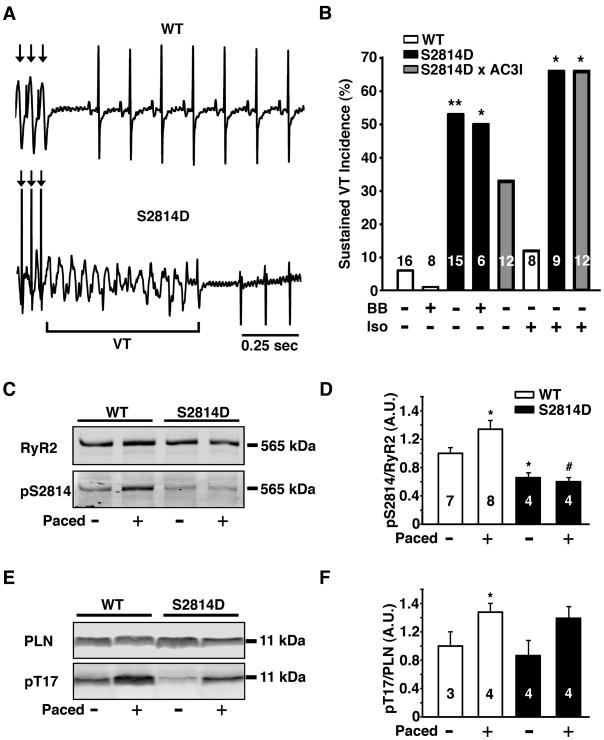
(A) Representative ECG traces after injection of 0.5 mg/kg isoproterenol and intracardiac overdrive pacing. Wild type (WT) mice exhibited normal sinus rhythm after intracardiac pacing, while S2814D mice were predisposed to development of ventricular tachycardia (VT). (B) Percent incidence of overdrive pacing-induced VT in WT, S2814D, and S2814D:AC3I mice with (+) and without (−) agonist isoproterenol (Iso, 0.5 mg/kg i.p.) and propranolol beta blocker (BB, 3 mg/kg i.p). (C) Representative Western blot of the RyR2 CaMKII site (S2814) in WT and S2814D mice before and after intracardiac pacing. (D) WT mice have a significant increase in phosphorylation at the CaMKII site S2814, whereas S2814D mice cannot be phosphorylated at the site. (E) Representative Western blot of the phospholamban (PLN) CaMKII site (T17) before and after intracardiac pacing. (F) There is a significant increase in phosphorylation of PLN by CaMKII in WT mice. N is indicated in bar graphs. Fisher’s Exact test was used to compare VT incidence data; an unpaired Student’s t-test was used to compare phosphorylation data. *P<0.05, **P<0.01 vs. WT treatment-matched control; # P<0.05 vs. S2814D non-paced control.
Figure 6
Figure 6. CaMKII phosphorylation of RyR2 causes cardiac dilation, loss of contractility, and early death from arrhythmias
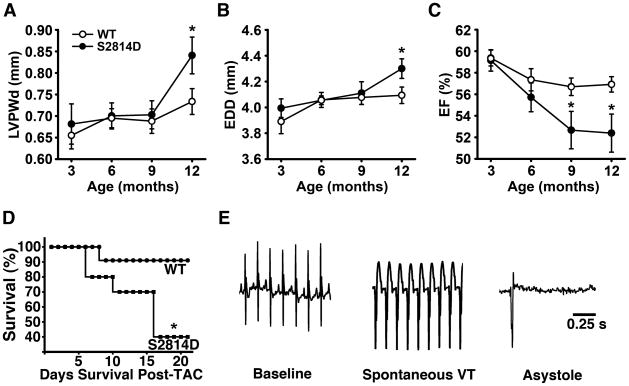
(A) Echocardiographic measurements of left ventricular posterior wall diameter (LVPWD), (B) end diastolic diameter (EDD), and (C) ejection fraction (EF) in S2814D and WT mice from 3 to 12 months. S2814D mice have significantly increased diastolic dimensions and reduction in EF versus WT mice (n = 14, both groups). (D) Kaplan-Meier survival curve in S2814D (n=10) and WT (n=11) mice 3 weeks post-TAC. (E) Representative ECG tracing of an arrhythmogenic death in a S2814D mouse that died post-TAC surgery day 21. Sudden death following ventricular tachycardia was only observed in S2814D mice, and in none of the WT mice after TAC. *P<0.05 vs. WT. Student’s t-test was used to compare echocardiographic data. A log-rank test was used to evaluate survival analysis.
Figure 7
Figure 7. Genetic blockade of CaMKII phosphorylation of RyR2 reduces risk for pacing-induced ventricular ectopy
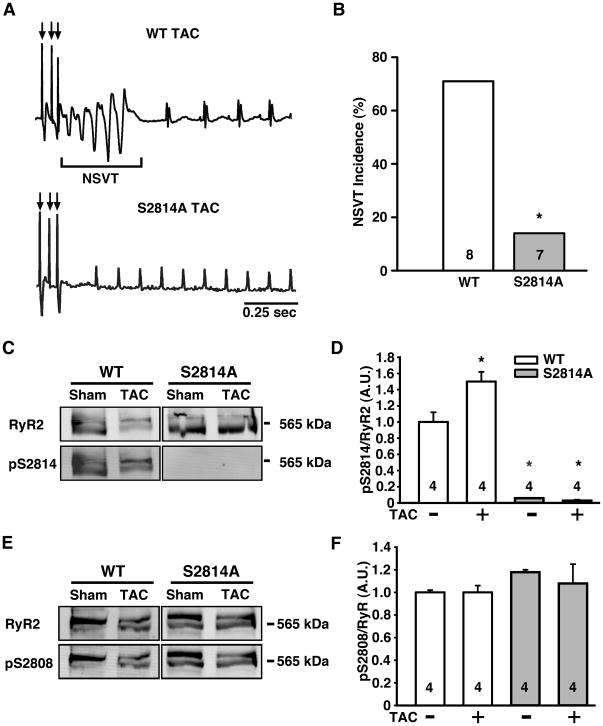
(A) Representative ECG tracing of pacing-induced non-sustained VT (NSVT) in WT mice 8 weeks after transverse aortic constriction (TAC; top), whereas the S2814A TAC mice typically showed sinus rhythm (bottom). (B) Bar graph showing incidence of pacing-induced NSVT in WT and S2814A mice at 8 weeks post-TAC. (C) Representative Western blots showing total RyR2 and CaMKII-phosphorylated RyR2 at S2814 in WT and S2814A mice at 8 weeks after transverse aortic constriction (TAC). (D) Bar graphs showing averaged ratio between phosphorylated RyR2-pS2814 and total RyR2. (E) Representative Western blots showing total RyR2 and PKA-phosphorylated RyR2 at S2808 in WT and S2814A mice at 8 weeks after TAC. (F) Bar graphs showing averaged ratio between phosphorylated RyR2-pS2808 and total RyR2. N is shown in bar graphs. Fisher’s Exact test was used to compare NSVT incidence; Student’s t-test was used to compare Western blot data. *P<0.05 versus WT surgically matched control.

References

    1. Farr MA, Basson CT. Sparking the failing heart. N Engl J Med. 2004;351:185–187. - PubMed
    1. Noseworthy PA, Newton-Cheh C. Genetic determinants of sudden cardiac death. Circulation. 2008;118:1854–1863. - PubMed
    1. Bers DM. Cardiac excitation-contraction coupling. Nature. 2002;415:198–205. - PubMed
    1. Pogwizd SM, Bers DM. Cellular basis of triggered arrhythmias in heart failure. Trends Cardiovasc Med. 2004;14:61–66. - PubMed
    1. Chelu MG, Sarma S, Sood S, Wang S, van Oort RJ, Skapura DG, Li N, Santonastasi M, Muller FU, Schmitz W, Schotten U, Anderson ME, Valderrabano M, Dobrev D, Wehrens XH. Calmodulin kinase II-mediated sarcoplasmic reticulum Ca2+ leak promotes atrial fibrillation in mice. J Clin Invest. 2009;119:1940–1951. - PMC - PubMed

Publication types

MeSH terms

Substances