


Case Reports
doi: 10.1159/000321791.
Epub 2010 Nov 24.
Plasma glial fibrillary acidic protein levels in a child with sickle cell disease and stroke
Affiliations
- PMID: 21099215
- PMCID: PMC3202928
- DOI: 10.1159/000321791
Item in Clipboard
Case Reports
Plasma glial fibrillary acidic protein levels in a child with sickle cell disease and stroke
Acta Haematol.
2011.
Abstract
A 12-year-old boy with HbSS sickle cell disease (SCD) was admitted with an acute febrile illness and developed overt stroke 3 days later. Plasma glial fibrillary acidic protein levels were elevated, as compared to pediatric controls, 32 h prior to the clinical diagnosis of stroke, peaked immediately prior to the exchange transfusion, and remained elevated 1 year later despite chronic transfusion therapy. Stroke in SCD can occur in the setting of acute illness, and a biomarker that could predict the onset and triage ill children to therapeutic intervention more quickly would be useful.
Copyright © 2010 S. Karger AG, Basel.
Figures
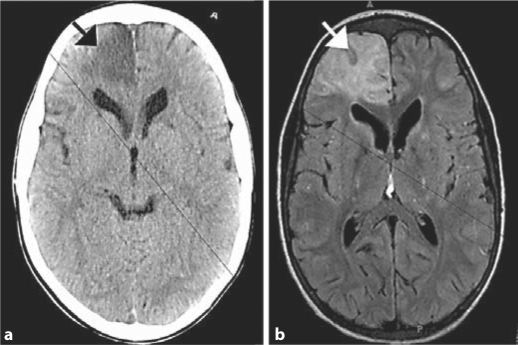
Neuroimaging of acute stroke in a 12-year-old HbSS patient who had plasma GFAP followed serially. a Noncontrast head CT immediately after clinical diagnosis of stroke showing a wedge of hypoattenuation in the right frontal lobe (arrow). b FLAIR MRI image 29 h after clinical diagnosis of stroke showing an evolving right anterior cerebral artery infarct (arrow).
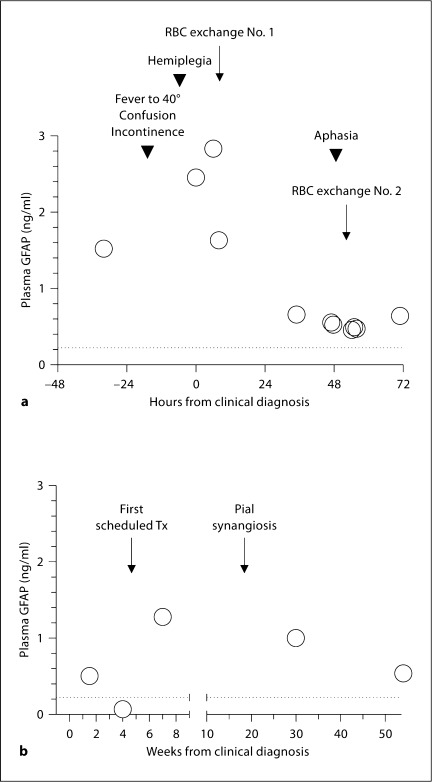
a Serial plasma GFAP levels in a 12-year-old patient with HbSS and acute stroke. A red cell exchange transfusion was performed 5 h after clinical diagnosis and again 47 h later for new neurologic deficits. The dotted line marks the 95th percentile value among 60 healthy pediatric controls. Arrowheads mark the presentation of relevant signs and symptoms. b Fifty-four weeks of follow-up GFAP measurements.
References
-
- Ohene-Frempong K, Weiner SJ, Sleeper LA, Miller ST, Embury S, Moohr JW, Wethers DL, Pegelow CH, Gill FM. Cerebrovascular accidents in sickle cell disease: rates and risk factors. Blood. 1998;91:288–294. - PubMed
-
- Verduzco LA, Nathan DG. Sickle cell disease and stroke. Blood. 2009;114:5117–5125. - PubMed
-
- Adams RJ, Brambilla D. Discontinuing prophylactic transfusions used to prevent stroke in sickle cell disease. N Engl J Med. 2005;353:2769–2778. - PubMed
-
- Woertgen C, Rothoerl RD, Wiesmann M, Missler U, Brawanski A. Glial and neuronal serum markers after controlled cortical impact injury in the rat. Acta Neurochir Suppl. 2002;81:205–207. - PubMed
Publication types
MeSH terms
Substances
Grants and funding
LinkOut - more resources
Full Text Sources
Other Literature Sources
Medical
