


Home compared with clinic-based screening for sexually transmitted infections: a randomized controlled trial
- PMID: 21099596
- PMCID: PMC3120128
- DOI: 10.1097/AOG.0b013e3181fae60d
Home compared with clinic-based screening for sexually transmitted infections: a randomized controlled trial
Abstract
Objective: To determine whether home-based screening for sexually transmitted infections results in a higher sexually transmitted infection screening rate compared with clinic-based screening in participants using long-acting reversible contraception.
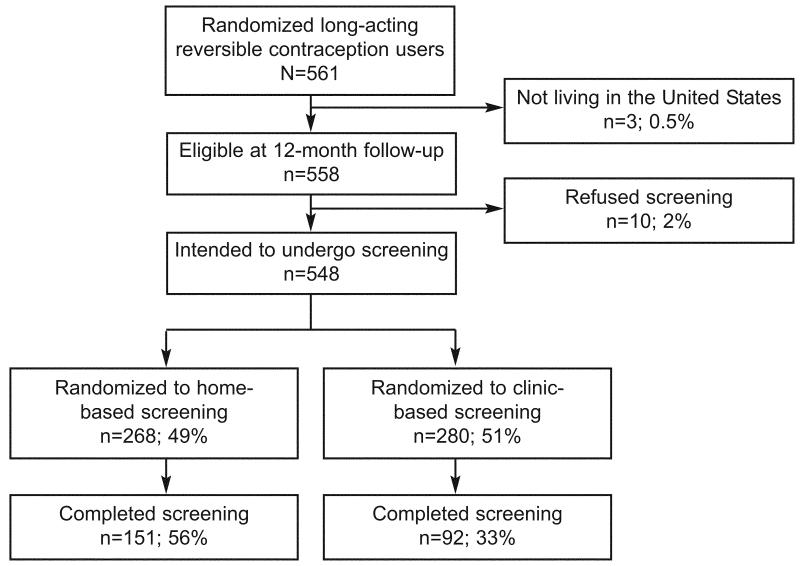
Methods: We performed a randomized clinical trial of women using long-acting reversible contraception methods in the Contraceptive CHOICE Project (n=558). Participants were randomly assigned to home-based testing (swabs mailed to the participant's home) or clinic-based testing. Self-collected vaginal swabs were tested for Chlamydia trachomatis and Neisseria gonorrhoeae using strand displacement analysis. We estimated the relative risk (RR) of screening by group using Poisson regression with robust error variance.
Results: The randomization groups were similar at baseline, except for marital status; the clinic group had more never-married women (62.0% compared with 51.6%), and the home group had more divorced women (12.1% compared with 5.6%, P=.007). Women in the home group were more likely to self-report screening compared with women in the clinic group in the multivariable analysis (56.3% compared with 32.9%; RR 1.7; 95% confidence interval [CI] 1.4-2.0). When analyzed by tests received or documented in medical records, similar results were obtained (56.3% compared with 25.0%; RR 2.2; 95% CI 1.7-2.7). Women who completed screening had higher levels of education and were more likely to receive public assistance compared with those who did not complete screening.
Conclusion: Long-acting reversible contraception users randomized to sexually transmitted infection screening at home were more likely to complete screening than those randomized to traditional clinic-based screening. Home-based screening may be useful in women using long-acting reversible contraceptive methods who may not present for regular screening.
Clinical trial registration: ClinicalTrials.gov, www.clinicaltrials.gov, NCT01184157.
Figures
References
-
- Weinstock H, Berman S, Cates W., Jr. Sexually transmitted diseases among American youth: incidence and prevalence estimates, 2000. Perspect Sex Reprod Health. 2004 Jan-Feb;36(1):6–10. - PubMed
-
- Workowski KA, Berman SM. Sexually transmitted diseases treatment guidelines, 2006. MMWR Recomm Rep. 2006 Aug 4;55(RR-11):1–94. - PubMed
-
- Cook RL, Hutchison SL, Ostergaard L, Braithwaite RS, Ness RB. Systematic review: noninvasive testing for Chlamydia trachomatis and Neisseria gonorrhoeae. Ann Intern Med. 2005 Jun 7;142(11):914–25. - PubMed
-
- Levine WC, Dicker LW, Devine O, Mosure DJ. Indirect estimation of Chlamydia screening coverage using public health surveillance data. Am J Epidemiol. 2004 Jul 1;160(1):91–6. - PubMed
Publication types
MeSH terms
Substances
Associated data
Grants and funding
LinkOut - more resources
Full Text Sources
Medical
