


Effects of ATPM-ET, a novel κ agonist with partial μ activity, on physical dependence and behavior sensitization in mice
- PMID: 21102484
- PMCID: PMC4002947
- DOI: 10.1038/aps.2010.164
Effects of ATPM-ET, a novel κ agonist with partial μ activity, on physical dependence and behavior sensitization in mice
Abstract
Aim: to investigate the effects of ATPM-ET [(-)-3-N-Ethylaminothiazolo [5,4-b]-N-cyclopropylmethylmorphinan hydrochloride] on physical dependence and behavioral sensitization to morphine in mice.
Methods: the pharmacological profile of ATPM-ET was characterized using competitive binding and GTPγS binding assays. We then examined the antinociceptive effects of ATPM-ET in the hot plate test. Morphine dependence assay and behavioral sensitization assay were used to determine the effect of ATPM-ET on physical dependence and behavior sensitization to morphine in mice.
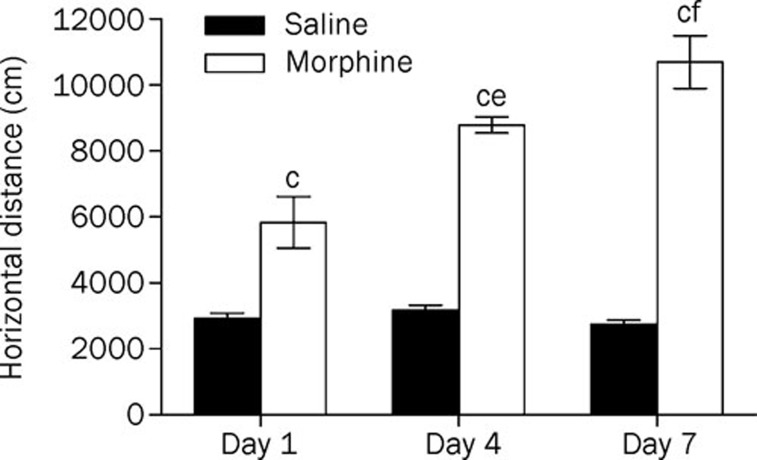
Results: the binding assay indicated that ATPM-ET ATPM-ET exhibited a high affinity to both κ- and μ-opioid receptors with K(i) values of 0.15 nmol/L and 4.7 nmol/L, respectively, indicating it was a full κ-opioid receptor agonist and a partial μ-opioid receptor agonist. In the hot plate test, ATPM-ET produced a dose-dependent antinociceptive effect, with an ED(50) value of 2.68 (2.34-3.07) mg/kg. Administration of ATPM-ET (1 and 2 mg/kg, sc) prior to naloxone (3.0 mg/kg, sc) injection significantly inhibited withdrawal jumping of mice. In addition, ATPM-ET (1 and 2 mg/kg, sc) also showed a trend toward decreasing morphine withdrawal-induced weight loss. ATPM-ET (1.5 and 3 mg/kg, sc) 15 min before the morphine challenge significantly inhibited the morphine-induced behavior sensitization (P<0.05).
Conclusion: ATPM-ET may have potential as a therapeutic agent for the treatment of drug abuse.
Figures



References
-
- Wells JL, Bartlett JL, Ananthan S, Bilsky EJ. In vivo pharmacological characterization of SoRI 9409, a nonpeptidic opioid mu-agonist/delta-antagonist that produces limited antinociceptive tolerance and attenuates morphine physical dependence. J Pharmacol Exp Ther. 2001;297:597–605. - PubMed
-
- Sepulveda J, Ortega A, Zapata G, Contreras E. Acamprosate decreases the induction of tolerance and physical dependence in morphine-treated mice. Eur J Pharmacol. 2002;445:87–91. - PubMed
-
- Fattore L, Spano MS, Deiana S, Melis V, Cossu G, Fadda P, et al. An endocannabinoid mechanism in relapse to drug seeking: a review of animal studies and clinical perspectives. Brain Res Rev. 2007;53:1–16. - PubMed
-
- Lyvers M. Drug addiction as a physical disease: the role of physical dependence and other chronic drug-induced neurophysiological changes in compulsive drug self-administration. Exp Clin Psychopharmacol. 1998;6:107–25. - PubMed
-
- Bell K, Salmon A. Pain, physical dependence and pseudoaddiction: redefining addiction for 'nice' people. Int J Drug Policy. 2009;20:170–8. - PubMed
Publication types
MeSH terms
Substances
LinkOut - more resources
Full Text Sources
Research Materials
Miscellaneous
