Case Reports
doi: 10.1159/000227735.
Aneurysm of the Superior Posterior Pancreatic-Duodenal Artery Presenting with Recurrent Syncopes
Affiliations
- PMID: 21103280
- PMCID: PMC2988962
- DOI: 10.1159/000227735
Item in Clipboard
Case Reports
Aneurysm of the Superior Posterior Pancreatic-Duodenal Artery Presenting with Recurrent Syncopes
Case Rep Gastroenterol.
.
Abstract
We present a 61-year-old woman with hypovolemic shock due to a ruptured aneurysm of the superior posterior pancreatic-duodenal artery in whom recurrent syncopes were the first presenting sign of pancreatic-duodenal artery aneurysm (PDAA). PDAA is a rare but life-threatening condition. The widely varying symptomatology may lead to a delay in diagnosis and treatment. Patients with atypical symptoms, such as vague abdominal pain, recurrent dizziness or syncope, may actually suffer from a sentinel bleeding of the vascular malformation. Radiological imaging, especially selective angiography, may provide a diagnostic as well as a therapeutic tool in these patients.
Figures
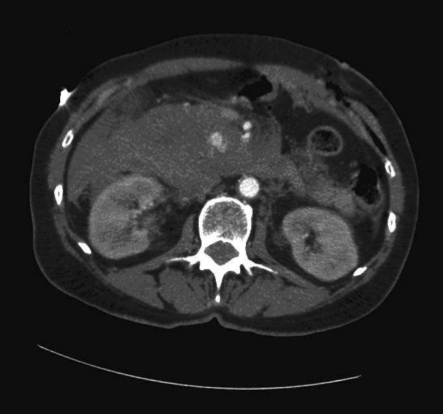
An active extravasation of contrast arising from a branch of the superior mesenteric artery with a large haematoma around the duodenum.

Selective angiography of the superior mesenteric artery. Approximately 5 cm from the major branch a small bleeding infarction is visible. Also, a large connection between the superior mesenteric artery and the celiac trunk via the gastroduodenal artery is present. This connection is also feeding the small bleeding.
References
-
- Stabile BE, Wilson SE, Debas HT. Reduced mortality from bleeding pseudocysts and pseudoaneurysms caused by pancreatitis. Arch Surg. 1983;118:45–51. - PubMed
-
- Sharif MA, O'Donnell ME, Johnston LC, Lau LL. Successful surgical management of a ruptured true pancreaticoduodenal artery aneurysm following failed transcatheter embolization. Vascular. 2007;15:231–234. - PubMed
-
- Eckhauser FE, Stanley JC, Zelenock GB, Borlaza GS, Freier DT, Lindenauer SM. Gastroduodenal and pancreaticoduodenal artery aneurysms: a complication of pancreatitis causing spontaneous gastrointestinal hemorrhage. Surgery. 1980;88:335–344. - PubMed
-
- Quandalle P, Chambon JP, Marache P, Saudemont A, Maes B. Pancreaticoduodenal artery aneurysms associated with celiac axis stenosis: report of two cases and review of the literature. Ann Vasc Surg. 1990;4:540–545. - PubMed
Publication types
LinkOut - more resources
Full Text Sources