


Patients' costs and cost-effectiveness of tuberculosis treatment in DOTS and non-DOTS facilities in Rio de Janeiro, Brazil
- PMID: 21103344
- PMCID: PMC2984447
- DOI: 10.1371/journal.pone.0014014
Patients' costs and cost-effectiveness of tuberculosis treatment in DOTS and non-DOTS facilities in Rio de Janeiro, Brazil
Abstract
Background: Costs of tuberculosis diagnosis and treatment may represent a significant burden for the poor and for the health system in resource-poor countries.
Objectives: The aim of this study was to analyze patients' costs of tuberculosis care and to estimate the incremental cost-effectiveness ratio (ICER) of the directly observed treatment (DOT) strategy per completed treatment in Rio de Janeiro, Brazil.
Methods: We interviewed 218 adult patients with bacteriologically confirmed pulmonary tuberculosis. Information on direct (out-of-pocket expenses) and indirect (hours lost) costs, loss in income and costs with extra help were gathered through a questionnaire. Healthcare system additional costs due to supervision of pill-intake were calculated considering staff salaries. Effectiveness was measured by treatment completion rate. The ICER of DOT compared to self-administered therapy (SAT) was calculated.
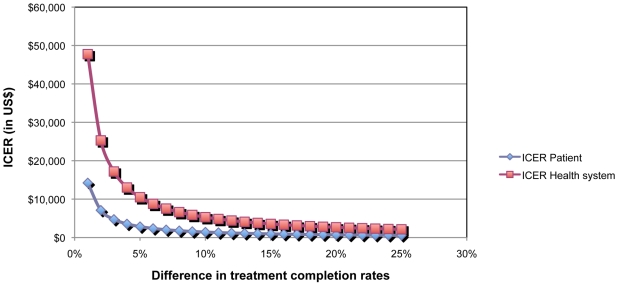
Principal findings: DOT increased costs during the treatment phase, while SAT increased costs in the pre-diagnostic phase, for both the patient and the health system. Treatment completion rates were 71% in SAT facilities and 79% in DOT facilities. Costs per completed treatment were US$ 194 for patients and U$ 189 for the health system in SAT facilities, compared to US$ 336 and US$ 726 in DOT facilities. The ICER was US$ 6,616 per completed DOT treatment compared to SAT.
Conclusions: Costs incurred by TB patients are high in Rio de Janeiro, especially for those under DOT. The DOT strategy doubles patients' costs and increases by fourfold the health system costs per completed treatment. The additional costs for DOT may be one of the contributing factors to the completion rates below the targeted 85% recommended by WHO.
Conflict of interest statement
Figures
References
-
- Muniyandi M, Ramachandran R, Balasubramanian R, Narayanan PR. Socio-economic dimensions of tuberculosis control: review of studies over two decades from Tuberculosis Research Center. J Commun Dis. 2006;38(3):204–215. - PubMed
-
- WHO. Geneva, Switzerland: WHO 2009; 2009. Global Tuberculosis Control: Surveillance, planning, financing. WHO Report 2009 WHO/HTM TB/2009411.
-
- Souza FB, Villa TC, Cavalcante SC, Ruffino Netto A, Lopes LB, et al. Peculiarities of tuberculosis control in a scenario of urban violence in a disadvantaged community in Rio de Janeiro, Brazil. J Bras Pneumol. 2007;33(3):318–322. - PubMed
-
- Cavalcante SC, Soares EC, Pacheco AG, Chaisson RE, Durovni B. Community DOT for tuberculosis in a Brazilian favela: comparison with a clinic model. Int J Tuberc Lung Dis. 2007;11(5):544–549. - PubMed
-
- Needham DM, Godfrey-Faussett P, Foster SD. Barriers to tuberculosis control in urban Zambia: the economic impact and burden on patients prior to diagnosis. Int J Tuberc Lung Dis. 1998;2(10):811–817. - PubMed
Publication types
MeSH terms
Substances
Grants and funding
LinkOut - more resources
Full Text Sources
Medical
Research Materials
