


False Memories for Suggestions: The Impact of Conceptual Elaboration
- PMID: 21103451
- PMCID: PMC2981863
- DOI: 10.1016/j.jml.2010.09.004
False Memories for Suggestions: The Impact of Conceptual Elaboration
Abstract
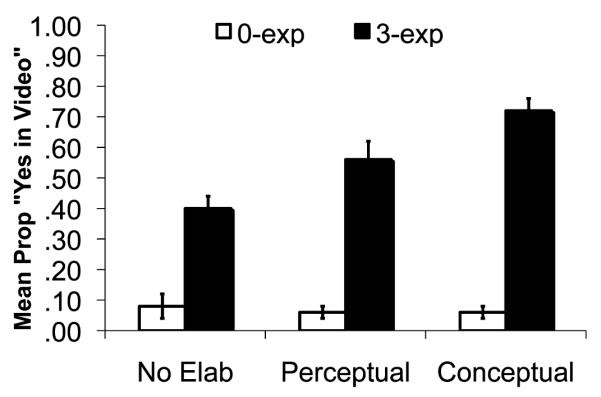
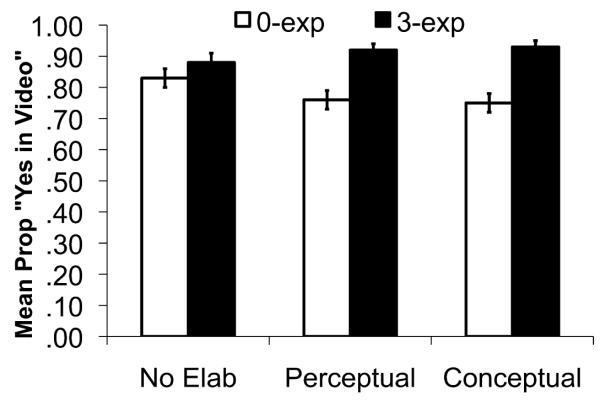
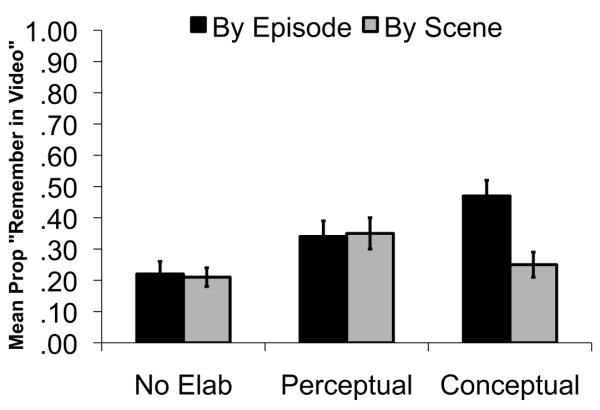
Relatively little attention has been paid to the potential role that reflecting on the meaning and implications of suggested events (i.e., conceptual elaboration) might play in promoting the creation of false memories. Two experiments assessed whether encouraging repeated conceptual elaboration, would, like perceptual elaboration, increase false memory for suggested events. Results showed that conceptual elaboration of suggested events more often resulted in high confidence false memories (Experiment 1) and false memories that were accompanied by the phenomenal experience of remembering them (Experiment 2) than did surface-level processing. Moreover, conceptual elaboration consistently led to higher rates of false memory than did perceptual elaboration. The false memory effects that resulted from conceptual elaboration were highly dependent on the organization of the postevent interview questions, such that conceptual elaboration only increased false memory beyond surface level processing when participants evaluated both true and suggested information in relation to the same theme or dimension.
Figures
References
-
- Bergman E, Roediger HL. Can Bartlett’s repeated reproduction experiments be replicated? Memory & Cognition. 1999;27:937–947. - PubMed
-
- Bransford JD, Johnson MK. Considerations of some problems of comprehension. In: Chase W, editor. Visual information processing. Academic Press; New York: 1973. pp. 383–438.
-
- Brewer WF, Treyens JC. Role of schemata in memory for places. Cognitive Psychology. 1981;13:207–230.
-
- Ceci SJ, Crotteau Huffman ML, Smith E, Loftus EF. Repeatedly thinking about non-events. Consciousness and Cognition. 1994;3:388–407.
-
- Chrobak Q, Zaragoza MS. Inventing stories: Forcing witnesses to fabricate entire fictitious events leads to freely reported false memories. Psychonomic Bulletin and Review. 2008;15(6):1190–1195. - PubMed
Grants and funding
LinkOut - more resources
Full Text Sources