


The association of serum 25-hydroxyvitamin D with indicators of bone quality in men of Caucasian and African ancestry
- PMID: 21104232
- PMCID: PMC3539808
- DOI: 10.1007/s00198-010-1481-1
The association of serum 25-hydroxyvitamin D with indicators of bone quality in men of Caucasian and African ancestry
Abstract
We examined the association of serum 25-hydroxyvitamin D [25(OH)D] with indices of bone quality in older men. Positive associations for 25(OH)D and bone mineral density, content, cortical thickness, and axial and polar strength strain indices were observed among Caucasians; however, among men of African descent findings were either null or negative.
Introduction: There are limited data on serum 25(OH)D and bone measures in men of African ancestry. To better understand racial differences in vitamin D status and bone health, a cross-sectional study among 446 Caucasian men in the US and 496 men of African ancestry in Tobago (age ≥ 65 years) was conducted.
Methods: Serum 25(OH)D (liquid chromatography and tandem mass spectrometry) was measured, and peripheral quantitative computed tomography scans were administered. Bone measures estimated included trabecular and cortical volumetric bone mineral density (vBMD), bone mineral content (BMC), bone geometry (cross-sectional area and cortical thickness), and polar and axial strength strain indices (SSIp and SSIx).
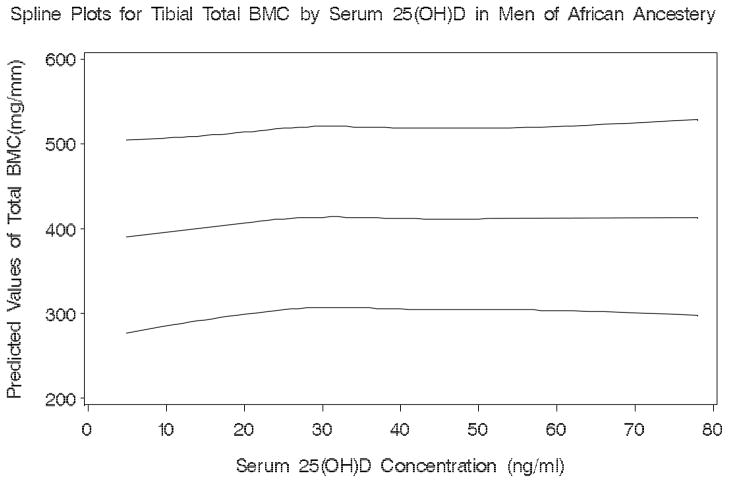
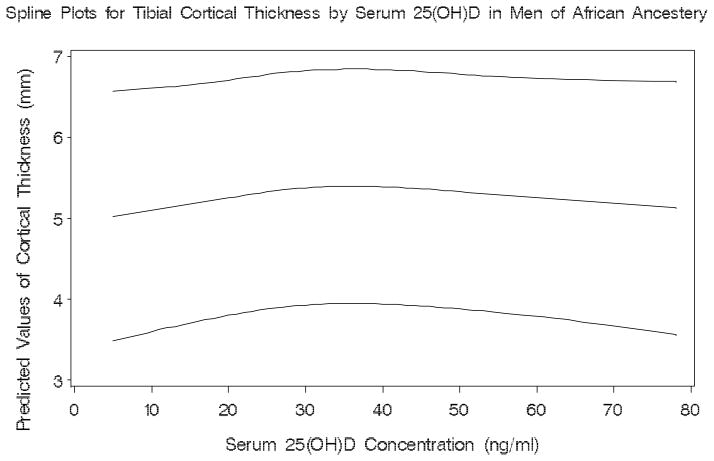
Results: Men of African ancestry had higher 25(OH)D than Caucasians (34.7 vs. 27.6 ng/ml, p < 0.01). Among Caucasians, 25(OH)D was positively (p trend < 0.05) associated with cortical vBMD, total BMC, cortical thickness, SSIp, and SSIx at the distal radius after adjustment for potential confounders. Similar patterns were observed at the distal tibia. In contrast, in men of African ancestry, there was an inverse association (p trend < 0.05) between 25(OH)D and the cross-sectional area, and SSIx. Race modified (p for interaction < 0.05) the association between 25(OH)D and total BMC, cross-sectional area, SSIp, SSIx, and trabecular vBMD of the radius. In men of African ancestry, there was evidence of a threshold effect (at approximately 18 ng/ml) for 25(OH)D on tibial total BMC and cortical thickness.
Conclusions: More studies are needed to better comprehend these race differences for 25(OH)D and bone density, geometry, and indices of bone strength.
Conflict of interest statement
Conflict of Interest: All authors have no conflict of interest and nothing to disclose.
Figures
References
-
- Holick MF. Vitamin D deficiency. N Engl J Med. 2007;357(3):266–81. - PubMed
-
- Zadshir A, Tareen N, Pan D, Norris K, Martins D. The prevalence of hypovitaminosis D among US adults: data from the NHANES III. Ethn Dis. 2005;15(4 Suppl 5):S5–101. - PubMed
-
- Lips P. Vitamin D deficiency and secondary hyperparathyroidism in the elderly: consequences for bone loss and fractures and therapeutic implications. Endocr Rev. 2001;22(4):477–501. - PubMed
Publication types
MeSH terms
Substances
Grants and funding
- U01 AR45632/AR/NIAMS NIH HHS/United States
- U01 AR45647/AR/NIAMS NIH HHS/United States
- R01 CA084950/CA/NCI NIH HHS/United States
- U01 AR45614/AR/NIAMS NIH HHS/United States
- U01 AR045654/AR/NIAMS NIH HHS/United States
- U01-AG027810/AG/NIA NIH HHS/United States
- U01 AG042140/AG/NIA NIH HHS/United States
- R01 AR049747/AR/NIAMS NIH HHS/United States
- U01 AR45583/AR/NIAMS NIH HHS/United States
- U01 AR045614/AR/NIAMS NIH HHS/United States
- U01 AR45654/AR/NIAMS NIH HHS/United States
- R01-AR049747/AR/NIAMS NIH HHS/United States
- U01 AR045583/AR/NIAMS NIH HHS/United States
- U01 AR045647/AR/NIAMS NIH HHS/United States
- U01 AR45580/AR/NIAMS NIH HHS/United States
- U01 AG027810/AG/NIA NIH HHS/United States
- UL1 RR024140/RR/NCRR NIH HHS/United States
- U01 AR045580/AR/NIAMS NIH HHS/United States
- U01 AG18197/AG/NIA NIH HHS/United States
- U01 AG018197/AG/NIA NIH HHS/United States
- R01-CA84950/CA/NCI NIH HHS/United States
- U01 AR066160/AR/NIAMS NIH HHS/United States
- U01 AR045632/AR/NIAMS NIH HHS/United States
LinkOut - more resources
Full Text Sources
Medical
