


Flexible epidemiological model for estimates and short-term projections in generalised HIV/AIDS epidemics
- PMID: 21106520
- PMCID: PMC3173822
- DOI: 10.1136/sti.2010.045104
Flexible epidemiological model for estimates and short-term projections in generalised HIV/AIDS epidemics
Abstract
Objective: UNAIDS and country analysts use a simple infectious disease model, embedded in the Estimation and Projection Package (EPP), to generate annual updates on the global HIV/AIDS epidemic. Our objective was to develop modifications to the current model that improve fit to recently observed prevalence trends across countries.
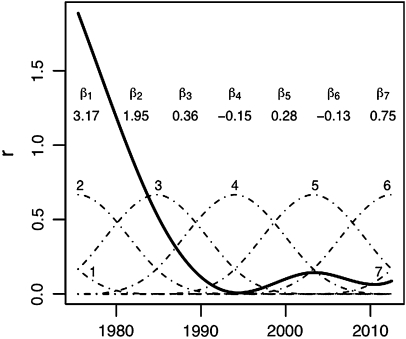
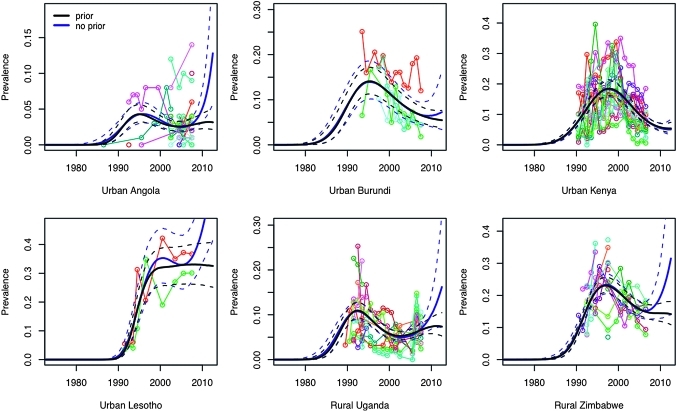
Methods: Our proposed alternative to the current EPP approach simplifies the model structure and explicitly models changes in average infection risk over time, operationalised using penalised B-splines in a Bayesian framework. We also present an alternative approach to initiating the epidemic that improves standardisation and efficiency, and add an informative prior distribution for changes in infection risk beyond the last data point that enhances the plausibility of short-term extrapolations.
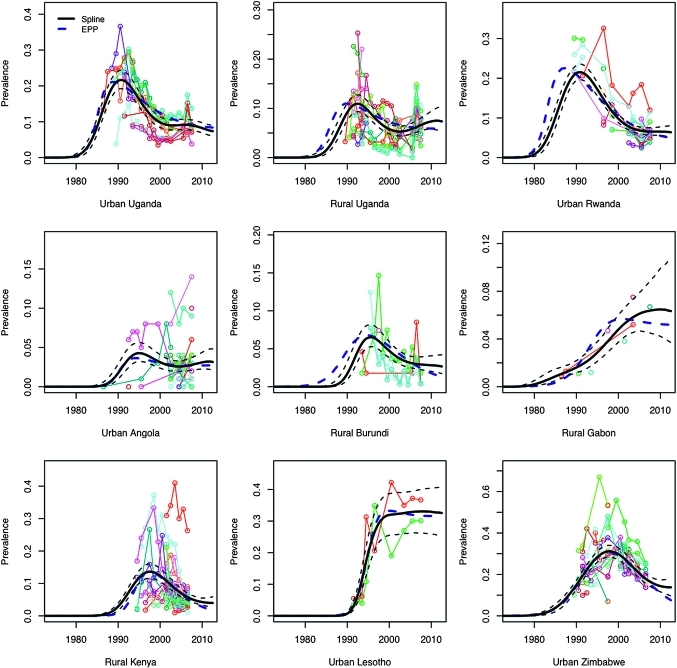
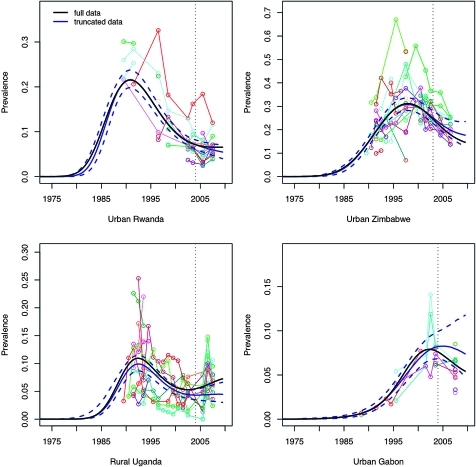
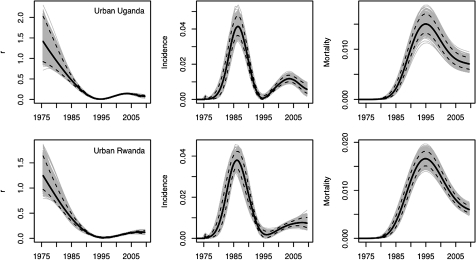
Results: The spline-based model produces better fits than the current model to observed prevalence trends in settings that have recently experienced levelling or rising prevalence following a steep decline, such as Uganda and urban Rwanda. The model also predicts a deceleration of the decline in prevalence for countries with recent experience of steady declines, such as Kenya and Zimbabwe. Estimates and projections from our alternative model are comparable to those from the current model where the latter performs well.
Conclusions: A more flexible epidemiological model that accommodates changing infection risk over time can provide better estimates and short-term projections of HIV/AIDS incidence, prevalence and mortality than the current EPP model. The alternative model specification can be incorporated easily into existing analytical tools that are used to produce updates on the global HIV/AIDS epidemic.
Conflict of interest statement
Figures
References
-
- The Joint United Nations Joint Programme on HIV/AIDS (UNAIDS) Report on the global HIV/AIDS epidemic, June 1998. Geneva: Joint United Nations Programme on HIV/AIDS and World Health Organization, 1998
-
- Anonymous. Improved methods and assumptions for estimation of the HIV/AIDS epidemic and its impact: Recommendations of the UNAIDS Reference Group on Estimates, Modelling and Projections. AIDS 2002;16:W1–14 - PubMed
Publication types
MeSH terms
Substances
Grants and funding
LinkOut - more resources
Full Text Sources
Medical
